In today’s fast-paced digital world, short forms and abbreviations dominate online communication.
One of the most commonly used yet often misunderstood expressions is etc.
People frequently search for the etc meaning in text because they see it everywhere — in messages, captions, emails, and even professional documents — but aren’t always sure how to use it correctly.
While it may seem simple, “etc” plays a powerful role in saving time, keeping messages concise, and implying additional ideas without listing everything.
Whether you’re chatting with friends, writing a professional email, or scrolling through social media, understanding the true meaning and proper usage of “etc” can instantly improve your communication.
This guide breaks down its definition, origins, modern usage across platforms, and common mistakes — all in clear, easy-to-understand language.
Meaning & Definition
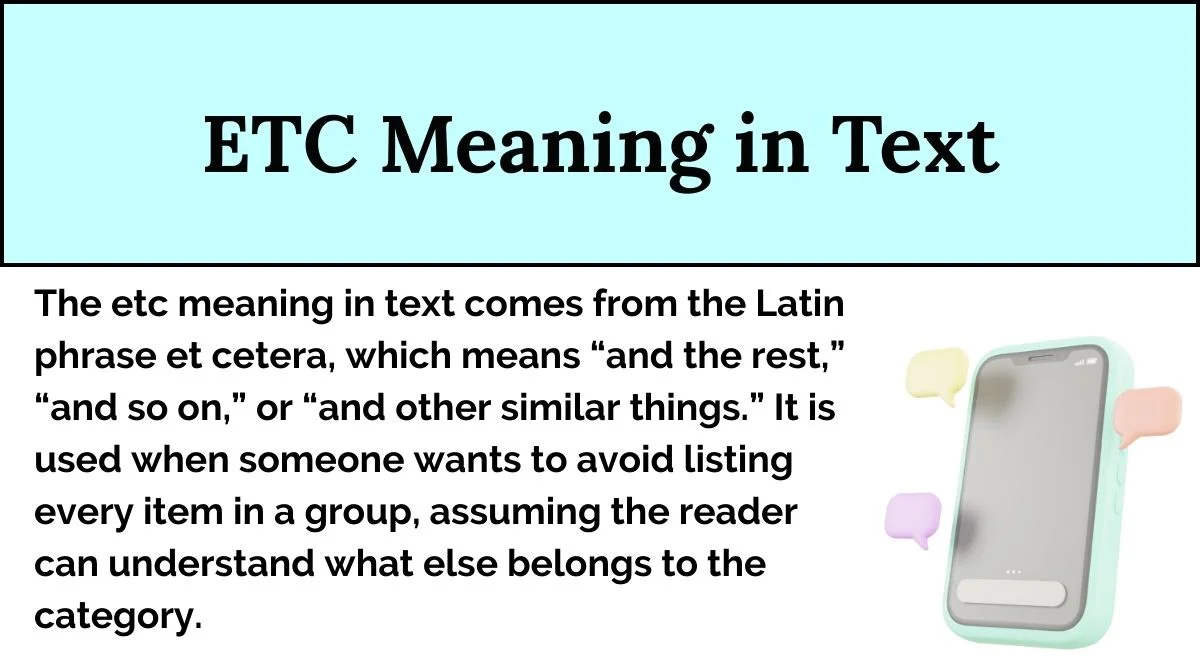
The etc meaning in text comes from the Latin phrase et cetera, which means “and the rest,” “and so on,” or “and other similar things.” It is used when someone wants to avoid listing every item in a group, assuming the reader can understand what else belongs to the category.
For example:
“I bought apples, bananas, oranges, etc.”
This tells the reader that other fruits were purchased without naming them individually.
In digital communication, “etc” works as a shortcut that makes messages faster and cleaner. Instead of writing long lists, people use it to suggest continuation. It can appear in casual texts, academic writing, business communication, and even captions on social media posts.
Despite its simplicity, many people misuse “etc” by placing it after incomplete or unclear lists. It should always follow two or more related items so the reader can logically infer what else is included. Writing “Bring snacks, etc.” sounds vague, but “Bring chips, cookies, candy, etc.” is much clearer.
Another important point: “etc” already includes the meaning of “and,” so phrases like “and etc.” are incorrect and redundant.
Overall, the etc meaning in text is about efficiency, clarity, and implication — helping writers communicate more with fewer words.
Background
The word “etc” has a long linguistic history that dates back to classical Latin. It originates from et cetera, where et means “and” and cetera means “the remaining things.” Over centuries, this phrase evolved into the shortened form “etc,” which became widely adopted in English writing.
In traditional academic and professional writing, “etc” was mainly used in lists, footnotes, and formal documents. However, with the rise of digital communication — texting, messaging apps, and social media — its usage expanded dramatically. People began using it not only for clarity but also for speed and casual tone.
The etc meaning in text has remained consistent, but its tone has shifted depending on context. In formal writing, it maintains a neutral and informative role. In casual communication, it often feels relaxed and conversational, sometimes even implying boredom or dismissal, depending on how it’s used.
For example:
“I have work, errands, emails, etc.”
This might suggest the speaker feels overwhelmed or uninterested in listing everything.
Interestingly, many languages adopted similar abbreviations based on Latin roots, making “etc” one of the most universally understood shorthand expressions worldwide. Its continued relevance shows how language adapts to efficiency-driven communication, especially in digital spaces.
Today, “etc” functions as both a grammatical tool and a conversational signal — a way to shorten thoughts, reduce repetition, and keep conversations flowing smoothly.
Usage in Different Contexts (Chat, Social Media, Professional Fields)
Understanding the etc meaning in text requires recognizing how its tone and impact change depending on where it’s used.
1. In Casual Chat
In everyday conversations, “etc” is often used to avoid typing long explanations.
Example:
“I need milk, bread, eggs, etc.”
This suggests more grocery items without spelling them out.
In chats, it can also imply that the remaining items are unimportant or obvious.
2. On Social Media
On platforms like Instagram, Twitter/X, and TikTok, “etc” appears in captions and comments to keep posts concise.
Example:
“Morning routine: coffee, skincare, journaling, etc.”
Here, it signals lifestyle habits without overloading the caption.
Sometimes, it adds humor or sarcasm:
“Monday meetings, emails, deadlines, etc. 😩”
3. In Professional Communication
In emails, reports, and workplace conversations, “etc” helps streamline lists but should be used carefully to avoid vagueness.
Example:
“Please submit your ID, certificates, transcripts, etc.”
This is acceptable but clearer alternatives might be better in formal contexts.
Professionals often replace “etc” with “and more,” “and related items,” or “and additional documents” for clarity.
4. In Academic Writing
While acceptable in informal writing, many academic institutions discourage excessive use of “etc” because it can weaken precision. Instead, writers are encouraged to specify or use structured phrases.
Across all contexts, the etc meaning in text remains consistent: there is more, but it’s unnecessary to list everything. What changes is the tone — casual, professional, humorous, or dismissive — depending on where and how it’s used.
Meaning in Chat, WhatsApp, Instagram, TikTok
On messaging and social platforms, the etc meaning in text becomes more expressive and conversational.
In Chat & WhatsApp
“Etc” is commonly used to shorten everyday messages.
Example:
“I’ve got work, errands, family stuff, etc.”
Here, it suggests a busy schedule without explaining details. It can also express emotional tone:
“He was late, forgot my birthday, didn’t apologize, etc.”
This implies frustration and emotional exhaustion.
On Instagram
On Instagram captions, “etc” helps keep posts minimal and aesthetic.
Example:
“Weekend vibes: brunch, coffee, sunsets, etc.”
It signals a lifestyle mood rather than exact activities.
On TikTok
In TikTok comments and captions, “etc” often functions humorously or casually.
Example:
“POV: school stress, deadlines, exams, etc.”
It reinforces relatability without extra words.
In Online Conversations
Sometimes, “etc” implies boredom or disinterest:
“He started explaining politics, history, economics, etc.”
This subtly suggests the speaker stopped paying attention.
Across platforms, the etc meaning in text stays the same — “and so on” — but emotionally, it can range from neutral to playful to dismissive depending on tone, emojis, and context.
Meaning in Physics, Medical, and Aircraft Terminology
While “etc” is mostly conversational, it also appears in technical fields — though with stricter usage standards.
1. In Physics
In physics texts, “etc” may follow lists of forces, particles, or properties when the remaining items are obvious to the reader.
Example:
“Energy exists in various forms such as kinetic, thermal, electrical, etc.”
However, scientific writing often avoids “etc” because precision is critical. Writers prefer listing full categories or using phrases like “among others.”
2. In Medical Terminology
In medical documents, “etc” might appear in informal notes or general explanations.
Example:
“Symptoms include fever, fatigue, nausea, etc.”
However, in formal medical records, “etc” is discouraged because ambiguity can affect patient safety.
3. In Aircraft & Aviation Contexts
In aviation manuals or discussions, “etc” may appear in informal summaries.
Example:
“Pre-flight checks include fuel levels, navigation systems, engine oil, etc.”
Official aviation documentation avoids it for clarity, replacing it with structured lists.
In technical fields, the etc meaning in text remains “and others of the same type,” but professionals prefer more exact language to avoid misunderstanding or risk.
Common Misconceptions
Despite its simplicity, many people misunderstand or misuse “etc.” Here are the most common mistakes:
1. Writing “and etc.”
This is incorrect because “etc” already means “and the rest.” Saying “and etc.” is redundant.
Incorrect:
“Bring pens, notebooks, and etc.”
Correct:
“Bring pens, notebooks, etc.”
2. Using “etc” After a Single Item
“Etc” should follow at least two related items.
Incorrect:
“I like pizza, etc.”
Correct:
“I like pizza, burgers, fries, etc.”
3. Using It When the Category Isn’t Clear
“Etc” only works when readers can logically infer the remaining items.
Unclear:
“He talked about stuff, etc.”
Clear:
“He talked about exams, deadlines, stress, etc.”
4. Overusing It in Formal Writing
In professional or academic writing, excessive use of “etc” can make content vague or lazy.
Understanding these misconceptions helps ensure that the etc meaning in text stays clear, professional, and effective.
Similar Terms & Alternatives
If you want variety or more clarity, here are common alternatives to “etc”:
- And so on – Slightly more conversational
- And more – Casual and friendly
- And others – Neutral and formal
- Among others – Academic tone
- And related items – Professional tone
- And similar things – Explanatory and simple
Example comparison:
“I bought apples, bananas, oranges, etc.”
“I bought apples, bananas, oranges, and other fruits.”
While these phrases serve similar purposes, “etc” remains the most compact and universally recognized option, especially in casual writing. Still, choosing alternatives can improve clarity in professional or academic contexts.
How to Respond to It
When someone uses “etc” in a message, how you respond depends on context and tone.
1. If the Meaning Is Clear
You can simply acknowledge it.
Example:
“I’ve got meetings, calls, emails, etc.”
Response:
“Sounds busy!”
2. If You Need Clarification
Sometimes “etc” feels vague. It’s okay to ask politely.
Example:
“Bring snacks, drinks, etc.”
Response:
“What kind of snacks should I bring?”
3. If It Sounds Dismissive
If “etc” feels like someone is brushing something off:
“He started complaining about work, coworkers, deadlines, etc.”
You might respond empathetically:
“That sounds stressful — want to talk about it?”
Understanding the etc meaning in text helps you interpret tone — whether casual, rushed, bored, or neutral — and respond appropriately.
Differences from Similar Words
Let’s compare “etc” with related expressions:
| Term | Meaning | Tone |
|---|---|---|
| Etc | And other similar things | Neutral |
| And so on | Continued list | Conversational |
| And more | Additional items | Casual |
| Among others | Part of a larger group | Formal |
| And such | Similar category | Informal |
Example:
“I enjoy movies, music, books, etc.”
“I enjoy movies, music, books, and more.”
“Etc” is more compact and slightly formal compared to “and more,” which feels casual and expressive.
Relevance in Online Conversations & Dating Apps
In modern digital communication — especially dating apps — “etc” plays a subtle but powerful role.
1. In Dating Bios
People often write:
“I love traveling, fitness, coffee dates, etc.”
This suggests a lifestyle without sounding overly detailed or rigid. It leaves room for interpretation and curiosity.
2. In Chat Conversations
On dating apps, “etc” can signal shared interests quickly.
Example:
“I’m into movies, music, long walks, etc.”
This invites follow-up questions naturally.
3. Emotional Tone
Sometimes “etc” can appear dismissive:
“My ex lied, cheated, ignored me, etc.”
Here, it implies emotional exhaustion rather than indifference.
Overall, the etc meaning in text helps keep conversations light, open-ended, and flowing — especially in online environments where brevity matters.
Conclusion
Understanding the etc meaning in text is essential for clear, efficient communication in both casual and professional settings.
It simply means “and the rest” or “and similar things,” but its tone and impact depend heavily on context.
From messaging apps and social media to academic writing and workplace communication, “etc” helps shorten lists, avoid repetition, and keep conversations flowing smoothly.
However, using it incorrectly — such as writing “and etc.” or placing it after unclear examples — can confuse readers and weaken your message.
Knowing when to use alternatives like “and more” or “among others” can improve clarity and tone, especially in formal writing.
Mastering this small abbreviation allows you to communicate more naturally, confidently, and effectively in today’s fast-paced digital world.

Joseph Roy crafts witty puns and punchlines that brighten your day. His playful twist on language keeps readers laughing and thinking.