The abbreviation FB is widely used in everyday digital communication, yet its meaning often depends on context.
People search for the FB meaning in text because they see it in chats, comments, or posts and want to understand what the sender intended.
In casual messaging, FB can mean something friendly and supportive, while in professional or technical settings, it can carry a completely different definition.
This flexibility makes it both useful and confusing at times.
With texting, social media, and workplace communication evolving rapidly, short forms like FB save time and space while keeping conversations flowing.
Understanding how FB is used across different platforms and situations helps avoid misunderstandings and improves communication.
In this guide, we’ll explore what FB means, where it comes from, how it’s used in chats and professional fields, and how you can respond to it confidently.
Meaning & Definition
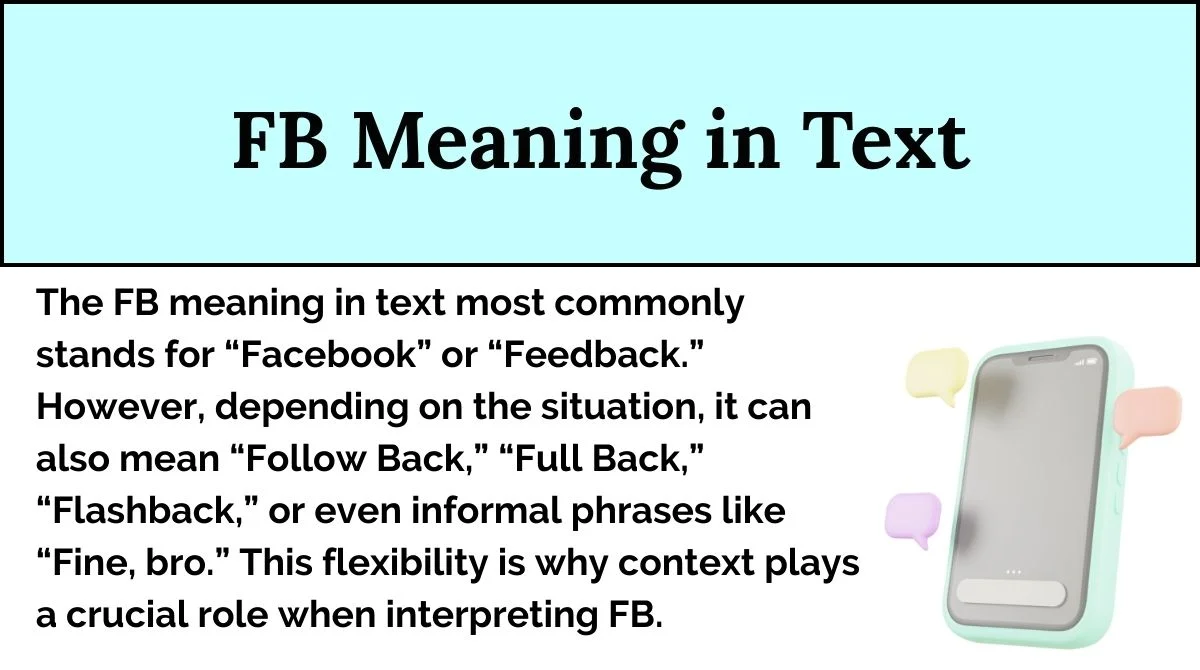
The FB meaning in text most commonly stands for “Facebook” or “Feedback.” However, depending on the situation, it can also mean “Follow Back,” “Full Back,” “Flashback,” or even informal phrases like “Fine, bro.” This flexibility is why context plays a crucial role when interpreting FB.
In casual chats, FB often refers to Facebook, such as:
- “Did you see it on FB?”
Here, FB clearly points to the social media platform.
In professional or academic settings, FB is frequently short for feedback:
- “Please send me your FB on the draft.”
In sports discussions, FB may refer to a fullback, while in storytelling or memory-sharing contexts, it can mean flashback.
Unlike formal abbreviations that usually have one fixed meaning, FB adapts to the tone, topic, and environment of the conversation. That adaptability is what makes it so popular in digital communication but also what causes confusion for readers unfamiliar with the context.
In short, FB is a shorthand term with multiple meanings, and understanding it requires paying attention to who’s speaking, what they’re talking about, and where the message appears. Once you recognize these clues, interpreting FB becomes straightforward and natural.
Background
The use of FB as an abbreviation grew alongside the rise of texting culture and online platforms. As mobile phones became common in the early 2000s, people started shortening words to save time and character space. Acronyms like LOL, BRB, and IMO became mainstream, and FB followed the same pattern.
One of the biggest drivers behind FB’s popularity is Facebook, which launched in 2004 and quickly became a dominant social media platform. Referring to it as FB was faster and more convenient, especially in casual chats and online comments. Over time, this shortened form became widely accepted and recognized globally.
Meanwhile, in workplaces and educational settings, FB evolved independently as shorthand for feedback, making communication more efficient in emails, meetings, and project discussions. This dual usage — social and professional — helped FB spread even more widely across digital spaces.
In sports and technical fields, abbreviations like FB had already existed for years, meaning fullback or other field-specific terms. The overlap between casual and professional meanings is what gives FB its versatility today.
Overall, FB reflects how language evolves in response to technology, convenience, and cultural trends. Its background shows how a simple two-letter abbreviation can take on multiple meanings while remaining useful across different contexts.
Usage in Different Contexts (Chat, Social Media, Professional Fields)
The FB meaning in text changes depending on where and how it’s used, making context the most important clue to interpretation.
In casual chats, FB often refers to Facebook or follow back:
- “Add me on FB.”
- “Nice pic, FB?”
On social media, especially Instagram and TikTok, FB can mean:
- “Follow back,” used when someone wants mutual engagement.
- “Facebook,” when cross-posting or referencing content.
In professional fields, FB usually stands for feedback:
- “Can you send me your FB by tomorrow?”
- “We’ll review your FB during the meeting.”
In sports discussions, FB commonly means fullback:
- “The FB played a great game last night.”
In storytelling or casual memory sharing, FB might mean flashback:
- “That song gave me an FB to high school days.”
The adaptability of FB makes it efficient, but it also requires readers to interpret based on tone and setting. In a work email, FB almost always means feedback, while in a casual DM, it likely points to Facebook or follow back.
Understanding these contextual shifts helps avoid miscommunication and ensures smoother digital conversations across personal, social, and professional environments.
Meaning in Chat, WhatsApp, Instagram, TikTok
In everyday messaging apps and social platforms, the FB meaning in text usually falls into a few common categories.
On WhatsApp and SMS, FB often means:
- Facebook: “I saw it on FB.”
- Feedback: “Send FB on my message.”
- Flashback: “That photo gave me an FB.”
On Instagram, FB most commonly stands for:
- Follow Back: “Nice post, FB?”
This is especially popular among influencers, small creators, and engagement-focused users.
On TikTok, FB can also mean:
- Follow Back, especially in comment sections.
- Occasionally Facebook, when referring to shared videos across platforms.
In casual chats, FB may also appear as friendly slang, such as “Fine, bro,” depending on regional or social group usage.
Overall, on social platforms, FB is typically informal and engagement-driven. When you see it under a post or in a DM, it’s usually either referencing Facebook or requesting a follow back. Understanding platform culture makes it easier to interpret FB without confusion.
Meaning in Physics, Medical, and Aircraft Terminology
Beyond casual messaging, the FB meaning in text appears in technical and professional fields with more specific definitions.
In physics, FB may refer to:
- Feedback, especially in control systems or electronics, where feedback loops regulate output and stability.
In medical contexts, FB can stand for:
- Foreign Body, describing an object inside the body that shouldn’t be there, such as a swallowed or embedded item.
- In some clinical notes, it may also mean feedback during therapy or assessments.
In aviation and aircraft terminology, FB often means:
- Flight Bag, referring to a pilot’s bag containing charts, manuals, and documents.
- Feedback, particularly in flight systems or simulator training.
These technical meanings are usually used in professional documentation, reports, or discussions among specialists. Unlike casual texting, these definitions are precise and standardized within their respective fields.
This shows how FB shifts from informal shorthand in everyday communication to structured terminology in technical environments, reinforcing the importance of context when interpreting its meaning.
Common Misconceptions
One of the biggest misconceptions about the FB meaning in text is assuming it always stands for Facebook. While that’s often true in casual chats, it’s far from the only meaning. In professional conversations, FB almost always means feedback, and interpreting it as Facebook in that context can lead to confusion or awkward misunderstandings.
Another misconception is thinking FB has a single, universal definition. In reality, it’s a flexible abbreviation that adapts to different environments. Someone new to online slang might also misinterpret FB as a person’s initials or a random code rather than a meaningful abbreviation.
Some people also confuse FB with similar acronyms like “TB” (throwback) or “FF” (follow forever), especially on social platforms. This can cause incorrect assumptions about what the sender intends.
Finally, users sometimes mistake FB for a reaction or emotional expression, when it’s often just informational or practical. Understanding that FB is context-based helps clear up these misconceptions and improves communication accuracy across digital spaces.
Similar Terms & Alternatives
Several abbreviations and terms are closely related to the FB meaning in text, depending on how it’s used.
For Facebook, alternatives include:
- Insta (Instagram)
- Snap (Snapchat)
- Meta (parent company reference)
For feedback, common alternatives are:
- Review
- Comments
- Thoughts
- Input
For follow back, similar terms include:
- F4F (Follow for Follow)
- L4L (Like for Like)
- Sub4Sub (on video platforms)
For flashback, alternatives include:
- TB (Throwback)
- Memory lane
For fullback in sports, people usually just say:
- RB (Running Back)
- Defender, depending on the sport
These alternatives often carry the same intent but differ slightly in tone or platform culture. Choosing between FB and its alternatives usually depends on audience, formality, and communication style.
How to Respond to It
Responding to FB depends entirely on what it means in the conversation.
If FB means Facebook:
- “Sure, I’ll add you on FB.”
- “I’ll check it on FB later.”
If FB means Feedback:
- “Thanks, I’ll send my FB shortly.”
- “Your FB was really helpful.”
If FB means Follow Back:
- “Done!”
- “Just followed you back 😊”
If FB means Flashback:
- “Same here, those were good times!”
- “That brought back memories too.”
The key is recognizing context and tone. In professional settings, respond formally and clearly. In casual chats or social media, a short and friendly reply works best. If you’re unsure, asking for clarification is always acceptable and avoids misunderstandings.
Differences from Similar Words
The FB meaning in text differs from similar abbreviations in both tone and usage.
- FB vs. TB (Throwback): FB can mean flashback or Facebook, while TB is specifically about memories or past moments.
- FB vs. F4F: FB (follow back) is a direct request, while F4F is a mutual agreement for ongoing engagement.
- FB vs. Review: FB (feedback) is informal and conversational, while “review” sounds more professional and structured.
- FB vs. DM: FB refers to a platform or action, while DM (direct message) refers to a type of communication.
These differences highlight that FB is more flexible and context-driven than many similar abbreviations. Understanding subtle distinctions helps ensure accurate interpretation and appropriate responses in both casual and professional conversations.
Relevance in Online Conversations & Dating Apps
In online conversations and dating apps, the FB meaning in text most often refers to Facebook or Follow Back. Users may ask for someone’s FB to continue chatting outside the app, verify identity, or build trust. For example:
- “Do you have FB?”
- “Let’s talk on FB instead.”
On platforms focused on engagement, FB can also mean follow back, signaling interest or mutual attraction:
- “Nice profile, FB?”
In dating contexts, FB sometimes carries social significance, as connecting on Facebook suggests a deeper level of interest compared to casual in-app messaging. It can also serve as a way to learn more about someone through their profile, friends, and posts.
Overall, FB plays a role in moving conversations forward, building connections, and strengthening online relationships, making it especially relevant in social and dating environments.
Conclusion
The FB meaning in text varies widely depending on context, ranging from Facebook and feedback to follow back, flashback, and professional terminology.
This flexibility makes FB a useful shorthand in both casual and formal communication, but it also means readers must rely on tone, platform, and topic to interpret it correctly.
Whether you see FB in a chat message, workplace email, or social media comment, understanding its context ensures clear and confident communication.
As digital language continues to evolve, abbreviations like FB will remain common, making it important to stay aware of their shifting meanings.
With the explanations in this guide, you can now recognize, respond to, and use FB naturally across different situations without confusion.

Joseph Roy crafts witty puns and punchlines that brighten your day. His playful twist on language keeps readers laughing and thinking.