If you’ve ever received a message saying “ihy” and paused to wonder what it means, you’re not alone.
Internet slang evolves quickly, and abbreviations like this can feel confusing—especially when tone and context aren’t always clear in digital conversations.
The phrase “ihy” is commonly seen in texts, social media posts, and comments, often carrying emotional weight that can range from playful teasing to serious dislike.
People search for the ihy meaning in text because it’s short, ambiguous, and easy to misinterpret, which can lead to awkward or even hurtful misunderstandings.
Understanding what “ihy” really means helps you respond appropriately and avoid unnecessary conflict.
In this article, we’ll explore its definition, background, usage across platforms, misconceptions, similar terms, and how to handle it in conversations—so you’ll never be caught off guard again.
Meaning & Definition
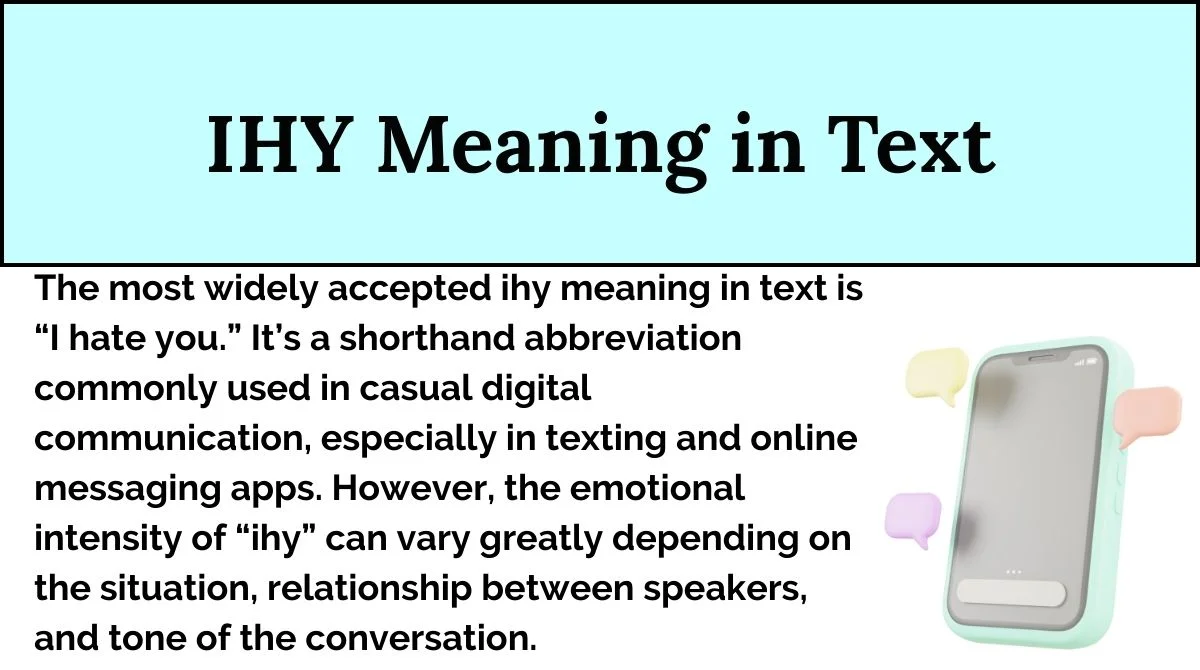
The most widely accepted ihy meaning in text is “I hate you.” It’s a shorthand abbreviation commonly used in casual digital communication, especially in texting and online messaging apps. However, the emotional intensity of “ihy” can vary greatly depending on the situation, relationship between speakers, and tone of the conversation.
In many cases, “ihy” doesn’t carry its literal meaning of deep hatred. Instead, it’s often used jokingly or sarcastically, similar to how people might say “I hate you” when a friend beats them in a game or teases them lightly. For example:
- “You ate the last slice of pizza? ihy 😭”
- “You spoiled the ending, ihy lol”
In these contexts, the phrase expresses playful annoyance rather than genuine anger. Emojis, punctuation, and surrounding words often signal the tone.
However, there are situations where “ihy” is meant seriously, particularly during arguments or emotionally charged conversations. In those cases, it may reflect frustration, resentment, or strong disagreement rather than lighthearted banter. That’s why understanding context is essential before reacting.
Another important point is that “ihy” is informal slang and rarely used in professional or academic communication. Its meaning stays consistent—“I hate you”—but its emotional weight shifts depending on how and where it’s used.
In short, the ihy meaning in text is simple in definition but complex in interpretation. It’s not just about the words themselves, but the relationship, mood, and digital setting in which they appear.
Background
The abbreviation “ihy” emerged as part of the broader trend of internet shorthand and texting acronyms. As mobile phones and messaging apps became central to communication, people began shortening common phrases to save time and effort. Just like “idk” (I don’t know), “brb” (be right back), and “lol” (laugh out loud), “ihy” followed the same pattern of reducing frequently used expressions to a few letters.
“I hate you” has long been a phrase used both seriously and jokingly in everyday speech, particularly among close friends and siblings. When texting culture exploded in the early 2000s and 2010s, it naturally evolved into “ihy” for speed and convenience. Over time, it became more popular on platforms like Twitter, Snapchat, Instagram, and TikTok, where character limits and casual tones encouraged brief, expressive language.
Another factor behind its popularity is emotional shorthand. Saying “ihy” can quickly express annoyance, frustration, or mock outrage without needing to explain further. It fits well into fast-paced online conversations where people often communicate through reactions rather than detailed explanations.
Cultural shifts also shaped its use. Younger generations, especially Gen Z, frequently use exaggerated language for humor. Phrases like “I hate this” or “I hate you” are often said dramatically but affectionately, and “ihy” fits perfectly into that style. This ironic usage helped normalize the abbreviation in casual contexts.
Still, despite its casual roots, “ihy” can feel harsh if taken literally, especially by people unfamiliar with internet slang or those from cultures where direct expressions of dislike are less common. This contrast between playful intent and strong wording explains why many people search for the ihy meaning in text—they want to understand whether it’s a joke or something more serious.
Usage in Different Contexts (Chat, Social Media, Professional Fields)
The way “ihy” is interpreted depends heavily on where it appears and who is using it. In informal digital spaces, it’s common and often lighthearted, but in professional environments, it’s almost never appropriate.
In Chat and Personal Messaging
In private texts between friends, partners, or siblings, “ihy” is frequently playful. It might follow teasing, competition, or minor annoyances:
- “You finished the series without me? ihy 😩”
Here, the tone is affectionate, and the sender likely doesn’t mean actual hatred.
However, during arguments, it can signal real frustration:
- “You never listen to me, ihy.”
In this case, the phrase may reflect genuine anger and emotional distance.
On Social Media
On platforms like Twitter, Instagram, TikTok, and Snapchat, “ihy” often appears in comments, captions, or replies. It’s commonly used humorously:
- “This exam was so hard ihy.”
- “You’re too pretty ihy 😭💀”
Here, it can express frustration, admiration, or mock jealousy rather than dislike.
Because social media culture thrives on exaggeration, “ihy” often becomes a dramatic way of saying “I’m annoyed,” “I’m jealous,” or even “I love you but I’m mad.”
In Professional Fields
In professional, academic, or workplace communication, “ihy” is inappropriate and rarely used. Its meaning—“I hate you”—is too strong and emotionally charged for formal settings. Even jokingly, it can appear unprofessional and damaging to workplace relationships. Instead, people rely on polite, constructive language to express disagreement or frustration.
In Online Communities and Gaming
In gaming chats and online communities, “ihy” is often used playfully when someone loses a match, gets defeated, or experiences bad luck:
- “You sniped me from across the map ihy 😂”
Again, it’s more about humor and competitiveness than actual hostility.
Overall, while the ihy meaning in text stays the same linguistically, its emotional impact changes drastically based on context. Understanding the environment and relationship between speakers is key to interpreting it correctly.
Meaning in Chat, WhatsApp, Instagram, TikTok
Across popular platforms, the ihy meaning in text remains “I hate you,” but its emotional tone often shifts toward humor, sarcasm, or exaggeration.
In Chat and WhatsApp
On messaging apps like WhatsApp, Messenger, or iMessage, “ihy” is commonly used among close friends or partners. It’s often paired with emojis, laughter, or follow-up messages that soften the phrase:
- “You ate my fries? ihy 😭😂”
- “ihy but I love you.”
These additions signal that the sender isn’t serious. However, when “ihy” appears alone without emojis or context, it may sound harsher and could indicate genuine frustration.
On Instagram
On Instagram, “ihy” appears frequently in comments under photos, reels, or stories:
- “Why are you so cute ihy.”
- “You look too good in this pic ihy 😭🔥”
Here, it often means mock jealousy or playful admiration rather than dislike. It’s part of internet humor where extreme language is used to express positive emotions dramatically.
On TikTok
TikTok culture is heavily driven by trends, exaggeration, and emotional expression. “ihy” is commonly used in captions, comments, and replies:
- “This video made me cry ihy.”
- “Why is this so relatable ihy.”
In these contexts, “ihy” translates more to “I’m emotionally overwhelmed” or “This affected me strongly,” not actual hatred. It’s often hyperbolic and expressive rather than literal.
Tone Indicators Matter
Across all platforms, tone indicators like emojis (😂😭💀), abbreviations like “lol,” or follow-up messages usually show playful intent. Without them, “ihy” can feel blunt or hurtful.
In summary, on chat apps and social media, “ihy” is rarely meant literally. It’s more commonly used as a dramatic or humorous way to express annoyance, admiration, or emotional reaction.
Meaning in Physics, Medical, and Aircraft Terminology
Interestingly, while “ihy” is widely known as slang for “I hate you” in texting, it has little to no established meaning in formal fields such as physics, medicine, or aviation. However, people often search for technical interpretations because acronyms commonly exist across industries, and not all abbreviations are informal slang.
In Physics
There is no recognized scientific acronym “IHY” used consistently in physics textbooks, formulas, or research literature. It does not represent a known unit, principle, or theory. If you encounter “IHY” in a technical physics context, it is most likely a custom abbreviation defined within a specific paper or dataset, not a standard term.
In Medical Terminology
Similarly, “IHY” is not a standard abbreviation in medicine, diagnostics, anatomy, or pharmacology. Medical fields rely on established shorthand like BP (blood pressure), HR (heart rate), or MRI (magnetic resonance imaging). “IHY” does not appear in common medical glossaries or clinical documentation.
In Aircraft and Aviation
In aviation and aircraft systems, standardized abbreviations are heavily regulated for safety and clarity. “IHY” is not a recognized aviation code, component label, or system term. Aviation uses codes like ILS (instrument landing system), ATC (air traffic control), and ICAO identifiers, but “IHY” is not among them.
Why the Confusion Exists
Many people assume every abbreviation must have a technical meaning, especially when they see it capitalized. Since “IHY” is sometimes written in uppercase, it can appear like an acronym rather than casual slang. This leads to searches about its meaning in science, medicine, or aviation.
In reality, the ihy meaning in text is almost exclusively social and informal. Outside of digital communication, it has no widely accepted professional or technical definition.
Common Misconceptions
Despite its simplicity, “ihy” is often misunderstood, leading to confusion or emotional reactions that aren’t always necessary. One of the most common misconceptions is that “ihy” always means genuine hatred. While the literal phrase “I hate you” sounds harsh, in modern digital communication it’s frequently used jokingly, sarcastically, or affectionately—especially among friends, couples, and online communities.
Another misconception is that “ihy” is always negative or hostile. In reality, many people use it to express playful frustration, mock jealousy, or exaggerated emotion:
- “You’re so talented ihy 😭”
Here, the meaning is closer to admiration than dislike.
Some people also believe that “ihy” has multiple formal definitions in different industries, such as medicine or engineering. As discussed earlier, there is no widely recognized technical meaning. This assumption often comes from the capitalization of the abbreviation, which makes it look like a professional acronym.
Another misunderstanding is thinking “ihy” is universally offensive. While it can certainly hurt if taken seriously or used during conflict, many online communities treat it as harmless slang. The emotional impact depends entirely on context, relationship, and tone.
Lastly, some users assume that responding seriously to “ihy” is always appropriate. In playful contexts, doing so can actually make the conversation awkward or tense. Recognizing whether it’s meant humorously or sincerely is crucial.
Understanding these misconceptions helps avoid overreacting and allows you to interpret the ihy meaning in text more accurately and confidently.
Similar Terms & Alternatives
The ihy meaning in text—“I hate you”—belongs to a broader group of informal expressions used to convey annoyance, frustration, or exaggerated emotion. Several similar abbreviations and phrases serve the same purpose, often with lighter or more humorous tones.
Similar Slang Terms
- ily – “I love you.” Often used playfully alongside “ihy,” as in “ihy but ily.”
- istg – “I swear to God.” Expresses frustration or disbelief.
- smh – “Shaking my head.” Signals disappointment or mild annoyance.
- omg – “Oh my God.” Used for surprise, shock, or strong emotion.
- wtf – “What the heck” (or stronger), used for confusion or irritation.
Softer Alternatives
If you want to express annoyance without sounding harsh, you might use:
- “You’re annoying 😭”
- “Why would you do that?”
- “I’m mad at you lol”
These alternatives keep the mood light and reduce the risk of misunderstanding.
Stronger or More Serious Alternatives
When expressing genuine frustration or conflict, people may use:
- “I’m really upset with you.”
- “That hurt my feelings.”
- “I’m angry about this.”
These phrases communicate emotion clearly without relying on slang that could be misinterpreted.
Overall, while “ihy” is quick and expressive, choosing an alternative can help match your tone to the situation and avoid unnecessary tension in conversations.
How to Respond to It
Knowing how to respond to “ihy” depends on whether it’s meant jokingly or seriously. Since the ihy meaning in text can shift based on tone and context, your reply should reflect what you think the sender truly intends.
If It’s Playful or Joking
When “ihy” is clearly used humorously, a lighthearted response works best:
- “😂 I know you love me.”
- “Deserved tbh.”
- “ihy too bestie 😭”
Matching their playful energy keeps the conversation fun and relaxed.
If It’s Mild Frustration
If someone seems annoyed but not genuinely angry, acknowledge their feelings without escalating:
- “Okay, that’s fair 😅.”
- “My bad, I didn’t mean to.”
- “I’ll make it up to you.”
This shows awareness and helps defuse tension.
If It’s Serious or Hurtful
When “ihy” feels genuinely aggressive or emotional, it’s better to address it calmly:
- “That hurt—can we talk about what’s wrong?”
- “Did I do something to upset you?”
- “I don’t like being spoken to that way.”
This encourages honest communication instead of conflict.
If You’re Unsure
If the tone is unclear, ask for clarification:
- “Are you joking or serious? 😅”
- “Wait, what did I do?”
This prevents misunderstandings and shows you’re open to resolving confusion.
Ultimately, the best response balances emotional awareness with context. Recognizing whether “ihy” is playful banter or real frustration helps you react appropriately and keep conversations healthy.
Differences from Similar Words
While “ihy” literally translates to “I hate you,” its usage differs significantly from other words and phrases that express dislike, frustration, or annoyance. Understanding these differences helps interpret tone more accurately in digital conversations.
“Ihy” vs. “I dislike you”
“I dislike you” is more neutral and controlled, often used seriously to express genuine feelings without exaggeration. “Ihy,” on the other hand, is informal and emotional, frequently exaggerated or playful rather than literal.
“Ihy” vs. “I’m mad at you”
“I’m mad at you” clearly signals temporary anger or frustration and is usually sincere. “Ihy” can be either sincere or joking, making it more ambiguous.
“Ihy” vs. “You’re annoying”
“You’re annoying” directly targets behavior rather than the person and is often less extreme. “Ihy” feels stronger linguistically, but in practice, it’s often used more lightly.
“Ihy” vs. “I hate this”
“I hate this” expresses frustration toward a situation or object, not a person. “Ihy” targets someone directly, which can feel more personal—even if used jokingly.
“Ihy” vs. “ily”
“Ihy” and “ily” are often used together humorously: “ihy but ily.” This contrast shows how “ihy” in slang culture doesn’t always mean real hatred—it can coexist with affection.
Overall, while “ihy” uses strong wording, its emotional weight is often softer than similar phrases, especially in casual online settings. Context and tone remain the deciding factors in interpretation.
Relevance in Online Conversations & Dating Apps
The ihy meaning in text has become particularly relevant in online conversations and dating apps, where tone, humor, and emotional expression are often condensed into short messages. Because digital communication lacks facial expressions and voice cues, abbreviations like “ihy” carry both risk and versatility.
In Online Conversations
In everyday chats, group messages, and social media interactions, “ihy” is often used as playful exaggeration. It allows people to express mock frustration, jealousy, or emotional overwhelm in a dramatic but humorous way:
- “You got tickets before me ihy 😭”
This use strengthens social bonding by turning annoyance into shared humor.
At the same time, because “ihy” is short and blunt, it can easily be misunderstood if the recipient doesn’t recognize the playful tone. This makes it both expressive and risky in casual communication.
In Dating Apps
On dating platforms like Tinder, Bumble, or Hinge, “ihy” is less common but still appears occasionally in playful flirting:
- “Why are you this cute ihy.”
Here, it’s usually meant as exaggerated admiration rather than dislike.
However, in dating contexts—where impressions matter more—using “ihy” can feel confusing or off-putting if tone isn’t clear. Some users may interpret it literally, which can hurt early rapport. Because of this, many people prefer clearer expressions like “You’re driving me to aggravate in the best way” or “You’re too good-looking for your own good.”
Emotional Impact
In both online chats and dating apps, “ihy” reflects modern communication trends: emotional shorthand, humor-driven exaggeration, and casual intimacy. Its relevance lies in how it compresses strong emotion into three letters, making conversations faster and more expressive—while also increasing the need for context awareness.
Conclusion
The ihy meaning in text is straightforward—“I hate you”—but its real-world usage is far more nuanced.
In modern digital communication, it’s often playful, exaggerated, or sarcastic rather than genuinely hostile.
Across chats, social media, and online communities, “ihy” commonly expresses mock frustration, admiration, or emotional overwhelm, especially when paired with emojis or casual tone markers.
However, in serious contexts, it can reflect real anger or hurt, making context and relationship crucial to interpretation.
Understanding how “ihy” works helps avoid misunderstandings and allows you to respond appropriately—whether with humor, empathy, or calm communication.
As with most internet slang, its meaning isn’t just in the letters, but in how, where, and by whom it’s used. Knowing this makes navigating online conversations smoother and more confident.

Joseph Roy crafts witty puns and punchlines that brighten your day. His playful twist on language keeps readers laughing and thinking.