In today’s fast-paced digital world, short forms, abbreviations, and slang dominate online conversations.
One term that has gained traction is “ion”, especially on social media platforms like Instagram, TikTok, and WhatsApp.
Users often encounter “ion” in comments, captions, and DMs, but its meaning can be confusing for those unfamiliar with online lingo.
People frequently search for ion meaning in text Instagram to understand whether it’s a casual filler, slang, or has a deeper significance.
This article explores the term in detail, examining its definitions, origins, usage across different contexts, and common misunderstandings.
By the end, readers will gain clarity on what “ion” represents and how to use or respond to it appropriately in online conversations.
Meaning & Definition
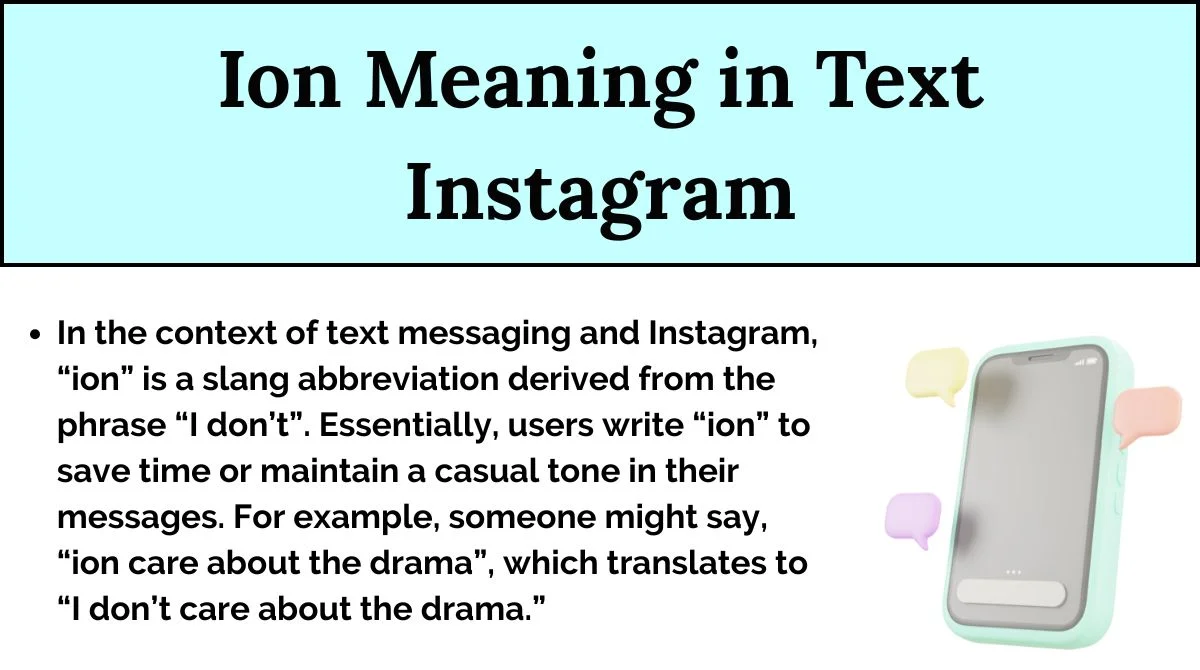
In the context of text messaging and Instagram, “ion” is a slang abbreviation derived from the phrase “I don’t”. Essentially, users write “ion” to save time or maintain a casual tone in their messages. For example, someone might say, “ion care about the drama”, which translates to “I don’t care about the drama.”
While its core meaning is straightforward, the simplicity of “ion” has allowed it to become versatile. Some use it to soften their messages, making statements feel more conversational and less formal. Others adopt it as part of online identity and personality, using abbreviations as a stylistic feature. Its brevity is appealing, particularly on platforms like Instagram and TikTok, where concise communication thrives.
Background
The rise of “ion” can be traced back to the evolution of text-based communication and the increasing demand for efficiency. With the advent of smartphones, character limits in early SMS, and the fast-scrolling nature of social media feeds, users naturally began shortening common phrases.
“Ion” is part of a broader trend of abbreviations such as “idk” (I don’t know), “smh” (shaking my head), and “wyd” (what are you doing). Over time, these shortened forms have transcended texting and entered the lexicon of social media influencers, meme culture, and casual online interactions, making them recognizable across different platforms.
Usage in Different Contexts
Chat & Social Media
On Instagram, WhatsApp, and TikTok, ion is mostly conversational. It often appears in captions, comments, and direct messages. For example, in response to a controversial post, a user might comment, “ion tryna get involved in that”, meaning “I’m not trying to get involved in that.”
Professional Fields
Outside social media, “ion” is rarely used in formal writing or professional communication. Using it in emails or workplace chats can appear unprofessional unless the audience is informal or familiar with internet slang.
Text Messaging
In casual text messages, “ion” serves as a quick way to express refusal, disinterest, or disagreement without typing a complete sentence. It helps maintain a friendly tone while communicating efficiently.
Meaning in Chat, WhatsApp, Instagram, TikTok
Across platforms, the core meaning of “ion” remains consistent—essentially standing for “I don’t.” However, context can slightly alter its interpretation:
- Instagram: Often appears in captions or comments to casually dismiss or disagree.
- WhatsApp: Functions as a quick reply or response in personal chats.
- TikTok: Used in video captions or comments, sometimes to emphasize humor or sarcasm.
Its flexibility allows users to convey emotion, humor, or casual detachment in a single three-letter word.
Meaning in Physics, Medical, and Aircraft Terminology
Outside digital slang, “ion” has established meanings in scientific and technical fields:
- Physics/Chemistry: An ion is an atom or molecule with a net electrical charge due to loss or gain of electrons.
- Medical: Ions are essential in physiology, affecting nerve transmission, muscle contraction, and electrolyte balance.
- Aircraft/Engineering: Ionization may refer to the process of charged particles affecting sensors or instruments.
It’s important to distinguish these contexts from social media slang, as the meaning shifts entirely depending on usage.
Common Misconceptions
Many users mistake “ion” for typos, abbreviations unrelated to “I don’t,” or even emojis. Misinterpretations can lead to confusion in online interactions. Another common misconception is equating “ion” with negative or aggressive sentiment—it’s usually neutral, casual, or playful.
Similar Terms & Alternatives
Several terms are used similarly to “ion” in text conversations:
- “idc” – I don’t care
- “nvm” – Never mind
- “not rn” – Not right now
- “smh” – Shaking my head (contextual alternative)
These alternatives provide varying levels of emphasis or tone, depending on the message’s intent.
How to Respond to It
Responding to “ion” depends on tone and context:
- If it expresses disinterest: Avoid pushing the topic further.
- If playful: Respond with humor or emojis.
- If unsure: Clarify politely with a follow-up question.
The key is recognizing that it’s casual slang, not a formal statement.
Differences from Similar Words
Unlike “idk” (I don’t know) or “ikr” (I know, right), “ion” explicitly conveys refusal, disinterest, or negation. It’s shorter and often more conversational, whereas other slang terms might convey uncertainty, agreement, or excitement. Understanding these subtle differences is crucial for appropriate usage.
Relevance in Online Conversations & Dating Apps
On dating apps and social media, “ion” is frequently used to maintain a casual, approachable tone. It allows users to disagree, decline, or distance themselves without seeming harsh. Its popularity in these contexts reflects a broader trend of abbreviated, casual communication that prioritizes brevity and relatability.
Conclusion
The term “ion” has become an integral part of online slang, especially on platforms like Instagram, TikTok, and WhatsApp.
Its simplicity and versatility make it ideal for quick communication, conveying disinterest, refusal, or casual detachment.
While it may have scientific and professional meanings in other fields, in social media, it’s a playful, informal expression.
Understanding “ion” enhances digital literacy, helping users interpret online conversations correctly and respond with appropriate tone.
Whether in a meme, caption, or chat, recognizing its meaning allows smoother, more effective interactions in the modern digital space.

Joseph Roy crafts witty puns and punchlines that brighten your day. His playful twist on language keeps readers laughing and thinking.