The internet has created countless abbreviations, acronyms, and slang expressions that make communication faster and more fun.
One such popular term is OC, which appears frequently in text messages, social media posts, comments, and even professional discussions.
Many people search for the OC meaning in text because its definition changes depending on the context.
Sometimes it refers to original content, while in other cases it means original character, or even obsessive-compulsive in medical settings.
Understanding OC is important because misinterpreting it can change the meaning of a conversation entirely.
Whether you’re chatting with friends, scrolling through TikTok, browsing Reddit, or reading professional documents, knowing how OC is used helps you communicate clearly and confidently.
In this article, we’ll explore its meanings, origins, real-life usage, misconceptions, and how to respond when someone uses it — all in a simple, engaging way.
Meaning & Definition
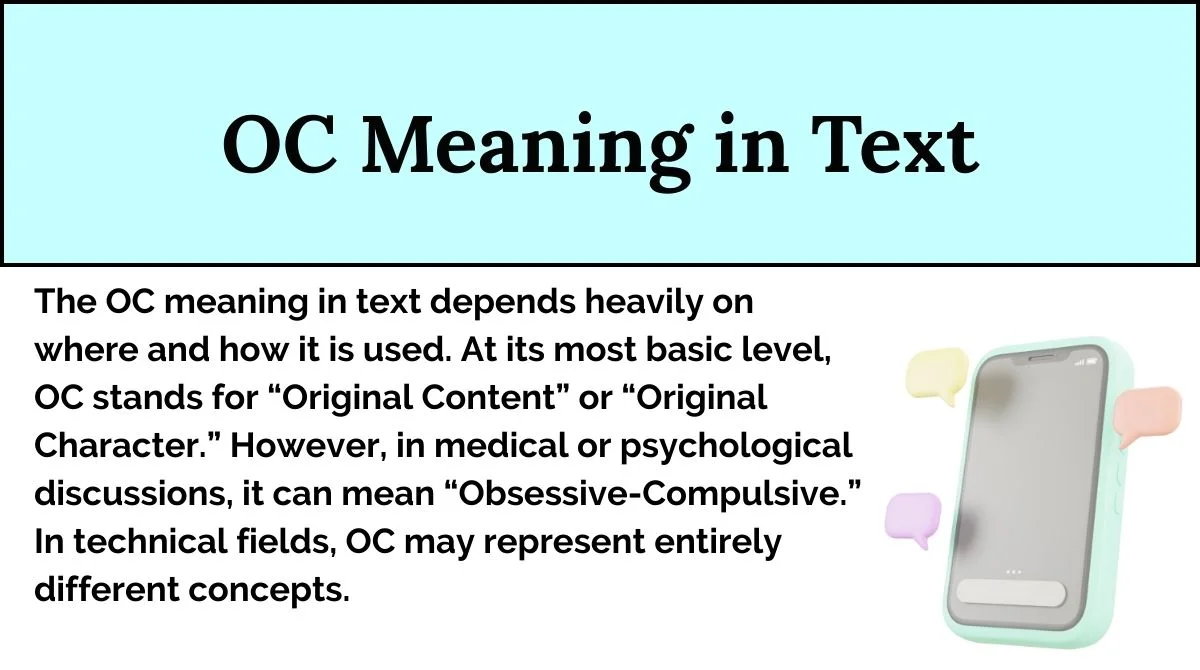
The OC meaning in text depends heavily on where and how it is used. At its most basic level, OC stands for “Original Content” or “Original Character.” However, in medical or psychological discussions, it can mean “Obsessive-Compulsive.” In technical fields, OC may represent entirely different concepts.
In casual digital communication, OC (Original Content) is commonly used when someone wants to clarify that something they shared — a meme, artwork, photo, or post — is their own creation. For example, someone might write, “This meme is OC,” meaning they made it themselves. This usage is especially common on platforms like Reddit, Instagram, and TikTok.
In fandom spaces, OC often means Original Character, referring to a fictional character created by a fan rather than an official character from a movie, show, or game. Writers and artists frequently introduce their OCs when sharing fan stories or artwork.
In psychology or medical contexts, OC is short for Obsessive-Compulsive, often used when discussing conditions like OCD (Obsessive-Compulsive Disorder). Here, the meaning is clinical rather than casual.
Overall, the key takeaway is that OC is a context-driven abbreviation. Without context, it can be confusing, but once you know the setting — social media, fandom, medical, or professional — its meaning becomes clear.
Background
The abbreviation OC didn’t originate from a single source. Instead, it evolved naturally as online communities developed shorthand language to communicate quickly and efficiently. Early internet forums, chat rooms, and fanfiction communities played a major role in shaping how OC is used today.
The phrase “Original Content” became popular as digital platforms grew and content sharing increased. As memes, artwork, and posts spread rapidly, creators wanted recognition for their work. Writing “OC” helped clarify ownership and originality, especially on platforms like Reddit, Imgur, and later Instagram and TikTok.
Meanwhile, “Original Character” emerged from fan communities, particularly in anime, gaming, and fanfiction circles. Fans who created their own characters within existing fictional universes needed a way to distinguish them from canon characters. OC became the perfect shorthand.
In medical and psychological contexts, OC has long been used as an abbreviation for obsessive-compulsive, well before internet slang made it mainstream. Professionals often shorten longer terms for efficiency, and OC fit naturally into that pattern.
Over time, OC became a multi-meaning abbreviation, adopted by different communities for different purposes. This adaptability is one reason it remains widely used today. As online communication continues to evolve, OC remains a simple yet powerful shorthand for originality, creativity, and specific technical meanings depending on the setting.
Usage in Different Contexts (Chat, Social Media, Professional Fields)
The OC meaning in text changes noticeably depending on where it’s used. Let’s explore how it works across casual conversations, social platforms, and professional environments.
In casual chat, OC usually means Original Content. Someone might say, “That drawing is OC,” to compliment a friend for creating something unique. It can also mean Original Character when discussing stories, games, or fandoms.
On social media, OC is often used as a label or hashtag. For example, creators might add “#OC” to posts to indicate the content wasn’t reposted or copied. This is especially common on Reddit, Instagram, TikTok, and art-sharing platforms like DeviantArt. Here, OC signals authenticity and originality, which many communities highly value.
In professional fields, OC can take on entirely different meanings. In psychology or healthcare, it might stand for obsessive-compulsive, such as in patient notes or research papers. In business, OC could refer to operational costs or organizational capacity, depending on the context. In technical documentation, it might represent system components, classifications, or codes specific to that field.
Because OC has such broad usage, understanding its meaning depends on the environment and topic of conversation. In informal settings, it usually points to originality or creativity. In formal contexts, it often refers to technical or medical terminology. Recognizing this distinction helps prevent misunderstandings and ensures clearer communication.
Meaning in Chat, WhatsApp, Instagram, TikTok
In everyday digital communication, the OC meaning in text is most often Original Content or Original Character.
On WhatsApp and texting, OC is usually casual and creative. Someone might say, “That meme is OC,” meaning they created it themselves. In fandom chats, “This is my OC” introduces a character someone invented for a story, game, or roleplay.
On Instagram, OC is commonly used in captions and hashtags. Artists, photographers, and creators use “#OC” to show that their post is original rather than reposted from someone else. It also helps build credibility and trust with followers.
On TikTok, OC often appears in video descriptions or comments. Creators might write “This trend is OC” or “All edits are OC,” emphasizing that the idea, video, or edit is their own. In creative communities, OC also refers to original characters in cosplay, animation, or storytelling videos.
In comment sections, people might ask, “Is this OC?” meaning, “Did you make this yourself?” This highlights how OC has become shorthand for originality and ownership online.
Overall, in chats and social platforms, OC signals creativity, authorship, and authenticity, making it a valuable term in today’s content-driven digital culture.
Meaning in Physics, Medical, and Aircraft Terminology
Outside casual communication, the OC meaning in text can shift into more technical territory.
In medical and psychological contexts, OC stands for Obsessive-Compulsive, often referencing behaviors or symptoms associated with obsessive-compulsive disorder (OCD). For example, in clinical notes, a professional might write, “Patient shows OC tendencies,” as shorthand for obsessive-compulsive traits. In this context, OC is strictly professional and not slang-based.
In physics and engineering, OC can represent specific technical terms depending on the discipline. For example, it may refer to open circuit in electrical systems, sometimes shortened to OC in diagrams or reports. An open circuit means there is a break in the electrical path, preventing current flow.
In aviation and aircraft terminology, OC may stand for operational control or other specialized classifications depending on documentation standards used by airlines, manufacturers, or aviation authorities. These meanings are not universal but exist within technical manuals and professional communication systems.
These technical uses show how OC functions as a multi-purpose abbreviation. Unlike its social media usage, these meanings rely on industry-specific knowledge. This is why understanding context is essential — the same two letters can carry completely different meanings across fields.
Common Misconceptions
One of the biggest misconceptions about the OC meaning in text is assuming it always means the same thing. Many people believe OC only stands for Original Content, but that’s just one of its most common uses. In fandom spaces, it often means Original Character, while in medical contexts, it refers to obsessive-compulsive.
Another misconception is that OC automatically means something is copyrighted or legally protected. While OC indicates originality, it doesn’t necessarily guarantee legal ownership or copyright registration. It simply signals that the creator claims the work as their own.
Some people also confuse OC with similar abbreviations like OP, which stands for Original Poster, or CC, meaning Creative Commons. These terms are related to content sharing but serve different purposes.
Another misunderstanding occurs when people assume OC always applies to creative content. In professional environments, it can refer to technical concepts, costs, classifications, or medical traits — meanings completely unrelated to creativity.
These misconceptions highlight the importance of reading the room. Understanding who is speaking, where the conversation is happening, and what the topic is will almost always clarify what OC truly means in that moment.
Similar Terms & Alternatives
Several terms and abbreviations overlap with the OC meaning in text, depending on context.
For Original Content, common alternatives include:
- My work
- Self-made
- Original post
- Created by me
- Fresh content
On platforms like Reddit, people sometimes use “OP content”, though OP technically refers to the original poster, not necessarily the creator.
For Original Character, alternatives include:
- Fan-made character
- Custom character
- My character
- Personal character design
In medical or psychological contexts, OC may be replaced by:
- Obsessive-compulsive
- Compulsive traits
- Anxiety-related behaviors (depending on context)
In technical fields, alternatives depend on the industry, such as open circuit in electronics instead of OC.
These alternatives are often clearer in professional writing, but OC remains popular because it’s short, efficient, and widely recognized, especially in online communities.
How to Respond to It
Knowing how to respond to OC depends on how it’s being used.
If someone says, “This is OC,” a good response might be:
- “Nice work — it looks great!”
- “Wow, impressive original content!”
- “That’s a cool OC!”
If someone asks, “Is this OC?”, you can reply with:
- “Yes, I made it myself.”
- “No, it’s a repost, credit goes to the original creator.”
If OC is used to mean Original Character, you might respond by showing interest:
- “Tell me more about your OC.”
- “That character design is awesome!”
In professional or medical contexts, responses should remain formal and context-specific. For example, if OC refers to obsessive-compulsive tendencies, a thoughtful or empathetic reply is appropriate.
Overall, the best responses show clarity, appreciation, or curiosity, depending on the conversation tone and setting.
Differences from Similar Words
The OC meaning in text is often confused with other similar abbreviations, but each has a distinct role.
- OC vs OP
OC means Original Content or Original Character. OP means Original Poster — the person who started a thread or discussion, not necessarily the creator of the content. - OC vs CC
OC means something is self-created. CC (Creative Commons) refers to a licensing system that allows others to reuse content legally under certain conditions. - OC vs Repost
OC indicates original work, while repost means sharing someone else’s content, often with credit. - OC vs Fan Art
Fan art can be OC if it’s original, but not all fan art is OC, especially if it’s directly copying scenes or characters without unique interpretation.
Understanding these differences helps avoid miscommunication, especially in online communities where originality and credit matter greatly.
Relevance in Online Conversations & Dating Apps
The OC meaning in text plays a surprisingly important role in modern digital communication — even on dating apps.
In online conversations, OC helps establish authenticity. When someone says their meme, photo, joke, or artwork is OC, it signals creativity and originality. This builds trust and respect, especially in communities that value unique contributions.
On dating apps, OC often appears in profile bios or photo captions. For example, someone might write, “All pics are OC,” meaning the photos are genuinely theirs and not borrowed or edited from elsewhere. This reassurance can increase credibility and reduce doubts about fake profiles or catfishing.
In creative or hobby-based dating communities, people may share artwork, poems, or characters and label them OC to show personal effort and passion. This can spark conversations and create deeper connections.
In short, OC helps users present themselves as genuine, creative, and trustworthy, making it a valuable term not just in social media but also in personal and romantic digital spaces.
Conclusion
Understanding the OC meaning in text helps you navigate modern communication with confidence and clarity.
Whether it stands for Original Content, Original Character, obsessive-compulsive, or a technical term in professional fields, its meaning always depends on context.
In casual chats and social media, OC highlights creativity and authenticity.
In fandom spaces, it celebrates imagination and storytelling. In medical or technical settings, it serves as a practical abbreviation for complex terms.
By recognizing how OC works across platforms like WhatsApp, Instagram, TikTok, and beyond, you can avoid misunderstandings and respond appropriately.
As online language continues to evolve, abbreviations like OC remain essential tools for fast, expressive communication.
Knowing what they mean — and how to use them — empowers you to connect more effectively in both personal and professional digital spaces.

Joseph Roy crafts witty puns and punchlines that brighten your day. His playful twist on language keeps readers laughing and thinking.