In the fast-paced world of online communication, slang and abbreviations evolve almost daily.
One term that has gained massive popularity across texting platforms, social media, and even memes is “oof.”
If you’ve seen it pop up in chats on WhatsApp, Instagram, TikTok, or gaming platforms and wondered, “What does oof mean in text?” you’re not alone.
People search for its meaning because its usage is versatile—it can express emotions ranging from surprise to empathy, discomfort, or even humor.
Understanding this term is essential for effective communication online, especially as digital conversations increasingly replace face-to-face interactions.
In this article, we’ll explore the origins, definitions, contexts, and misconceptions surrounding oof, helping you master its usage in both casual and professional settings.
Meaning & Definition
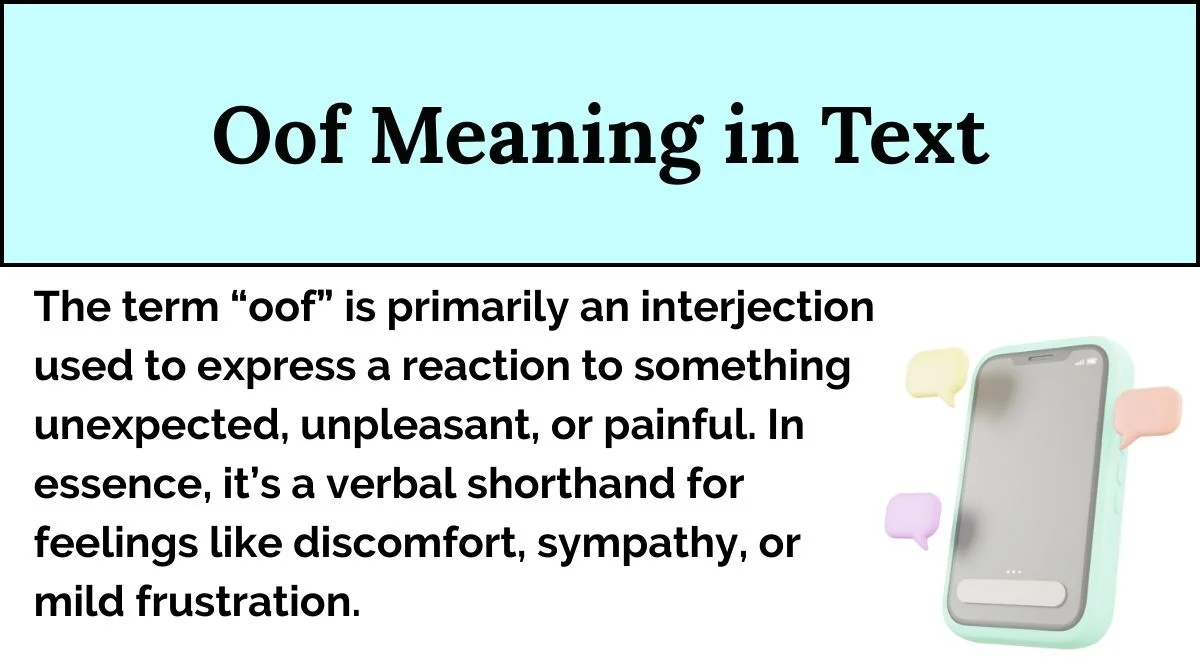
The term “oof” is primarily an interjection used to express a reaction to something unexpected, unpleasant, or painful. In essence, it’s a verbal shorthand for feelings like discomfort, sympathy, or mild frustration. Depending on context, oof can indicate:
- Surprise or shock: “Oof, I didn’t see that coming.”
- Physical or emotional pain: “Oof, that hurt.”
- Empathy for someone’s misfortune: “Oof, I feel for you.”
- Awkwardness or embarrassment: “Oof, that was awkward.”
While simple, its flexibility makes it popular in informal conversations and online interactions. Its meaning can shift subtly depending on the tone, platform, or even accompanying emoji.
Background
The word “oof” has been widely associated with internet culture and meme-driven communication. Though it may feel like a new phenomenon, oof likely originated from comic book and gaming sound effects in the late 20th century. In particular, it became well-known through the Roblox gaming platform, where a character death sound effect was labeled as “oof.” This exposure introduced the term to a wider audience, blending gaming culture with everyday slang.
With the rise of social media platforms like Instagram, TikTok, and Twitter, oof evolved beyond gaming to signify a quick, relatable reaction. Its appeal lies in its simplicity—one short syllable can convey a complex mix of emotions without typing a full sentence.
Usage in Different Contexts
Oof has transcended casual chats to appear in multiple contexts:
- Chat & Social Media: Expressing empathy, shock, or embarrassment.
- Professional Fields: Rarely used formally, but in casual workplace chats, it can convey lighthearted acknowledgment of minor setbacks.
- Gaming: Indicates player failure or unexpected outcomes.
- Memes & Pop Culture: Often paired with images or GIFs for humorous emphasis.
Because it is highly adaptable, understanding its context is crucial to prevent misinterpretation.
Meaning in Chat, WhatsApp, Instagram, TikTok
On messaging apps and social media, oof is most commonly used as a reaction to:
- Bad news or a minor mishap: “Oof, that’s rough.”
- Awkward statements: “Oof, did you really say that?”
- Relatable frustrations: “Oof, I have so much homework.”
TikTok and Instagram users often pair oof with emojis like 😬, 😅, or 💀 to emphasize the emotional undertone. On WhatsApp, it can be a standalone message expressing sympathy or shared frustration without additional context.
Meaning in Physics, Medical, and Aircraft Terminology
While oof is mainly internet slang, it occasionally appears in specialized fields—but with different interpretations:
- Physics: Rarely used, sometimes humorously, to describe a sudden force or impact.
- Medical Field: Informally, some practitioners may jokingly use it to denote minor patient discomfort.
- Aviation: Not an official term, but occasionally pilots or crew may humorously refer to unexpected turbulence as an “oof moment.”
In professional settings, the term is never formal but occasionally seeps in as casual shorthand.
Common Misconceptions
Many people misinterpret oof as an expression of extreme distress or pain. In reality, it is mostly used for mild to moderate reactions and rarely conveys deep suffering. Another misconception is that it is strictly gaming-related; however, its widespread usage on social media has made it mainstream slang.
Similar Terms & Alternatives
If you want to diversify your reactions, you can use terms similar to oof:
- “Yikes” – surprise or minor discomfort
- “Ow” – physical pain
- “Ugh” – annoyance or frustration
- “Dang” – mild shock or disappointment
- “Oops” – small mistake
Each carries slightly different emotional nuances, so choosing the right one depends on context.
How to Respond to It
When someone sends oof, appropriate responses can include:
- Acknowledgment: “Yeah, that’s rough.”
- Empathy: “Oof, I understand.”
- Humor: “Oof, tell me about it!”
- Emoji reaction: 💀, 😬, 😅
Responding appropriately shows emotional awareness and keeps the conversation flowing naturally.
Differences from Similar Words
Unlike yikes or ugh, which can indicate stronger emotions like disgust or extreme surprise, oof is softer and often more relatable. It blends empathy, humor, and mild shock in one expression. This subtlety is what makes it effective for casual online communication.
Relevance in Online Conversations & Dating Apps
In digital dating apps, oof is sometimes used to react to awkward, funny, or mildly disappointing statements. It can serve as an icebreaker or lighthearted response. Its popularity in chats shows the evolution of slang: one short word can convey shared emotion, helping users connect without lengthy explanations.
Conclusion
The term oof may be small, but it carries significant expressive power in online communication.
From its gaming origins to mainstream social media adoption, it’s now a versatile tool for expressing empathy, surprise, or humor.
Understanding its nuances and context ensures you can use it effectively, whether in chats, TikTok comments, or casual workplace conversations.
As online interactions continue to dominate daily life, mastering words like oof enhances relatability and keeps digital communication both expressive and concise.

Joseph Roy crafts witty puns and punchlines that brighten your day. His playful twist on language keeps readers laughing and thinking.