If you have ever received “ASL” in a text, chat, or social media message, you may have wondered what the person was asking.
The ASL meaning slang can vary depending on the conversation, but it is most commonly associated with asking about someone’s age, sex, and location.
This abbreviation became especially popular in early internet chatrooms and instant messaging, where people wanted to learn basic details about someone quickly.
Today, ASL can still appear in casual conversations, dating apps, social media comments, and private messages. However, its meaning is not always the same.
In some situations, ASL can refer to American Sign Language, while in technical or professional contexts, it may have completely different meanings.
Understanding the surrounding conversation is therefore important before deciding what ASL means. This guide explains its common slang meaning, history, uses, alternative meanings, and appropriate ways to respond.
Meaning & Definition of ASL
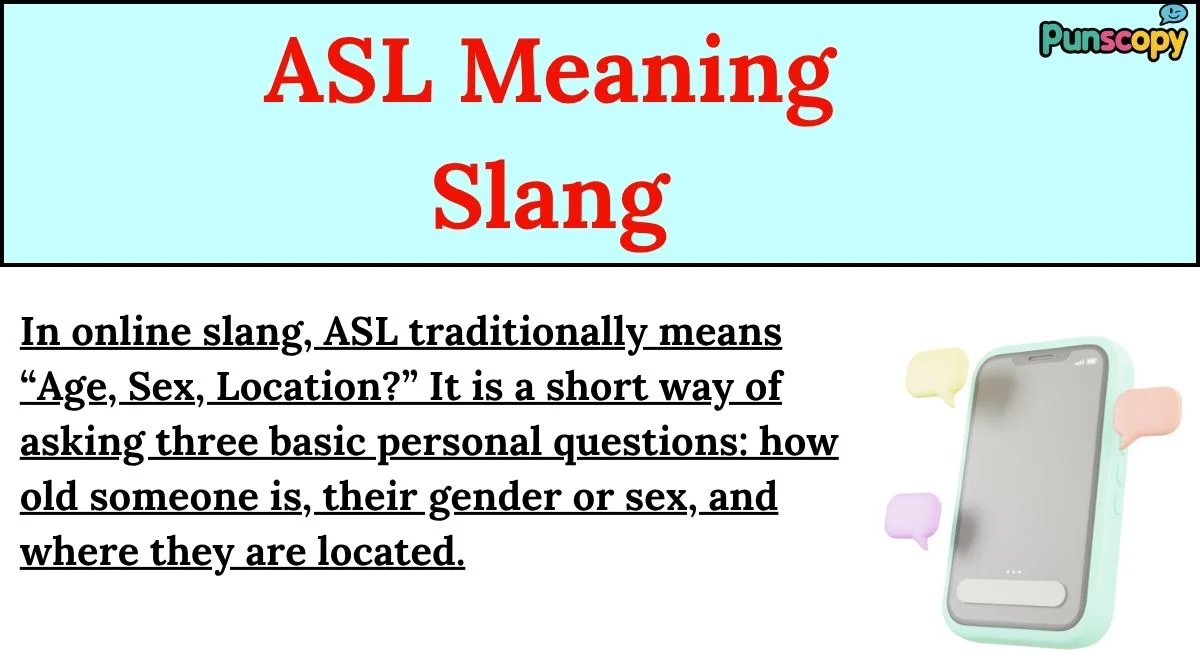
In online slang, ASL traditionally means “Age, Sex, Location?” It is a short way of asking three basic personal questions: how old someone is, their gender or sex, and where they are located.
For example, someone might enter a chatroom and type:
“Hey! ASL?”
The person is essentially asking:
“How old are you, what is your gender, and where are you from?”
ASL became popular because early online conversations often involved strangers. Typing three separate questions took more time, so abbreviations made communication faster.
The abbreviation is generally informal. You are much more likely to see it in casual chats, online communities, dating conversations, or conversations between people who do not know each other well than in professional emails.
The exact interpretation can depend on context. If someone is discussing accessibility, hearing communities, education, or communication, ASL may mean American Sign Language rather than “age, sex, location.”
The slang version is also somewhat old-fashioned today. Modern internet users often ask these questions directly or use phrases such as “Where are you from?” rather than simply saying ASL.
Background and History of ASL Slang
The slang use of ASL developed during the early days of internet chatrooms and instant messaging. Online communication was much more text-based than it is today, and users frequently relied on short abbreviations to save time.
Chatrooms often connected strangers from different cities and countries. When two people started talking, they might want to know basic information about each other. Asking “ASL?” became a quick introduction.
The abbreviation was particularly common on platforms and services where users interacted anonymously. Instead of introducing themselves with a long message, people could use three letters to ask several questions at once.
As social media evolved, ASL became less dominant. Platforms began offering profile pictures, usernames, biographies, locations, ages, and other information directly on user profiles. This reduced the need for abbreviations such as ASL.
Even so, the expression remains recognizable because it became part of internet slang history. Someone who uses ASL today may be intentionally using an old-school chat style, or they may simply be familiar with traditional online abbreviations.
The abbreviation also survived because it is extremely short and easy to type. Its meaning can still be understood in some informal conversations, particularly when people are talking to strangers online.
ASL in Different Contexts: Chat, Social Media, and Professional Fields
The meaning of ASL changes considerably depending on where you see it.
In Online Chat
In casual chat, ASL can mean “Age, Sex, Location?” This is the traditional slang interpretation. It is usually used when someone wants basic information about another person.
On Social Media
On platforms such as Instagram, TikTok, or Facebook, ASL may have several meanings. Someone discussing accessibility, language, or deaf culture may use it for American Sign Language. In a casual private message, however, it could refer to the older slang expression.
In Professional Communication
In professional settings, ASL should not automatically be interpreted as internet slang. It may represent a specialized term, organization, measurement, technical abbreviation, or American Sign Language.
For example, an educator discussing communication accessibility might use ASL specifically to refer to American Sign Language.
In Informal Conversations
Friends may occasionally use ASL jokingly or nostalgically. Someone might say “ASL?” to imitate the style of older chatrooms.
Therefore, the surrounding words are essential. The same three letters can represent completely different ideas.
ASL Meaning in Chat, WhatsApp, Instagram, and TikTok
The interpretation of ASL can depend heavily on the platform and conversation.
ASL Meaning in Chat
In chat, ASL traditionally means “Age, Sex, Location?” It may be used as a quick way to learn basic information about another person.
ASL Meaning on WhatsApp
On WhatsApp, the slang meaning is possible when someone is talking to a new contact. However, many users today would consider “ASL?” less common than simply asking their age or where they live.
ASL Meaning on Instagram
On Instagram, context matters. A direct message from a stranger saying “ASL?” could be asking for personal details. A post about deaf communities or accessibility is much more likely to use ASL as American Sign Language.
ASL Meaning on TikTok
TikTok users may use ASL when discussing sign language, deaf culture, or communication. In private messages, the traditional slang meaning can still appear, although it is less common than it once was.
Always read the surrounding conversation before deciding what the abbreviation means.
ASL Meaning in Physics, Medical, and Aircraft Terminology
ASL is not limited to internet slang. It can also appear in technical and professional fields.
ASL in Physics and Science
In scientific or technical writing, abbreviations can have specialized meanings. ASL may appear in formulas, research, measurements, or terminology depending on the specific field. It should therefore not automatically be interpreted as internet slang.
ASL in Medical Contexts
Medical professionals use many abbreviations, and ASL can have specialized meanings depending on the subject being discussed. In healthcare writing, the surrounding terminology and documentation are important for understanding the abbreviation correctly.
If you encounter ASL in medical information, relying on the slang interpretation could create confusion.
ASL in Aircraft and Aviation
Aviation also uses numerous abbreviations and standardized terms. ASL may appear in aviation-related material with a meaning determined by the particular document, organization, or technical system.
For this reason, professional abbreviations should always be interpreted from their specific context.
The key point is simple: ASL in a casual message and ASL in a technical document may mean completely different things.
Common Misconceptions About ASL
One common misconception is that ASL always means “Age, Sex, Location?” That interpretation is strongly associated with old internet slang, but it is not the only meaning.
Another misconception is that every use of ASL refers to American Sign Language. Although this is a very important modern meaning, the abbreviation can also represent other terms depending on the subject.
Some people also assume that asking “ASL?” is always harmless. In reality, asking someone for their age, gender, and location can involve personal information. You are not required to provide these details simply because someone asks.
Another misconception is that ASL is equally common on every platform. Internet language changes quickly, and many younger users may not use or recognize the abbreviation in its traditional slang sense.
Finally, ASL should not be treated as having one universal definition. Context determines meaning.
Similar Terms and Alternatives
Several expressions can serve a similar purpose to the slang use of ASL.
Instead of saying “ASL?”, someone might ask:
- “How old are you?”
- “Where are you from?”
- “What’s your age?”
- “Where do you live?”
- “Tell me a little about yourself.”
- “What should I know about you?”
These alternatives are generally clearer because they explain exactly what information the person wants.
For American Sign Language, related terms include sign language, ASL interpreter, and American Sign Language communication.
The best alternative depends on the context. In a friendly conversation, asking one question at a time may sound more natural than using the old abbreviation.
Using direct language can also reduce misunderstandings because the recipient does not have to guess which meaning of ASL you intended.
How to Respond to ASL
Your response should depend on who is asking and how comfortable you are sharing personal information.
If someone uses ASL in the traditional slang sense and you are comfortable answering, you could provide general information:
“I’m 25, male, and from Lahore.”
You do not have to provide an exact location. A city, region, or country may be enough if you want to protect your privacy.
You can also respond with:
“What do you mean by ASL?”
This is useful when you are unsure whether the person means Age, Sex, Location or American Sign Language.
If a stranger asks for personal details and you do not want to answer, you can simply say:
“I prefer not to share personal information.”
There is no obligation to reveal your age, gender, or location online. A respectful conversation should allow people to decide what information they are comfortable sharing.
Differences Between ASL and Similar Words
ASL can be confused with other short internet expressions, especially when people are unfamiliar with older chat slang.
For example, “age”, “location”, and “where are you from?” may communicate parts of the same idea, but they are not abbreviations for the complete phrase.
ASL is also different from A/S/L, even though they usually represent the same traditional slang expression. The version with slashes reflects the way the phrase was commonly formatted in older online chats.
Another important distinction is between ASL meaning “Age, Sex, Location?” and ASL meaning “American Sign Language.” These are completely different uses of the same abbreviation.
The first is an informal personal-information question, while the second refers to a recognized visual language used by members of Deaf communities and others.
Understanding these differences prevents unnecessary confusion when reading online messages.
ASL in Online Conversations and Dating Apps
The traditional slang meaning of ASL is particularly relevant to conversations between strangers. Dating apps, social platforms, and anonymous communities can involve people who want to learn basic information about one another.
However, modern dating apps already display information such as age and sometimes location or distance. Because of this, asking “ASL?” may feel outdated or unnecessary.
If someone sends ASL in a dating conversation, they may simply be trying to start a conversation or learn more about you. Still, you should decide how much personal information you want to reveal.
A safer approach is to give broad information rather than precise details. For example, saying “I’m in Lahore” is less specific than sharing your neighborhood, street, workplace, or exact location.
If someone immediately pressures you for private information, you can change the subject or end the conversation.
In online dating, abbreviations may make conversations faster, but clear communication and privacy awareness remain important.
FAQs
What does ASL mean in slang?
In traditional internet slang, ASL means “Age, Sex, Location?” It is used to ask someone for basic personal information.
What does ASL mean in text messages?
In text messages, ASL can mean “Age, Sex, Location?” when used informally. However, it can also mean American Sign Language, depending on the context.
Is ASL still commonly used?
The slang meaning is less common than it was during the early days of online chatrooms. Modern users often ask the questions directly.
What does ASL mean on social media?
On social media, ASL can have multiple meanings. It may refer to American Sign Language or the older slang phrase “Age, Sex, Location?”
What does ASL mean on WhatsApp?
On WhatsApp, ASL can be used as an informal request for someone’s age, gender, and location. The exact meaning depends on the conversation.
Should I answer ASL if a stranger asks me?
You do not have to. If you are uncomfortable sharing personal information, you can politely decline or provide only general information.
Does ASL always mean Age, Sex, Location?
No. ASL has multiple meanings. American Sign Language is another major interpretation, and technical fields may use the abbreviation differently.
Conclusion
The ASL meaning slang is traditionally “Age, Sex, Location?”, a short expression that became popular during the early era of internet chatrooms and instant messaging. It allowed strangers to ask several basic questions quickly.
Today, the abbreviation is less common in its slang form, but it can still appear in private messages, online communities, and dating conversations.
At the same time, ASL is widely recognized as American Sign Language, making context especially important.
If someone sends you “ASL?”, consider the conversation before deciding what they mean. When the meaning is unclear, simply asking for clarification is the safest approach.
And if the question involves personal information, remember that you can choose what you are comfortable sharing.

Joseph Roy crafts witty puns and punchlines that brighten your day. His playful twist on language keeps readers laughing and thinking.