The word “brat” is commonly used in everyday English, online conversations, and social media. Its meaning can change depending on who says it, how they say it, and the relationship between the people involved.
Traditionally, a brat describes someone who behaves badly, acts spoiled, or expects to get their way. However, modern internet culture has given the word several lighter and more playful meanings.
People often search for brat meaning slang because they encounter the word in texts, Instagram captions, TikTok videos, dating profiles, or casual conversations and are unsure whether it is meant as an insult, a joke, or even a form of affection.
In some situations, calling someone a brat can be teasing and harmless. In others, it can criticize someone’s behavior. The surrounding conversation is therefore important when interpreting it.
Meaning & Definition of Brat
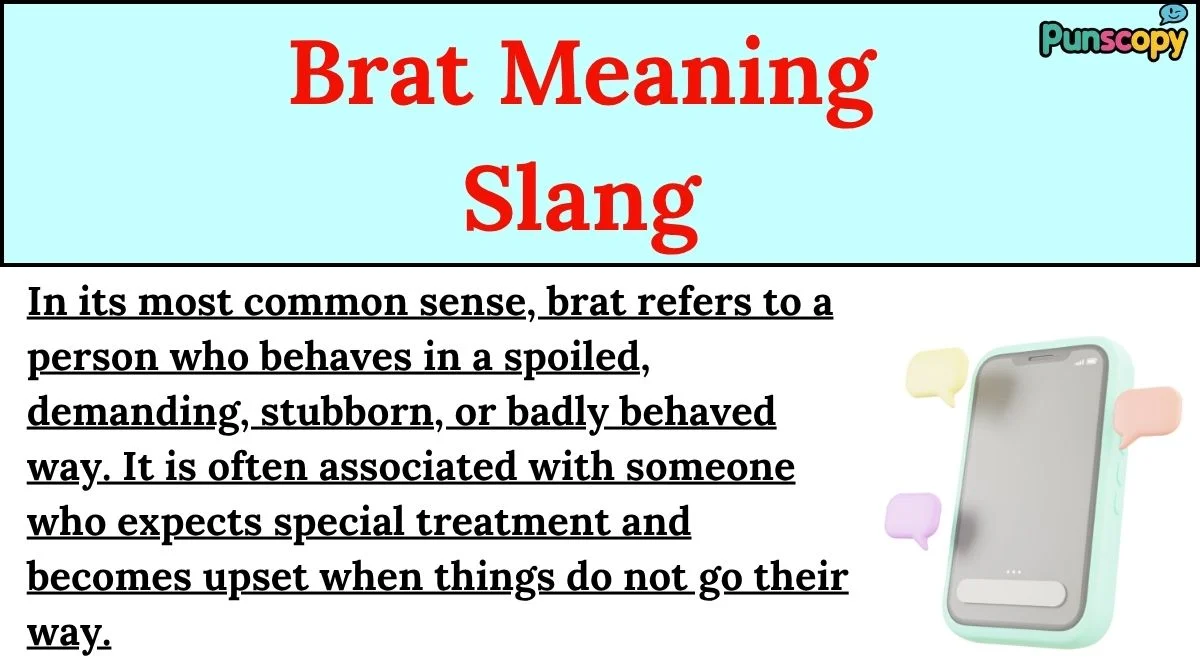
In its most common sense, brat refers to a person who behaves in a spoiled, demanding, stubborn, or badly behaved way. It is often associated with someone who expects special treatment and becomes upset when things do not go their way.
For example, a parent might say:
“My little brother is being such a brat today.”
Here, the speaker probably means that the brother is behaving badly or being difficult.
However, the word does not always have a seriously negative meaning. Friends may use brat playfully when someone is being stubborn, dramatic, mischievous, or demanding in a humorous way.
For example:
“You’re such a brat 😂”
Depending on the relationship, this could simply mean:
- You are being difficult.
- You are acting spoiled.
- You are teasing me.
- You always want things your way.
- You are being playfully demanding.
Online conversations can make the meaning even more flexible. Emojis, punctuation, and previous messages can completely change the tone.
A laughing emoji may make the expression feel playful, while an angry message may make it sound genuinely critical.
The word can also appear as an adjective in informal expressions such as “bratty.” Someone described as bratty may be acting spoiled, demanding, or immature.
Therefore, when interpreting the term, it is useful to consider both the dictionary meaning and the social context.
Background of the Word Brat
The word brat has been used in English for a long time as an informal term for a badly behaved or troublesome child. Over time, its meaning became closely associated with children who were considered spoiled, rude, demanding, or difficult to control.
The expression “spoiled brat” is particularly common. It describes someone who receives many privileges or material benefits but behaves as though they deserve even more.
For example:
“He acts like a spoiled brat whenever he doesn’t get what he wants.”
Although the traditional meaning focuses on children, modern informal English can apply the word to adults as well.
Someone might call an adult a brat when that person is acting stubborn, demanding, dramatic, or playful.
The internet has also helped broaden the word’s social meaning. On platforms such as TikTok and Instagram, users may use brat in humorous captions, memes, relationship discussions, and personality descriptions.
In some online communities, the term can even be used positively or self-referentially. A person may describe themselves as a brat to jokingly acknowledge that they enjoy getting their way or being a little demanding.
Because language changes with culture, the modern use of brat cannot always be understood simply as “bad child.”
Today, tone and relationship matter considerably.
A close friend saying “You’re a brat” may be teasing. A stranger saying the same thing during an argument is more likely to be insulting.
Usage in Different Contexts: Chat, Social Media, and Professional Fields
The meaning of brat depends heavily on the setting.
In Casual Chat
In everyday texting, brat usually describes someone who is acting spoiled, stubborn, annoying, or demanding.
For example:
“Stop being a brat.”
This may mean:
“Stop acting difficult.”
Among close friends, it can also be playful:
“You got your favorite dessert again. Such a brat 😂”
On Social Media
Social media users often use the word humorously. It may appear in memes, captions, comments, or personality-related posts.
Someone might write:
“I know I’m a brat, but I like what I like.”
Here, the speaker may be joking about having strong preferences rather than seriously insulting themselves.
In Professional Communication
The term is generally inappropriate in formal workplace communication. Calling a colleague or customer a brat can sound disrespectful or childish.
Instead of saying:
“He’s acting like a brat.”
a professional setting might use:
- difficult
- demanding
- uncooperative
- unreasonable
- overly demanding
- immature
In Family Conversations
Parents, siblings, and relatives commonly use brat to describe misbehavior.
For example:
“The kids were being brats all afternoon.”
The expression can be affectionate, humorous, or critical depending on the speaker’s tone.
In Romantic Relationships
Partners may use brat playfully when one person is being stubborn, teasing, demanding, or intentionally mischievous.
Because romantic conversations can contain private meanings, the exact interpretation depends on the relationship and surrounding messages.
Brat Meaning in Chat, WhatsApp, Instagram, and TikTok
When you see brat in a digital conversation, it usually describes someone’s behavior rather than identifying a specific type of person.
Brat Meaning in Chat
In a normal text conversation, brat often means:
“You are acting spoiled, difficult, or stubborn.”
But between friends, it may simply be affectionate teasing.
Brat Meaning on WhatsApp
WhatsApp conversations are usually personal, so context is especially important.
For example:
“You didn’t save me any pizza. You’re a brat 😂”
This is probably playful.
But:
“You’re such a brat. I can’t deal with you.”
could indicate genuine frustration.
Brat Meaning on Instagram
On Instagram, the word may appear in captions, comments, memes, or personality posts.
Someone might call their friend a brat after seeing them demand something expensive or behave dramatically.
Brat Meaning on TikTok
TikTok frequently turns ordinary words into humorous personality labels. A creator may use brat to describe a person who is confident, demanding, dramatic, playful, or determined to get what they want.
The word can therefore be self-deprecating or humorous rather than purely insulting.
Emojis Can Change the Tone
Consider:
“You’re a brat 😭😂”
This sounds much more playful than:
“You’re a brat.”
The first may be friendly teasing, while the second could be criticism.
Brat Meaning in Physics, Medical, and Aircraft Terminology
The word brat is primarily an ordinary English slang or informal term rather than a standard technical concept in physics, medicine, or aviation.
In Physics
There is no widely recognized general physics definition in which brat means the same thing as its everyday slang use. If the word appears in a physics-related discussion, it may be a person’s name, an abbreviation specific to a paper, software, project, or another context.
Therefore, it should not automatically be interpreted as a standard physics term.
In Medical Contexts
Brat is not normally a standard medical diagnosis or universally recognized medical abbreviation. If it appears in medical documentation, the surrounding text should be examined carefully because abbreviations can vary between institutions and specialties.
In Aircraft or Aviation Terminology
Likewise, brat is not generally used as a universal aviation term meaning “spoiled person.” Aviation uses many specialized abbreviations and codes, so an unfamiliar abbreviation should be interpreted from the specific document or communication.
This distinction is important because people sometimes assume that every short word appearing online has a specialized technical definition.
If you encounter BRAT in capital letters in a technical document, its meaning may be completely different from lowercase brat used in casual conversation.
Common Misconceptions About Brat
One common misconception is that brat always means “bad person.” That is not necessarily true.
The traditional meaning is negative, but casual communication often uses the word jokingly.
For example:
“You’re such a brat!”
A friend may say this while laughing because you refused to share your fries. The speaker may not genuinely believe that you are rude or spoiled.
Another misconception is that the word only applies to children. Although brat has historically been associated with badly behaved children, adults can also be described as brats when they behave in a demanding or stubborn way.
Some people also assume that calling someone a brat is always offensive. The relationship between the speakers matters considerably.
A close friend may use it as affectionate teasing, while a stranger may intend it as an insult.
Another misunderstanding comes from online communities where the word can take on specialized meanings. A person’s use of brat in a particular community may not match the traditional dictionary definition.
Finally, capitalization does not automatically establish a single meaning. BRAT may function as an acronym in a specialized context, while brat in ordinary texting is usually an informal noun.
Always examine the sentence, relationship, platform, and tone before deciding what the speaker intended.
Similar Terms and Alternatives
Several words can overlap with brat, but they do not all carry exactly the same meaning.
Spoiled
Someone who is spoiled is accustomed to receiving special treatment or getting what they want.
Difficult
Difficult is broader and less insulting. It can describe someone who is hard to deal with without necessarily suggesting that they are spoiled.
Stubborn
A stubborn person refuses to change their opinion or behavior easily.
Demanding
Demanding describes someone who expects a lot from others.
Mischievous
Mischievous usually suggests playful troublemaking rather than serious bad behavior.
Spoiled Brat
This is a stronger expression emphasizing entitlement and poor behavior.
Bratty
Bratty is an adjective meaning that someone is behaving like a brat.
For example:
“She’s being really bratty today.”
The best alternative depends on the intended tone. If you want to sound polite, “demanding” or “difficult” may be more appropriate. If you’re joking with a friend, “bratty” or “spoiled” might fit better.
How to Respond When Someone Calls You a Brat
Your response should depend on whether the person is joking or genuinely criticizing you.
If They Are Teasing
You can respond playfully:
“Maybe I am 😂”
or:
“You love my bratty side.”
If You Want to Joke Back
Try:
“Only because you let me be one!”
This keeps the conversation light.
If You Are Unsure
You can simply ask:
“Haha, what makes you say that?”
This gives the other person a chance to explain their meaning.
If It Feels Insulting
A calm response works best:
“What did I do that made you feel that way?”
This moves the conversation toward the actual behavior instead of arguing over the label.
If You Want to Set a Boundary
You can say:
“I don’t appreciate being called that.”
There is no single correct response because the relationship and tone matter. A playful message deserves a different response from a serious argument.
Differences Between Brat and Similar Words
Although brat, spoiled, stubborn, rude, and difficult can overlap, they describe different characteristics.
A brat is usually someone behaving in a spoiled, demanding, or immature way.
A spoiled person is someone who may be accustomed to receiving excessive privileges or attention.
A stubborn person may simply refuse to change their position. They do not necessarily expect special treatment.
A rude person behaves disrespectfully toward others. Rudeness does not automatically involve being spoiled.
A difficult person can be challenging to communicate or cooperate with, but the term is broader and less specific.
For example, imagine someone refuses to compromise during an argument.
Calling them stubborn focuses on their unwillingness to change.
Calling them rude focuses on disrespectful behavior.
Calling them a brat suggests they are acting demanding, spoiled, or immature.
Calling them difficult simply indicates that interacting with them is challenging.
Understanding these differences helps you interpret messages more accurately.
Relevance in Online Conversations and Dating Apps
The word brat can have an especially flexible meaning in online dating and romantic conversations.
Someone might use it playfully when describing a person’s personality:
“I can already tell you’re a little brat 😂.”
In this situation, the speaker may be flirting or teasing.
A dating profile might also use the word to communicate a playful personality, suggesting that the person is demanding, mischievous, confident, or likes being spoiled.
However, the meaning can become more personal in romantic conversations. Some people use brat as part of a consensual relationship dynamic or particular online community vocabulary. In those situations, the term can carry a meaning that goes beyond ordinary teasing.
It is therefore important not to assume the exact intention from the word alone.
If someone uses it toward you and you’re unsure, consider the surrounding conversation.
Look at:
- What was being discussed?
- Was the person joking?
- Did they use laughing or playful emojis?
- Are you close friends or romantic partners?
- Have they used the word before?
- Did they explain what they meant?
Dating apps also contain people from different backgrounds, so the same expression may have different interpretations.
When the meaning is unclear, asking directly is usually the simplest solution.
FAQs
What does brat mean in slang?
In slang and casual English, brat usually describes someone who is acting spoiled, demanding, stubborn, difficult, or immature. It can also be used playfully among friends.
Is calling someone a brat an insult?
It can be. However, friends and romantic partners sometimes use brat affectionately or humorously. The tone and relationship determine whether it is offensive.
What does brat mean from a girl?
If a girl calls someone a brat, she may be saying that the person is acting spoiled, stubborn, playful, or demanding. In a friendly conversation, it may simply be teasing.
What does brat mean from a guy?
A guy calling someone a brat can similarly mean that they are being difficult, demanding, stubborn, or playfully mischievous. Context determines the intended tone.
What does “you’re such a brat” mean?
“You’re such a brat” generally means “you’re acting spoiled or difficult.” When accompanied by laughing emojis or playful conversation, it can be affectionate teasing.
Does brat always mean spoiled?
No. Spoiled behavior is central to the traditional meaning, but people also use brat more loosely for someone who is being stubborn, demanding, dramatic, or mischievous.
What is the adjective form of brat?
The common adjective is bratty, meaning someone is behaving in a way associated with a brat.
Can adults be called brats?
Yes. Although the traditional word is strongly associated with children, adults can also be called brats when they behave in a spoiled, demanding, or immature way.
Conclusion
The word brat has a straightforward traditional meaning but can take on different tones in modern communication. It generally describes someone who is spoiled, demanding, stubborn, difficult, or badly behaved.
However, friends, family members, and romantic partners may also use it as playful teasing.
When you see brat in a text, WhatsApp message, Instagram comment, TikTok caption, or dating conversation, don’t judge the meaning from the word alone. Consider the surrounding message, relationship, emojis, and overall tone.
In formal or professional communication, the word can sound disrespectful, so more neutral alternatives such as “demanding,” “difficult,” or “uncooperative” are usually better.
Ultimately, understanding brat meaning slang requires looking at context. The same word can be a criticism in one conversation and an affectionate joke in another.

Joseph Roy crafts witty puns and punchlines that brighten your day. His playful twist on language keeps readers laughing and thinking.