Last updated on August 31st, 2026 at 04:37 pm
In today’s digital age, communication has evolved far beyond simple words.
One term that frequently pops up in text conversations, social media, and messaging apps is “ditto.”
But what does ditto mean in text?
Many users see it and either ignore it or wonder about its context.
Essentially, “ditto” is a shorthand way to express agreement, repetition, or acknowledgment without rewriting an entire statement.
Its popularity has grown with texting apps like WhatsApp, Instagram, and platforms like TikTok, where quick and concise communication is key.
Understanding what “ditto” conveys can prevent misunderstandings in casual chats, professional messages, or even dating app interactions.
This article dives deep into the term’s meaning, origin, and usage across multiple contexts, helping you communicate more effectively online and offline.
Meaning & Definition of Ditto
The term “ditto” is often used to indicate agreement, repetition, or similarity. In text conversations, it usually implies that the user agrees with or shares the sentiment expressed in a previous message. For example:
- Person A: “I had a great day today!”
- Person B: “Ditto!”
Here, Person B is essentially saying, “I feel the same way” without typing a full response.
Originally, “ditto” comes from the Italian word detto, meaning “said” or “aforementioned.” Historically, it was used in writing and accounting to avoid repeating numbers or words, saving space and time. In modern digital communication, its use has evolved to convey brevity, agreement, or acknowledgment efficiently.
Does Ditto Always Mean Agreement?
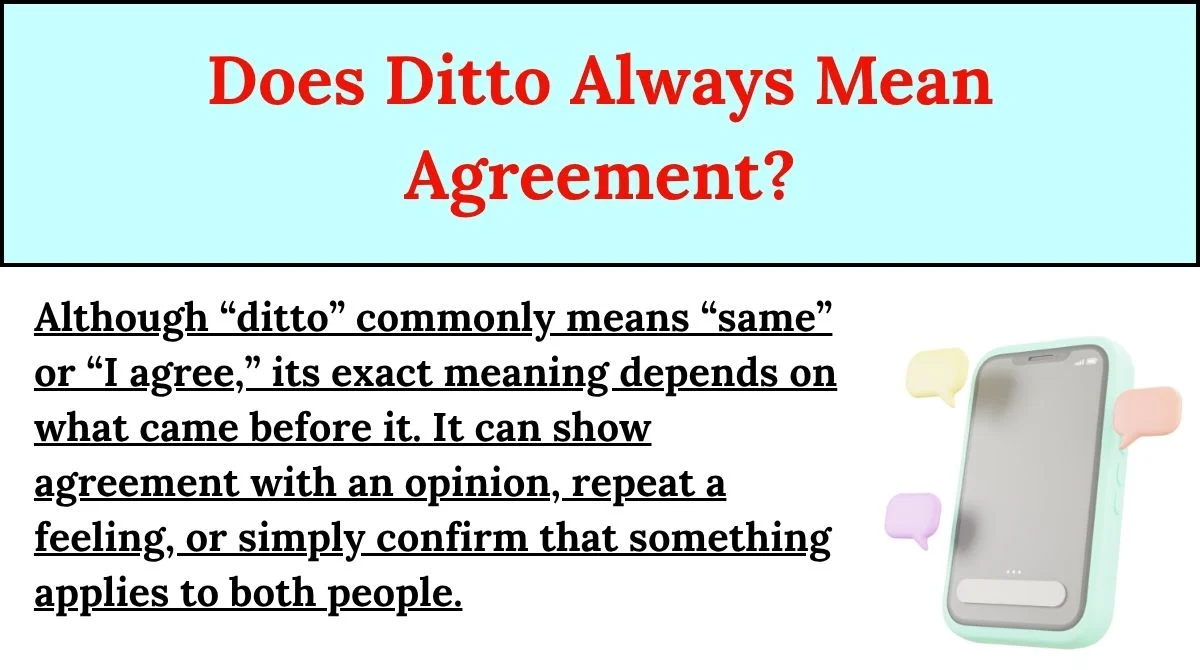
Although “ditto” commonly means “same” or “I agree,” its exact meaning depends on what came before it. It can show agreement with an opinion, repeat a feeling, or simply confirm that something applies to both people.
For instance, if someone says, “I’m feeling tired today,” a reply of “ditto” means the other person feels tired as well. If someone says, “That was a great experience,” “ditto” can mean they had the same positive reaction.
The surrounding conversation and tone are important. In some situations, “ditto” can also sound playful or humorous rather than completely serious.
When Should You Use Ditto in a Text?
“Ditto” is best used when you want to quickly show that you share the same opinion, feeling, or experience. It works naturally in casual conversations with friends, family, or people you know well.
For example, if someone says, “I really enjoyed this movie,” replying “Ditto!” means you enjoyed it too. Similarly, “I’m ready for the weekend” followed by “Ditto” shows the same feeling.
However, it may not always be suitable for serious or formal conversations. In professional messages, a clearer response such as “I agree” or “I feel the same way” can avoid confusion.
Ditto Meaning in Text from a Boy
When a boy types “ditto” in chat, it also means “same” or “I agree.” He’s using it as a quick way to say he feels the same as you do. For example, if you say “That was fun,” and he replies “ditto,” it means he enjoyed it too.
The tone is usually casual and straightforward. Guys often use it to keep things simple without adding extra words.
It doesn’t carry any hidden meaning—it’s just a concise way to agree or mirror your statement in conversation.
Background of Ditto
The word “ditto” has roots dating back to the 17th century in English, primarily as a bookkeeping or documentation term. Clerks used it to indicate repeated entries in ledgers. Over time, it spread into everyday language, eventually becoming a common conversational shorthand.
In the context of digital communication, the transition was natural. Texting, social media, and chat platforms thrive on brevity, making “ditto” an ideal tool. Unlike “I agree” or “me too,” “ditto” is concise, casual, and often playful. Its adoption across messaging apps has turned it into a cultural staple, especially among younger users.
Usage in Different Contexts
“Ditto” is versatile and adapts to multiple contexts:
- Chat & Messaging: Expresses agreement or shared sentiment.
- Social Media: Used in comments, captions, or reactions to show alignment with another user’s opinion.
- Professional Fields: Occasionally appears in emails or notes to indicate repetition or approval without rewriting content.
The adaptability of “ditto” makes it widely understood, though its tone can shift from casual to formal depending on context.
Meaning in Chat, WhatsApp, Instagram, TikTok
In informal digital communication:
- Chat & WhatsApp: Typically expresses personal agreement. For example, replying “ditto” to “I’m exhausted today” signals shared feeling.
- Instagram: Used in captions or comments to echo thoughts or feelings from others.
- TikTok: Appears in text overlays or comments to show agreement with trends or opinions quickly.
Across these platforms, “ditto” emphasizes relatability, connection, and brevity in online interactions.
Meaning in Physics, Medical, and Aircraft Terminology
Interestingly, “ditto” is not limited to casual communication. In specific professional fields:
- Physics & Science: May be used in lab notes to indicate repetition of a value or observation.
- Medical: Common in charts or prescriptions to denote repeated instructions or dosages.
- Aircraft & Aviation: Pilots or engineers may use it to indicate repeated data or instructions in logs or communication.
In these contexts, “ditto” retains its traditional function—denoting repetition—but serves as a precise shorthand to save time and reduce errors.
Common Misconceptions
Despite its simplicity, “ditto” is often misunderstood:
- Some think it implies laziness, but it actually saves time.
- Others mistake it for sarcasm in informal chats.
- In professional contexts, some assume it lacks clarity, though its traditional usage is precise.
Understanding context is key to interpreting “ditto” correctly.
Similar Terms & Alternatives
Other words or phrases convey similar meaning:
- Me too
- Likewise
- Same here
- I agree
- As above
While alternatives exist, “ditto” remains uniquely concise and playful, making it ideal for digital conversations.
How to Respond to It
If someone texts “ditto”:
- Respond with “same here” for clarification.
- Use emojis to match tone, e.g., 😊, 👍.
- In professional contexts, you might restate the agreement with formal phrasing, e.g., “Noted and agreed.”
Differences from Similar Words
While “ditto” overlaps with “me too” or “same here,” the differences are subtle:
- Ditto: Short, neutral, playful; can indicate agreement with a previous message without extra words.
- Me too: Slightly more personal and expressive.
- Likewise: Formal, often used in professional or polite conversations.
Recognizing these nuances ensures effective communication.
Relevance in Online Conversations & Dating Apps
On dating apps or social media, “ditto” serves as a tool for connection:
- Signals shared interests or feelings quickly.
- Creates a lighthearted tone in conversations.
- Encourages brevity without losing engagement.
Its simplicity makes it a go-to choice for expressing mutual sentiment without overcomplicating messages.
Ditto Meaning in Text from a Girl
When a girl uses “ditto” in text, it means “same here” or “I feel the same way.” She’s agreeing with what you said without repeating it.
For example, if you say “I had a great time,” and she replies “ditto,” it means she felt the same. The tone is usually friendly, warm, and sometimes even a bit sweet—especially in personal or emotional conversations.
In some cases, it can come across as playful or light. Overall, it’s a simple and positive way to show agreement or shared feelings without typing a full response.
FAQs
What does “ditto” mean in text?
“Ditto” in text usually means “same,” “me too,” or “I agree.” It is used when someone wants to express the same feeling, opinion, or experience as the person who sent the previous message.
Is “ditto” a positive or negative word?
“Ditto” is generally a neutral or positive expression, depending on the conversation. It simply shows that someone agrees with or shares what was previously said. The exact tone depends on the context and the relationship between the people chatting.
What does it mean when a boy texts “ditto”?
When a boy texts “ditto,” he usually means “I feel the same” or “same here.” For example, if you say, “I really enjoyed talking to you,” and he replies “ditto,” he is indicating that he enjoyed the conversation as well.
What does it mean when a girl texts “ditto”?
When a girl replies with “ditto,” she generally means “same here” or “I agree.” It can be friendly, casual, or playful depending on the conversation. It does not automatically indicate romantic interest.
Can “ditto” be used in professional communication?
Yes, “ditto” can sometimes be used in professional communication to indicate repetition or agreement. However, in formal emails or important business messages, phrases such as “I agree,” “likewise,” or “as mentioned above” may be clearer and more professional.
Is “ditto” the same as “me too”?
“Ditto” and “me too” are very similar because both can express that you share someone’s feeling or opinion. However, “ditto” can also indicate repetition or that the same information applies again, making it slightly broader than “me too.”
What is the origin of the word “ditto”?
The word “ditto” comes from the Italian “detto,” meaning “said” or “the aforesaid.” It entered English usage as a way to avoid repeating information, particularly in written records and documents.
How should you reply when someone says “ditto”?
Your response depends on the conversation. You can simply continue the discussion, say “same here,” or acknowledge the agreement with an emoji. If the conversation is professional, you can respond with a clearer phrase such as “Agreed” or “Understood.”
Does “ditto” have a hidden meaning in texting?
Usually, no. “Ditto” generally has a straightforward meaning: the person agrees with, shares, or repeats what was previously stated. Any additional meaning comes from the surrounding conversation rather than the word itself.
Is “ditto” still commonly used today?
Yes. “Ditto” is still understood and used in everyday conversations, texting, social media, and informal online communication. Its short and convenient nature makes it useful when someone wants to agree without repeating an entire statement.
Conclusion
Understanding ditto meaning in text is crucial in modern digital communication.
From casual chats to professional logs, it efficiently conveys agreement, repetition, or acknowledgment.
Its origins in Italian and historical use in record-keeping highlight its longstanding practicality.
Today, it thrives on social media, messaging apps, and even professional contexts, bridging brevity with clarity.
Knowing how to interpret and respond to “ditto” enhances your communication, reduces misunderstandings, and makes online interactions smoother.
Whether in WhatsApp groups, Instagram comments, TikTok replies, or even formal documentation, “ditto” remains a simple yet powerful linguistic tool for connecting with others effectively.

Joseph Roy crafts witty puns and punchlines that brighten your day. His playful twist on language keeps readers laughing and thinking.