The DND meaning in text is usually “Do Not Disturb.” It is a common abbreviation used in digital communication when someone wants to show that they are unavailable, busy, resting, or simply do not want to receive interruptions.
You may see DND in text messages, social media posts, messaging apps, phone settings, and even workplace communication.
People often search for this term because its meaning can change slightly depending on where it appears. For example, a friend may use DND to say they do not want to be contacted for a while, while a phone may display DND as a setting that silences notifications.
In some situations, DND can also have completely different meanings outside casual texting.
Understanding the context makes it easier to interpret the abbreviation correctly.
Whether you saw DND in a WhatsApp message, Instagram conversation, TikTok comment, or dating app, the surrounding words usually reveal what the sender means.
Meaning & Definition
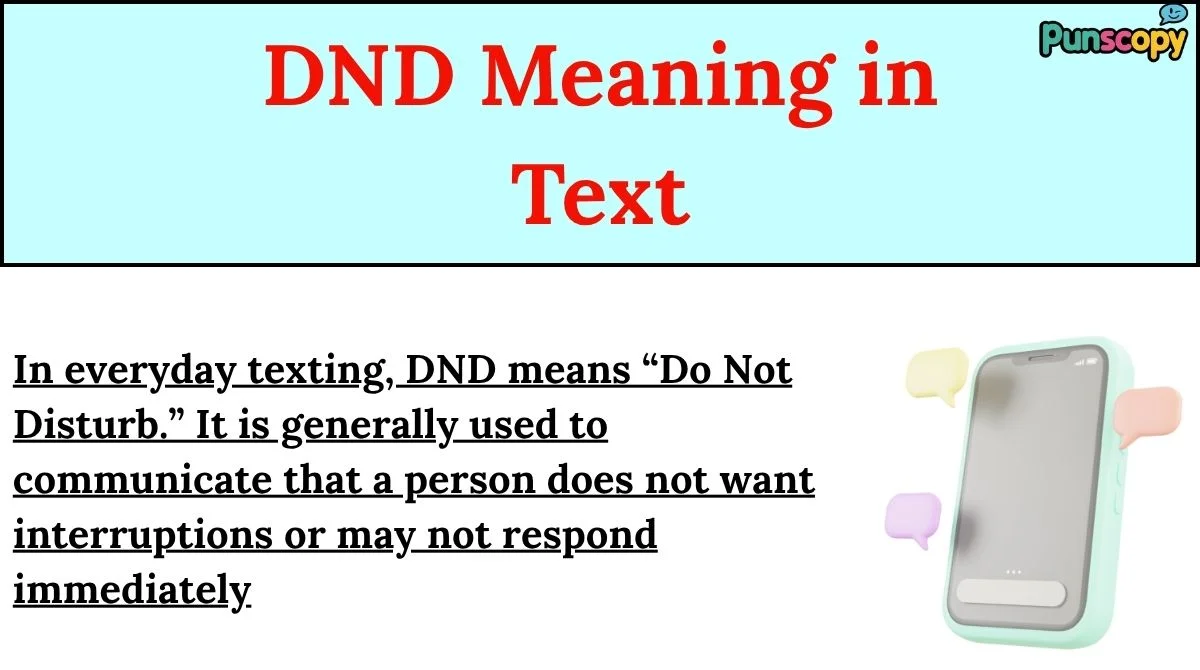
In everyday texting, DND means “Do Not Disturb.” It is generally used to communicate that a person does not want interruptions or may not respond immediately. The expression can be direct, but it does not automatically indicate that the person is angry or avoiding someone.
For example, someone might send:
- “I’m studying rn, DND.”
- “DND until tomorrow morning.”
- “Got a meeting. DND for an hour.”
- “My phone is on DND.”
In these examples, the abbreviation signals temporary unavailability. The sender may still read messages later, but they are asking others not to expect an immediate response.
DND is especially useful because it communicates a complete idea using only three letters. Online conversations often favor short expressions, so abbreviations such as DND have become common.
The phrase can also describe a feature on smartphones and communication platforms. When Do Not Disturb mode is activated, notifications, calls, or alerts may be muted according to the user’s settings. Therefore, if someone says, “I’m on DND,” they could be referring to their phone’s notification mode rather than directly telling another person not to message them.
Context is important. A message such as “DND, I need sleep” is clearly personal, while “Turn on DND before the meeting” refers to a device or communication setting.
Overall, the most common definition remains Do Not Disturb, with the exact tone depending on the conversation.
Background
The phrase “Do Not Disturb” existed long before texting and social media. Traditionally, it was used on signs, doors, offices, hotel rooms, and other places where a person wanted privacy or uninterrupted time.
Digital communication adopted the same idea and eventually shortened it to DND. As texting became faster and more informal, abbreviations became a practical way to communicate common phrases. DND fits naturally into this style because it is short, recognizable, and easy to type.
The rise of smartphones gave the term another important meaning. Mobile operating systems introduced notification-management features that allow users to reduce interruptions from calls, messages, and applications. These features commonly use the phrase Do Not Disturb or the abbreviation DND.
This created two closely connected uses. One is conversational: a person tells others that they do not want interruptions. The other is technological: a person activates a device mode that controls notifications.
Social media and messaging platforms further popularized the abbreviation. People may put “DND” in a status, profile description, story, or direct message to indicate that they are unavailable.
The meaning has remained relatively stable because it is based on an ordinary English phrase rather than a complicated piece of slang. However, people sometimes encounter DND in specialized fields where it can represent something else.
For that reason, context should always be considered before interpreting an abbreviation. In casual online communication, Do Not Disturb is generally the intended meaning, but professional, scientific, medical, or technical settings may use the same letters differently.
Usage in Different Contexts: Chat, Social Media, and Professional Fields
The use of DND varies depending on the communication environment.
In Casual Chat
Friends may use DND to explain why they are not replying. A person could say, “DND right now, talk later.” This usually means they want some uninterrupted time.
On Social Media
DND can appear in bios, captions, stories, comments, or status updates. Someone might post “DND today” to tell followers that they are taking a break from messages or social interaction.
In Group Chats
DND may be used to signal that a person does not want notifications or immediate replies. For example, someone might say, “I have an exam tomorrow, DND please.” This communicates a temporary boundary.
In Professional Communication
At work, DND can refer to an employee’s availability or a device’s notification settings. A colleague might write, “I’ll be on DND during the presentation,” meaning they do not want their phone or computer to interrupt them.
However, professional environments sometimes use specialized abbreviations. If DND appears in a technical report, industry document, or workplace system, its meaning should be determined from the surrounding material rather than automatically assuming “Do Not Disturb.”
The tone can also change. Among friends, DND may sound relaxed and informal. In professional communication, it can communicate a practical need for uninterrupted concentration.
The abbreviation is therefore useful across several settings because the central idea remains similar: reducing interruptions or indicating limited availability.
DND Meaning in Chat, WhatsApp, Instagram, and TikTok
On messaging and social platforms, DND usually means “Do Not Disturb.” The exact interpretation depends on how the sender uses it.
DND Meaning in Chat
In a normal text conversation, DND often means the person is unavailable or does not want to be interrupted.
Example:
“DND for a bit, I’ll text you later.”
This generally means the person wants some quiet time.
DND Meaning on WhatsApp
A WhatsApp user might write DND in a status or message to indicate that they are busy, sleeping, studying, working, or taking a break.
Example:
“DND until 8 PM.”
This suggests that the person does not want to be disturbed during that period.
DND Meaning on Instagram
On Instagram, DND can appear in a bio, story, caption, or direct message. It may indicate that someone is temporarily unavailable or does not want to respond to DMs.
Example:
“DND — taking a social media break.”
Here, it is more of a personal availability notice.
DND Meaning on TikTok
TikTok users may use DND casually in comments, captions, or private messages. It can mean that the person is unavailable or wants to avoid interruptions while doing something else.
The important point is that DND does not automatically mean rejection. Someone using it may simply be busy or trying to focus. The surrounding conversation should be considered before assuming anything about their feelings.
DND Meaning in Physics, Medical, and Aircraft Terminology
Although Do Not Disturb is the common texting interpretation, DND can have other meanings in specialized fields.
Physics
DND is not generally recognized as one universal abbreviation with a single standard meaning throughout physics. Its interpretation can depend on a particular paper, laboratory, formula, research project, or technical context. Therefore, seeing DND in physics should not automatically lead to the texting definition.
Medical Context
In healthcare, abbreviations can have specialized meanings, and the exact definition may depend on the medical document or institution. Because abbreviations can be ambiguous, healthcare professionals generally rely on context and established terminology rather than assuming that DND always means “Do Not Disturb.”
If DND appears in a medical record, prescription-related material, or clinical communication, the surrounding documentation should be checked carefully.
Aircraft and Aviation
In aviation, DND may occur as an abbreviation, code, identifier, or organization-specific terminology depending on the context. Aviation language contains many standardized abbreviations, so the exact source matters.
For example, a DND reference in an aircraft manual is very different from a friend texting “DND tonight.”
The key lesson is simple: the same three letters can have different meanings in specialized environments. In everyday texting, “Do Not Disturb” is the most likely interpretation, but technical contexts require additional information.
Common Misconceptions About DND
One common misconception is that DND always means a person is angry. It does not. Someone may use DND because they are sleeping, studying, working, exercising, driving, attending a meeting, or simply taking personal time.
Another misconception is that DND means “never message me.” Usually, it describes a temporary period of limited availability. The sender may return to the conversation later.
Some people also assume that DND means a message has been blocked. These are different concepts. A person can activate Do Not Disturb while remaining fully connected to their messaging apps and contacts.
Another misunderstanding occurs when people interpret DND as a relationship signal. For example, seeing “DND” in someone’s status does not by itself prove that they are ignoring a particular person. It may simply be a general availability notice.
People can also confuse DND with other abbreviations. Because online slang changes quickly, readers sometimes assign an incorrect meaning based on another acronym they already know.
The safest approach is to examine the sentence and surrounding conversation. If someone writes, “DND, I’m sleeping,” the meaning is obvious. If DND appears in a technical document, the context may point to an entirely different definition.
In short, DND communicates limited availability, not necessarily negative emotion or rejection.
Similar Terms and Alternatives
Several expressions can communicate a similar idea to DND.
“Busy”
This is one of the simplest alternatives. It tells someone that you currently have something else to focus on.
“BRB”
BRB means “Be Right Back.” It usually indicates a short absence rather than a request not to be disturbed.
“AFK”
AFK means “Away From Keyboard.” It is common in gaming and online communities and indicates that someone is temporarily away.
“Offline”
This can mean that someone is not currently active or connected.
“Can’t Talk Right Now”
This is a direct sentence explaining that the person cannot communicate at the moment.
“Do Not Contact Me”
This is stronger than DND because it can sound like a firm request to avoid contact rather than a temporary notification preference.
“Mute”
Mute usually refers to silencing notifications or a conversation rather than necessarily being unavailable.
Although these terms overlap, they are not identical. DND focuses on avoiding interruptions, while BRB focuses on returning soon, AFK focuses on being away, and “busy” simply indicates that someone has other priorities.
How to Respond to DND
The best response depends on the situation and your relationship with the person.
If someone says, “DND for a while,” a simple response such as “Sure, talk later” is usually appropriate. You do not need to continue sending messages if they have clearly asked for uninterrupted time.
If the matter is urgent, you can briefly explain that it is important and ask when would be a suitable time to talk.
For example:
- “Sure, I’ll let you focus.”
- “No problem. Message me when you’re free.”
- “Okay, talk later.”
- “Got it. Let me know when you’re available.”
- “Sure. I’ll wait.”
In a romantic or dating conversation, avoid immediately assuming that DND means the other person has lost interest. Give them reasonable space and consider the broader communication pattern.
If someone repeatedly uses DND but later continues the conversation normally, it may simply be part of their communication habits.
The most respectful response is generally to acknowledge the boundary and give the person time. If the message is ambiguous, you can ask politely what they mean rather than making assumptions.
Differences Between DND and Similar Words
DND, busy, unavailable, muted, and offline can appear similar, but they describe slightly different situations.
| Term | Common meaning | Main idea |
|---|---|---|
| DND | Do Not Disturb | Avoid interruptions |
| Busy | Occupied | Currently engaged with something |
| BRB | Be Right Back | Temporarily leaving |
| AFK | Away From Keyboard | Temporarily away from a device |
| Offline | Not currently connected/active | No active online presence |
| Mute | Silence notifications | Reduce alerts without necessarily leaving |
| Ignore | Choosing not to respond | No response, potentially intentional |
DND is particularly interesting because it can describe both a personal request and a technology feature.
For example, “I’m busy” describes someone’s situation, while “My phone is on DND” describes a device setting.
Likewise, being offline does not necessarily mean someone has activated DND. They could simply have no internet connection or have closed an application.
These distinctions matter when interpreting messages. A person saying “DND” is usually communicating that they want fewer interruptions, but that does not necessarily mean they are completely unavailable.
Relevance in Online Conversations and Dating Apps
DND can be useful in online conversations because people are not always available to respond immediately. Messaging platforms make communication feel instant, but users still have work, studies, sleep, family responsibilities, hobbies, and personal time.
On dating apps, the meaning should be interpreted carefully. If someone says, “DND, I’m heading to bed,” the most straightforward interpretation is that they do not want to continue chatting at that moment.
It is better not to treat one DND message as proof of attraction, disinterest, rejection, or avoidance. The meaning depends on the complete interaction.
For example, compare:
“DND tonight, I have an early morning.”
This gives a clear practical reason.
By contrast:
“DND.”
This is shorter and may require more context. The person could be busy, overwhelmed by notifications, taking a break, or simply unavailable.
In dating conversations, respecting communication boundaries can help prevent unnecessary misunderstandings. If the person wants to continue talking, they can return when they are available.
DND also allows people to maintain personal boundaries without writing a long explanation. That makes it especially useful in fast-moving digital communication.
FAQs
What does DND mean in text?
DND most commonly means “Do Not Disturb.” It usually indicates that someone does not want interruptions or is temporarily unavailable.
What does DND mean on WhatsApp?
On WhatsApp, DND commonly means Do Not Disturb. A person may use it to say they are busy, sleeping, studying, or taking a break from messages.
Does DND mean someone is ignoring you?
Not necessarily. DND usually means the person wants fewer interruptions or is unavailable for a period of time. It does not automatically mean they are deliberately ignoring you.
What does DND mean from a girl?
If a girl uses DND in a text, it generally means Do Not Disturb, just as it does for anyone else. The specific reason depends on the surrounding conversation.
What does DND mean from a guy?
If a guy sends DND, it usually means Do Not Disturb or that he does not want interruptions at that moment. The context can explain whether he is busy, sleeping, working, or taking a break.
Is DND rude?
DND is not inherently rude. Its tone depends on the wording and situation. A brief DND message can simply be a practical way to communicate a need for personal space.
What should I reply when someone says DND?
You can respond politely with something like, “No problem, talk later” or “Sure, message me when you’re free.” If the matter is urgent, briefly explain why you need to contact them.
Is DND the same as being offline?
No. DND generally means interruptions or notifications are being limited, while offline usually means someone is not currently connected or active.
Conclusion
The most common DND meaning in text is “Do Not Disturb.” It is a simple abbreviation used to communicate that someone wants uninterrupted time or may not be available to respond immediately.
You can encounter it in texts, WhatsApp conversations, Instagram messages, TikTok interactions, social media statuses, and everyday digital communication.
DND does not automatically indicate anger, rejection, or intentional avoidance. The correct interpretation depends on the context and the relationship between the people communicating.
It can also describe a smartphone feature that limits notifications and alerts.
Although DND may have specialized meanings in technical fields, “Do Not Disturb” remains the most familiar interpretation in casual online conversations. When you see the abbreviation, consider the surrounding words before drawing conclusions.
A respectful response is usually to acknowledge the request and allow the person some uninterrupted time.

Joseph Roy crafts witty puns and punchlines that brighten your day. His playful twist on language keeps readers laughing and thinking.