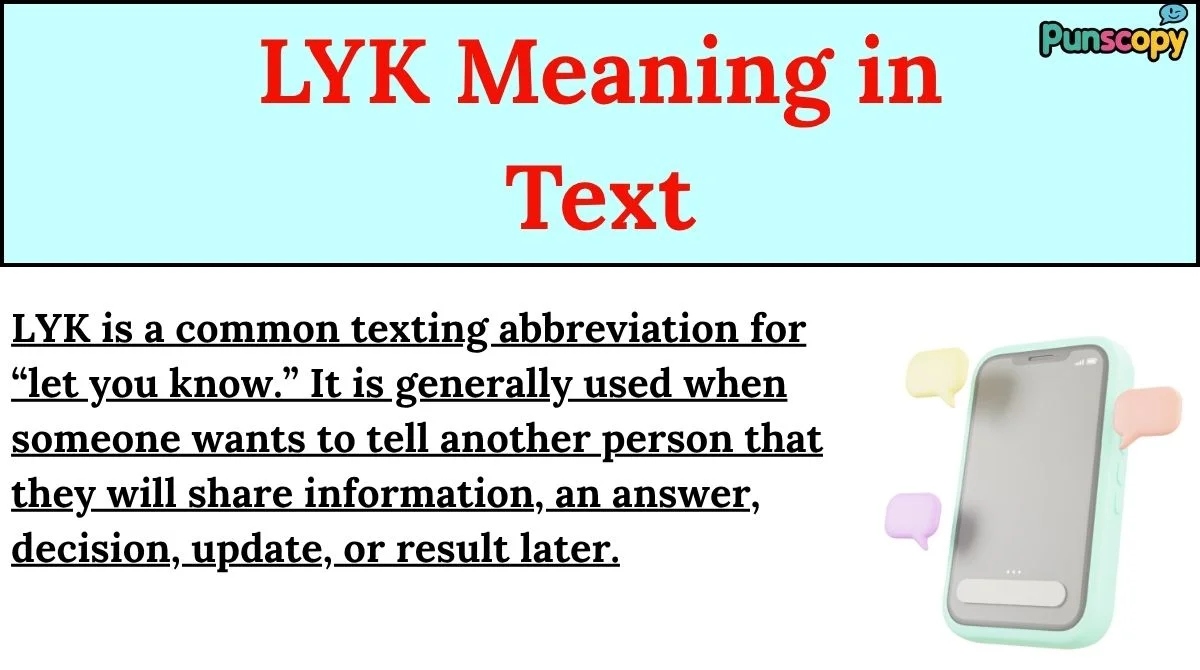
If you have seen “LYK” in a text message, comment, or social media conversation, you may wonder what the person is trying to say. The LYK meaning in text is usually “let you know.”
It is a shortened form people use when they want to say that they will provide information or give someone an update later.
For example, someone might text, “I’ll LYK when I get there.” This simply means, “I’ll let you know when I get there.”
LYK is popular because texting and social media often favor short, quick expressions. Instead of typing three separate words, people can use three letters and still communicate the same idea.
It is especially common in casual conversations between friends, family members, coworkers, and people who are getting to know each other.
Understanding the context is important because abbreviations can sometimes have different meanings. However, in everyday texting, LYK most commonly means “let you know.”
Meaning & Definition of LYK
LYK is a common texting abbreviation for “let you know.” It is generally used when someone wants to tell another person that they will share information, an answer, decision, update, or result later.
The phrase is based on the normal expression “let you know.” By removing the vowels and shortening the words, users can type the message much faster.
For example:
- “I’ll LYK tomorrow.”
- “Let me check and LYK.”
- “I don’t know yet, but I’ll LYK.”
- “I’ll LYK when I find out.”
- “Can you LYK if you’re coming?”
In each example, LYK communicates the idea of giving someone information later.
The abbreviation does not usually express a strong emotion by itself. Its meaning depends heavily on the surrounding sentence. Someone may use it while making plans, answering a question, discussing work, or talking casually with a friend.
For instance, if someone asks, “Are you free tonight?” and the reply is “I’ll LYK,” the person is saying they need to check first and will provide an answer later.
LYK can also make a conversation feel informal and relaxed. It is generally more appropriate for messages, social media conversations, and casual online communication than formal documents.
The abbreviation is also flexible. It can appear at the beginning or end of a sentence:
- “LYK when you arrive.”
- “I’ll check and LYK.”
Although “let you know” is the standard interpretation, the exact tone can range from friendly to neutral depending on the conversation.
Background of LYK
LYK developed from the broader habit of shortening everyday expressions in digital communication. As texting, instant messaging, and online chatting became popular, users began creating abbreviations that made conversations faster and easier.
People already used shortened expressions such as LOL, BRB, BTW, IDK, and TTYL. LYK fits naturally into this style because “let you know” is a phrase that frequently appears in everyday conversations.
The abbreviation is particularly useful when someone does not have an immediate answer. Instead of writing, “I don’t know yet, but I will let you know once I find out,” a person can simply write, “I’ll LYK.”
This makes the expression practical for quick communication.
Unlike some slang terms that are strongly connected with a particular generation or platform, LYK is relatively straightforward. Its meaning comes directly from the words it represents, making it easy to understand once you know the abbreviation.
Digital communication has also encouraged people to use lowercase forms. Therefore, you may see LYK, lyk, or sometimes Lyk. In most casual situations, capitalization does not change the meaning.
The abbreviation can be found in conversations about plans, appointments, relationships, school, work, shopping, travel, and many other everyday topics.
For example:
Person A: “Do you know what time the meeting starts?”
Person B: “Not yet. I’ll LYK.”
Here, LYK simply means that Person B will provide the information once they have it.
The background of LYK is therefore less about a specific invention and more about the evolution of convenient digital language. It represents how ordinary phrases become shorter as people adapt communication to fast-moving online environments.
LYK Usage in Different Contexts
The meaning of LYK generally stays the same across different contexts, but its purpose can change slightly depending on the conversation.
In casual chat
Friends may use LYK when discussing plans.
“I’ll LYK if I can come tonight.”
This means the person has not decided yet and will provide an update later.
On social media
People may use LYK in comments or direct messages.
“I’ll LYK when I post the details.”
Here, the abbreviation tells someone to expect more information later.
In group conversations
LYK can be useful when someone needs to confirm information before responding.
“Let me ask him and LYK.”
The person is saying they will return with an answer.
In professional communication
LYK can occasionally appear in informal workplace chats, especially when coworkers already communicate casually.
For example:
“I’ll LYK once the client confirms.”
However, it is usually better to write “I’ll let you know” in formal emails, official reports, applications, and other professional documents.
In personal relationships
Someone may say:
“I’ll LYK when I’m home.”
This is a simple way of promising an update.
Therefore, LYK is not limited to one type of conversation. Its central idea remains the same: the speaker will provide information later.
LYK Meaning in Chat, WhatsApp, Instagram, and TikTok
On messaging and social media platforms, LYK is usually understood as “let you know.”
LYK in chat
In ordinary chat, LYK is often used when someone does not have an immediate answer.
“I need to check my schedule. I’ll LYK.”
The message means the person will respond after checking.
LYK on WhatsApp
WhatsApp conversations are often informal, so abbreviations such as LYK can fit naturally.
“I’ll LYK when I reach home.”
This means, “I’ll let you know when I reach home.”
LYK on Instagram
On Instagram, you might see LYK in direct messages, comments, or conversations about plans.
“I’ll LYK after I talk to her.”
Again, it indicates a future update.
LYK on TikTok
TikTok users may use abbreviations in comments and direct messages because short online language is common on the platform.
For example:
“If I find the original video, I’ll LYK.”
The person is promising to provide information later.
The abbreviation can also appear in lowercase:
“i’ll lyk later”
There is normally no meaningful difference between LYK and lyk. Capitalization is generally a matter of personal typing style.
One important point is that LYK should not automatically be interpreted as romantic, rude, or emotional. Its meaning is usually neutral. The surrounding words and relationship between the people determine the tone.
LYK Meaning in Physics, Medical, and Aircraft Terminology
When researching an abbreviation, it is easy to assume that the same letters must have the same meaning everywhere. That is not necessarily true.
In everyday texting, LYK commonly means “let you know.” However, specialized fields can use abbreviations independently.
Physics
LYK is not a standard, universally recognized physics abbreviation that carries the same everyday meaning. If you encounter these letters in a physics textbook, research paper, laboratory document, or technical discussion, the surrounding material should be examined carefully.
Medical terminology
Medical professionals use many abbreviations, but LYK is not generally recognized as a universal medical abbreviation meaning “let you know.” Medical abbreviations can vary between institutions and specialties, so an unfamiliar abbreviation should not be interpreted automatically.
Aircraft and aviation
Aviation uses standardized codes, abbreviations, identifiers, and terminology. A three-letter combination may have a technical meaning depending on the system in which it appears. Therefore, LYK in an aviation document should be interpreted from its specific context rather than assuming it means “let you know.”
This distinction is important because texting slang and professional terminology are different language systems.
If you see LYK in a casual message such as “I’ll LYK tonight,” the intended meaning is almost certainly “I’ll let you know tonight.” If you see it in a technical document, however, investigate the relevant terminology before making an assumption.
Common Misconceptions About LYK
Several misunderstandings can happen when people encounter LYK for the first time.
Misconception 1: LYK is always romantic
It is not. LYK is normally a neutral abbreviation. Friends, relatives, coworkers, classmates, and romantic partners can all use it.
Misconception 2: LYK means “like”
Because LYK visually resembles the beginning of “like,” some people may initially confuse it with that word. In texting slang, however, LYK usually means “let you know.”
Misconception 3: LYK is rude
Using an abbreviation does not automatically make a message rude. Tone depends on the complete sentence.
“I’ll LYK later 😊” may sound friendly, while “I’ll LYK” may sound more direct or neutral.
Misconception 4: Only young people use LYK
Digital abbreviations are not restricted to one age group. Anyone familiar with informal online communication may use them.
Misconception 5: Capitalization changes the meaning
LYK, Lyk, and lyk generally have the same meaning in casual messaging.
Misconception 6: LYK always means an immediate response
Not necessarily. It usually suggests that the speaker will provide information later, after they know something or make a decision.
Understanding these points makes it easier to interpret LYK naturally rather than assigning an unnecessary hidden meaning to a simple abbreviation.
Similar Terms and Alternatives to LYK
Several expressions can communicate an idea similar to LYK.
LMK — Let Me Know
LMK is one of the closest related abbreviations.
- LMK: Let me know.
- LYK: Let you know.
The difference is the direction of the request.
“LMK when you arrive.”
The speaker is asking the other person to provide an update.
“I’ll LYK when I arrive.”
The speaker is promising to provide an update.
IDK — I Don’t Know
IDK is different because it directly expresses uncertainty.
“IDK yet. I’ll LYK later.”
Here, both abbreviations can appear naturally in the same message.
TTYL — Talk to You Later
TTYL means the conversation will continue at another time. It does not specifically mean that someone will provide information.
BTW — By the Way
BTW introduces additional information, while LYK generally promises future information.
FYI — For Your Information
FYI is used to give information that someone may need to know. LYK, in contrast, usually indicates that information will be provided later.
These distinctions are useful because several texting abbreviations may appear similar while serving different purposes.
How to Respond to LYK
How you respond depends on what the person is saying.
If someone writes:
“I’ll LYK when I know.”
You could simply reply:
- “Sure.”
- “Okay, thanks!”
- “Sounds good.”
- “No problem.”
- “Alright, let me know.”
If the conversation is friendly, you can make the response warmer:
“Sure 😊 Just let me know when you find out.”
If someone says:
“I’ll LYK if I can make it.”
A natural response might be:
“No worries. Just keep me posted.”
If you need the answer quickly, you can politely communicate that:
“Sure, just let me know as soon as you can.”
There is no special response required for LYK. Since it usually means “let you know,” the natural response is simply to acknowledge the promise or wait for the information.
In professional messaging, you may respond more formally:
“Thanks. Please let me know once you have confirmation.”
The important thing is to consider the complete message rather than focusing only on the abbreviation.
Differences Between LYK and Similar Words
LYK can be confused with several short expressions, but their meanings are different.
| Term | Meaning | Main Purpose |
|---|---|---|
| LYK | Let you know | Promise to provide information |
| LMK | Let me know | Ask someone for information |
| IDK | I don’t know | Express uncertainty |
| TTYL | Talk to you later | End or pause a conversation |
| FYI | For your information | Provide information |
| BTW | By the way | Introduce additional information |
| IKR | I know, right? | Agree with someone |
Consider these examples:
“I’ll LYK tomorrow.”
The speaker will provide an update.
“LMK tomorrow.”
The speaker wants the other person to provide an update.
“IDK tomorrow’s schedule.”
The speaker does not know the schedule.
These subtle differences are important when reading fast-moving conversations. A single letter can change who is expected to provide information.
LYK in Online Conversations and Dating Apps
LYK can appear naturally in dating conversations, but it does not automatically carry romantic meaning.
For example:
“I’ll LYK when I’m free this weekend.”
This could simply mean that the person will check their schedule before making plans.
In dating apps, context matters even more because people often communicate with short messages.
Someone might say:
“I’ll LYK if I can meet Saturday.”
This indicates uncertainty about their availability. It is better not to interpret the message as a definite yes or no.
Likewise:
“I’ll LYK when I get home.”
Usually means the person intends to send an update after arriving home.
If someone repeatedly says they will LYK but never follows up, the issue is not the abbreviation itself. Their behavior and communication pattern provide more information than the slang.
When replying on a dating app, keep your response natural:
“Sounds good! Just let me know.”
Or:
“Sure, no rush 😊”
LYK can therefore be part of casual, friendly, or romantic conversations. The abbreviation itself does not determine the relationship or emotional tone.
FAQs
1. What does LYK mean in text?
LYK usually means “let you know.” It is commonly used when someone promises to provide information or an update later.
2. What does LYK mean on WhatsApp?
On WhatsApp, LYK generally means “let you know.” For example, “I’ll LYK when I arrive” means “I’ll let you know when I arrive.”
3. Is LYK a slang word?
LYK is better described as a texting abbreviation. It comes from the phrase “let you know” and is commonly used in informal digital communication.
4. What is the difference between LYK and LMK?
LYK means “let you know,” while LMK means “let me know.” LYK usually promises information, while LMK asks someone else to provide information.
5. Does LYK have a romantic meaning?
Not by itself. LYK is normally neutral and can be used by friends, coworkers, family members, or romantic partners.
6. Can LYK mean something different?
It can have other meanings in specialized contexts, but in everyday texting, “let you know” is the most common interpretation.
7. Is LYK rude?
No. LYK is not inherently rude. The tone depends on the full message and the relationship between the people communicating.
Conclusion
The LYK meaning in text is most commonly “let you know.” It is a simple abbreviation used in texting, messaging apps, social media, and other informal online conversations.
People generally use it when they want to promise an update, provide information later, or tell someone that they will respond after checking something.
Understanding LYK becomes especially easy when you look at the words around it. Whether someone says, “I’ll LYK later,” “I’ll LYK tomorrow,” or “Let me check and LYK,” the basic idea remains the same.
It is also useful to distinguish LYK from related abbreviations such as LMK, IDK, TTYL, and FYI. Although these expressions may appear together in digital conversations, each has its own purpose.
In short, when you see LYK in an ordinary text or social media message, the safest interpretation is “let you know.”

Joseph Roy crafts witty puns and punchlines that brighten your day. His playful twist on language keeps readers laughing and thinking.