The internet has created a world where people often communicate through short forms, acronyms, and slang. One abbreviation that can be confusing is PMO.
If you have seen PMO in a text message, social media comment, or online conversation, you may wonder what the sender actually means.
The PMO meaning in text can change depending on the situation. In casual conversations, it is commonly used to mean “pisses me off” or “put me on.” These meanings are very different, so the surrounding words are important for understanding the intended message.
People also search for PMO because the abbreviation can appear in professional, technical, medical, and other specialized contexts. In those areas, it may have completely unrelated meanings.
This guide explains the different uses of PMO, how to understand it from context, and how to respond naturally when someone sends it to you.
Meaning & Definition
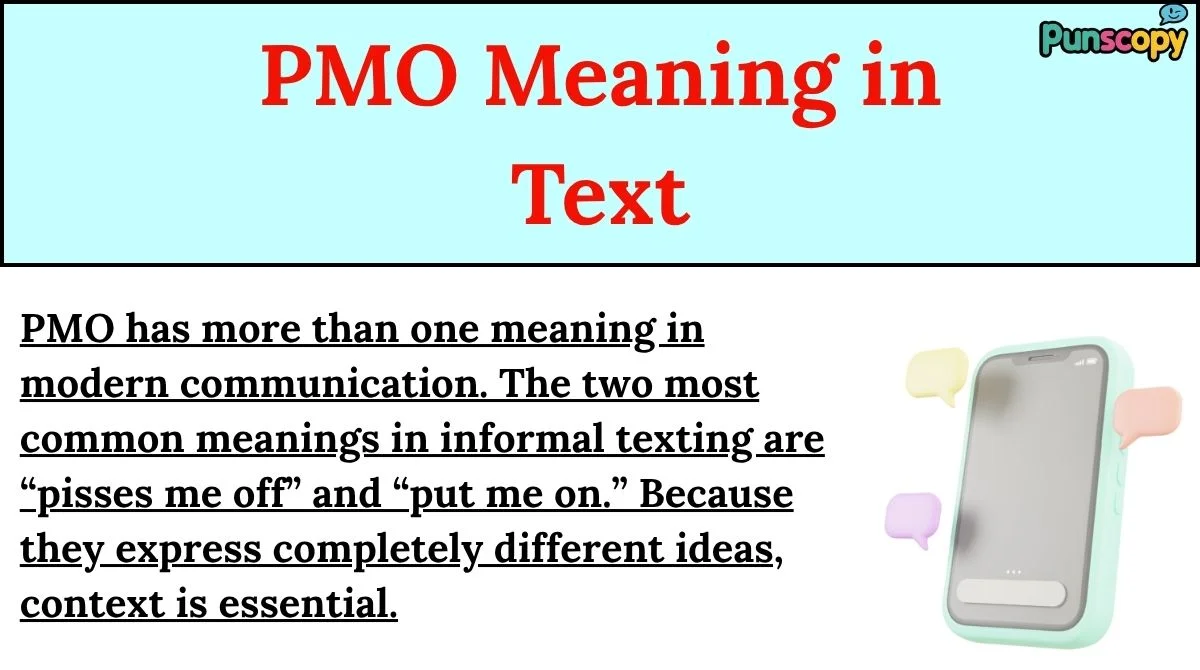
PMO has more than one meaning in modern communication. The two most common meanings in informal texting are “pisses me off” and “put me on.” Because they express completely different ideas, context is essential.
When someone uses PMO to mean “pisses me off,” they are expressing annoyance, frustration, or anger.
For example:
- “That constant noise PMO.”
- “It really PMO when people cancel at the last minute.”
- “His attitude PMO so much.”
In these examples, PMO describes something that irritates the speaker.
Another common meaning is “put me on.” This can mean asking someone to introduce, recommend, connect, or inform them about something.
For example:
- “PMO to a good restaurant.”
- “Can you PMO to that playlist?”
- “PMO to your favorite shoes.”
Here, the person is essentially asking for a recommendation, introduction, or information.
The meaning may also depend on capitalization and the platform where it appears. Some users write abbreviations in uppercase, while others use lowercase forms such as “pmo.”
The safest approach is to examine the complete sentence. If the message describes something irritating, PMO probably means “pisses me off.” If someone is asking for access, information, or a recommendation, it may mean “put me on.”
Background
The use of abbreviations in digital communication developed largely because people wanted faster and shorter ways to express ideas. Text messaging, online forums, gaming communities, and social media all contributed to the growth of internet slang.
PMO fits naturally into this culture because three letters can communicate an idea that would otherwise require several words. As social platforms became more popular, users began developing their own informal vocabulary. Many abbreviations moved from private conversations into comments, captions, direct messages, and public posts.
One reason PMO can be confusing is that it does not have one universally accepted definition. Internet slang often develops organically rather than through an official dictionary or organization. Different communities can therefore assign different meanings to the same abbreviation.
The phrase “pisses me off” is especially common in casual conversations where someone wants to express frustration quickly. It is generally informal and can sound stronger than simply saying “annoys me.”
Meanwhile, “put me on” is often associated with recommendations or introductions. A person may use it when asking a friend to tell them about a song, clothing brand, restaurant, artist, product, or trend.
Over time, these uses have become recognizable to many internet users. However, PMO should still be interpreted according to context rather than automatically assigned one definition.
This is an important feature of internet slang: the same three letters can mean different things to different people.
Usage in Different Contexts: Chat, Social Media, and Professional Fields
PMO is primarily associated with informal communication, but its interpretation changes considerably depending on where it appears.
In casual chat
Friends may use PMO to express frustration or request recommendations. For example, “That situation PMO” suggests irritation, while “PMO to some good music” suggests a request for recommendations.
On social media
PMO can appear in comments, captions, replies, and direct messages. Social media users often shorten phrases to make their communication quicker and more conversational.
A person might comment:
“PMO to this creator.”
In this context, the likely meaning is “put me on to this creator,” meaning they want to discover or learn more about the creator.
Alternatively:
“People who do that PMO.”
Here, the abbreviation likely expresses frustration.
In professional settings
PMO can mean something completely different. In business, PMO commonly refers to a Project Management Office. This is a department, team, or organizational function that helps establish and maintain project-management processes.
Therefore, a workplace message such as “Please send this to the PMO” should not automatically be interpreted as internet slang.
The same principle applies to technical industries. Acronyms often have specialized meanings that are unrelated to texting slang.
Context is the key. A three-letter abbreviation appearing in a friend’s Instagram DM should be interpreted differently from PMO appearing in a corporate project document.
PMO Meaning in Chat, WhatsApp, Instagram, and TikTok
The meaning of PMO can shift slightly depending on the platform, but the basic slang interpretations remain similar.
PMO in chat
In ordinary text conversations, PMO can mean “pisses me off” when someone is complaining.
Example:
“Waiting two hours PMO.”
It can also mean “put me on” when someone wants a recommendation.
“PMO to some good movies.”
PMO on WhatsApp
WhatsApp conversations are usually personal and informal, so PMO can be used casually between friends.
For example:
“That traffic PMO today.”
The intended meaning is likely frustration.
PMO on Instagram
Instagram users may use PMO when asking someone about a creator, outfit, product, song, or trend.
For example:
“PMO to that jacket.”
This can mean “show me where I can find that jacket” or “introduce me to that style.”
PMO on TikTok
TikTok slang changes quickly because trends spread rapidly. PMO may appear in comments when users ask someone to introduce them to new content or express annoyance.
For example:
“PMO to more videos like this.”
Here, the person is asking for recommendations or similar content.
The important point is that PMO does not have one platform-specific definition. Instead, users rely on sentence structure and conversation context to communicate the intended meaning.
PMO Meaning in Physics, Medical, and Aircraft Terminology
PMO can also appear outside internet slang. In specialized fields, abbreviations frequently have meanings that have nothing to do with texting.
Physics
There is no single universal physics definition of PMO that applies across every textbook or research area. Specialized papers, laboratories, and technical systems may use PMO as an abbreviation for a particular concept, model, process, or organization.
Therefore, the surrounding material should always be checked before interpreting the acronym.
Medical terminology
In healthcare, PMO can also represent different phrases depending on the specialty, institution, or medical document. Medical abbreviations are particularly context-dependent.
A person reading a medical record should not assume that PMO means “pisses me off” or “put me on.” The surrounding medical terminology and the document’s context determine the intended meaning.
Aircraft and aviation
Aviation uses a large number of abbreviations for airports, procedures, organizations, equipment, and operational terms. PMO may therefore appear as a technical abbreviation rather than internet slang.
For example, an aviation document, flight-management system, or industry database may use an acronym differently from a social media conversation.
This distinction is important because online slang and professional acronyms are separate language systems. If PMO appears in a technical document, its specialized definition should be verified rather than inferred from social media usage.
Common Misconceptions About PMO
One of the biggest misconceptions is that PMO always means “pisses me off.” That is not necessarily true.
If someone writes:
“PMO to that song.”
They probably are not saying the song makes them angry. They may be asking someone to “put me on” to the song.
Another misconception is that every abbreviation has one fixed meaning. Internet slang does not work that way. Words and acronyms can develop different meanings among different communities.
People may also assume that PMO is always rude because one of its common meanings contains profanity. However, “put me on” is generally harmless and conversational.
Another mistake is interpreting an acronym without reading the surrounding sentence. For example:
- “That behavior PMO” → likely frustration.
- “PMO to some good restaurants” → likely a request for recommendations.
- “Send this to the PMO” → likely a professional organizational reference.
These examples demonstrate why context matters.
It is also worth remembering that slang changes over time. A meaning that is popular in one online community may be less common somewhere else.
When uncertain, look at the words before and after PMO, consider the platform, and think about the relationship between the people communicating.
Similar Terms & Alternatives
PMO has several expressions that can communicate similar ideas, depending on which definition is intended.
When PMO means “pisses me off,” alternatives include:
- Annoys me
- Irritates me
- Frustrates me
- Makes me angry
- Gets on my nerves
- Bothers me
For example:
“That really PMO.”
could be rewritten as:
“That really annoys me.”
When PMO means “put me on,” possible alternatives include:
- Recommend something
- Tell me about it
- Show me
- Introduce me
- Give me a recommendation
- Let me know where to find it
For example:
“PMO to some good music.”
could become:
“Recommend some good music to me.”
The slang version is shorter and more casual, while the alternatives are often clearer for people who are unfamiliar with internet abbreviations.
In professional environments, PMO may refer to Project Management Office, which has entirely different alternatives such as project-management team, project office, or project governance function, depending on the organization.
How to Respond to PMO
Your response should depend on what the sender intended.
If PMO means “pisses me off,” you can respond with empathy or ask what happened.
For example:
- “What happened?”
- “Yeah, I can see why that annoyed you.”
- “That sounds frustrating.”
- “Seriously? What did they do?”
If PMO means “put me on,” respond by providing the requested recommendation or information.
For example:
- “Sure, check out this playlist.”
- “Yeah, I’ll send you the link.”
- “You should try this one.”
- “I got you!”
If you’re unsure which meaning they intended, simply ask:
“What do you mean by PMO?”
There is nothing awkward about asking. Abbreviations can be confusing, especially when someone uses slang you have not encountered before.
In a professional setting, you should use the formal meaning that fits the workplace context. If a colleague mentions the PMO in a project discussion, they are likely referring to the Project Management Office rather than internet slang.
Differences From Similar Words
PMO can be confused with several other abbreviations because online language frequently uses short combinations of letters.
For example, IMO commonly means “in my opinion,” while IMHO means “in my humble opinion.” Neither has the same meaning as PMO.
Similarly, OMG usually expresses surprise, excitement, or shock, whereas PMO can express frustration or request a recommendation.
The difference between PMO and “put me on” is particularly interesting because the phrase itself can be used without the abbreviation. Someone might say:
“Put me on to some good music.”
The abbreviated form can become:
“PMO to some good music.”
On the other hand, “pisses me off” expresses an emotional reaction. It tells the reader that something has caused irritation.
The easiest way to distinguish the meanings is to ask what role PMO plays in the sentence:
- Complaint or negative reaction → likely “pisses me off.”
- Request for recommendation or introduction → likely “put me on.”
- Business/project discussion → possibly “Project Management Office.”
- Technical document → investigate the specialized definition.
This approach is more reliable than memorizing a single definition.
Relevance in Online Conversations & Dating Apps
PMO can occasionally appear in dating-app messages, especially when people communicate casually and use internet slang.
If someone says:
“PMO to your favorite date spot.”
they may be asking you to recommend a place.
If someone says:
“People who ghost PMO.”
they are probably expressing frustration about people who disappear from conversations.
On dating apps, tone matters more than ever because messages are short and lack facial expressions or voice cues. An abbreviation can therefore be interpreted incorrectly.
Someone unfamiliar with PMO may misunderstand a casual message as aggressive when the sender intended something completely different. For example, “PMO to some good restaurants” is likely a friendly request, while “That behavior PMO” is an expression of annoyance.
If you’re using PMO while talking to someone new, clarity is usually better than relying heavily on slang. Established friends may immediately understand your abbreviations, but a new dating connection may not.
When receiving PMO on a dating app, consider the entire conversation before interpreting it. If the person was discussing music, fashion, restaurants, or entertainment, “put me on” may make sense. If they were complaining about something, “pisses me off” is more likely.
FAQs
What does PMO mean in text?
In informal texting, PMO commonly means “pisses me off” or “put me on.” The correct meaning depends on the sentence and conversation.
What does PMO mean on Instagram?
On Instagram, PMO can mean “put me on,” especially when someone asks for recommendations. It can also mean “pisses me off” when someone is expressing frustration.
What does PMO mean on TikTok?
On TikTok, PMO is often used informally to mean “put me on” when asking for recommendations or discovering content. It can also express annoyance.
Is PMO a bad word?
Not necessarily. One common interpretation, “pisses me off,” contains profanity, but another common meaning, “put me on,” is casual and generally harmless.
What does PMO mean in business?
In business, PMO commonly means Project Management Office. It refers to a function or team that supports project-management processes, standards, and coordination.
How do I know which PMO meaning someone intends?
Look at the surrounding sentence. A complaint usually points toward “pisses me off,” while a request for recommendations often indicates “put me on.”
Can PMO mean different things?
Yes. PMO can have multiple meanings in slang, business, and technical contexts. Context is essential for identifying the intended definition.
Conclusion
Understanding the PMO meaning in text is mainly about reading the context. In casual online conversations, the abbreviation most commonly represents “pisses me off” or “put me on.”
One expresses frustration, while the other is generally used when someone wants a recommendation, introduction, or information.
The same abbreviation can also appear in professional and technical environments with completely different meanings, including Project Management Office in business. That is why assuming one definition every time can lead to confusion.
Whether you encounter PMO in a WhatsApp message, Instagram comment, TikTok conversation, dating app, or workplace document, pay attention to the words around it.
Once you understand the context, the intended meaning is usually much easier to recognize.

Joseph Roy crafts witty puns and punchlines that brighten your day. His playful twist on language keeps readers laughing and thinking.