Have you ever received a message saying “DND” and wondered what the person meant? The DND meaning in text is usually “Do Not Disturb.”
People commonly use this short form when they do not want to receive messages, calls, notifications, or interruptions for a while.
You may see DND in text messages, group chats, WhatsApp conversations, Instagram messages, TikTok comments, or even dating apps.
Its meaning is normally easy to understand from the situation, but the abbreviation can sometimes have other meanings.
For example, someone may write “I’m on DND” to explain that they are unavailable. A person might also say “DND, please” when they want some quiet time.
Because abbreviations change meaning depending on context, many people search for DND before replying. Understanding the situation around the word can help you choose the right response and avoid misunderstandings.
Meaning & Definition
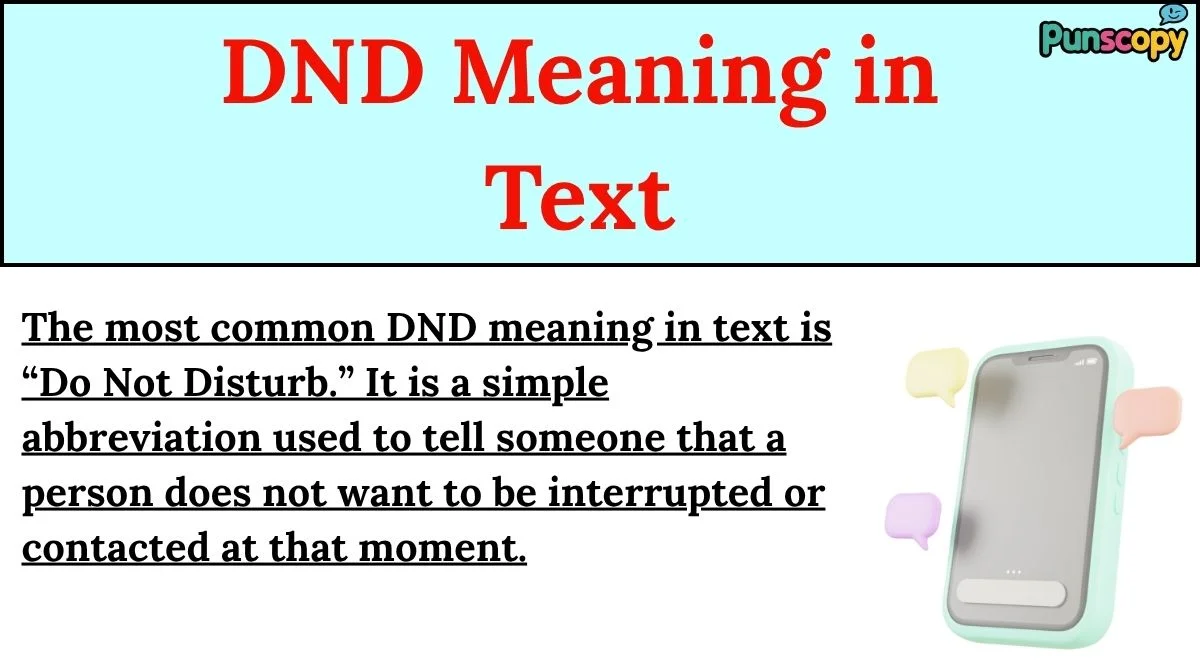
The most common DND meaning in text is “Do Not Disturb.” It is a simple abbreviation used to tell someone that a person does not want to be interrupted or contacted at that moment.
The phrase is closely connected to the Do Not Disturb feature found on smartphones, tablets, computers, and other devices. When someone turns this feature on, notifications and calls may be silenced or limited.
In everyday texting, however, DND can be used even when the person has not activated a phone setting.
For example:
- “I’m studying, DND.”
- “Going to sleep. DND.”
- “DND for the next two hours.”
- “Sorry, I was on DND.”
- “Please respect my DND time.”
In these examples, the person is communicating that they want fewer interruptions.
DND can also describe a temporary state. Someone may use it because they are working, sleeping, studying, traveling, relaxing, attending a meeting, or simply taking a break from communication.
The tone depends on how it is written. “DND pls” may sound casual, while “DND right now” can sound more direct. If someone says “I’m on DND,” they are usually explaining why they did not answer.
There is another important possibility. In some conversations, DND may refer to Dungeons & Dragons, the popular tabletop role-playing game. In that situation, words such as “campaign,” “character,” “DM,” “dice,” or “party” can reveal the intended meaning.
Therefore, context matters. In ordinary texting, Do Not Disturb is the safest interpretation. In gaming conversations, DND may refer to Dungeons & Dragons instead.
Background
The idea behind DND comes from the simple phrase “Do Not Disturb.” Before smartphones became common, the phrase was already used on signs, doors, hotel rooms, offices, and other places where someone wanted privacy.
Modern technology turned the phrase into a digital feature. Smartphones introduced settings that allow users to reduce interruptions from calls, texts, alerts, and applications. Instead of writing the entire phrase, people often refer to the setting simply as DND.
Texting culture helped make the abbreviation even more convenient. People naturally shorten common expressions to save time and make conversations faster. Similar examples include “BRB” for “be right back,” “AFK” for “away from keyboard,” and “IDK” for “I don’t know.”
DND fits naturally into this style of communication.
Someone does not need to explain a long reason for being unavailable. A quick message such as “DND right now” can communicate the basic idea immediately.
The abbreviation can also be used socially. A person may put “DND” in a status, profile description, story, or group message to signal that they are taking a break from communication.
The growth of social media has expanded the use of short expressions. People now communicate across several platforms, and abbreviations make it easier to express simple ideas quickly.
However, DND is not limited to digital communication. The phrase behind the abbreviation still has a broader meaning: a request for privacy or uninterrupted time.
It is also important to remember that DND is not a completely universal abbreviation. In gaming communities, DND can refer to Dungeons & Dragons. In specialized organizations and professional environments, the same letters may represent different terms.
So, the safest approach is to look at the surrounding conversation before deciding what DND means.
Usage in Different Contexts: Chat, Social Media, and Professional Fields
DND appears in many communication environments, but its tone can change depending on where it is used.
In casual chat
Friends may use DND when they are busy or unavailable.
Example:
“DND for a bit. I’ll text you later.”
Here, the message simply means the person wants uninterrupted time.
On social media
DND may appear in a profile, status, story, or caption. Someone might post:
“DND — taking some time offline.”
This tells followers that the person may not respond quickly.
In group chats
A group member might write:
“Guys, DND. I have an exam tomorrow.”
This usually means they do not want notifications or messages distracting them.
In professional communication
The abbreviation can be understood in workplace conversations, especially when discussing phones or communication settings. However, using “Do Not Disturb” instead of DND is often clearer in formal emails or business documents.
For example:
Casual: “I’m on DND during the meeting.”
Professional: “I’ll have notifications turned off during the meeting.”
The surrounding language helps determine whether DND sounds appropriate.
In gaming
DND can have an entirely different meaning. In a gaming discussion, DND may refer to Dungeons & Dragons.
For example:
“Are you playing DND tonight?”
Here, the person is almost certainly talking about the tabletop role-playing game rather than phone notifications.
Context is therefore essential. A conversation about smartphones, sleep, work, or privacy points toward Do Not Disturb. A conversation about fantasy characters, dice, campaigns, or tabletop games points toward Dungeons & Dragons.
DND Meaning in Chat, WhatsApp, Instagram, and TikTok
The abbreviation is particularly common in digital conversations because people often need a quick way to explain that they are unavailable.
DND in chat
In ordinary chat, DND usually means Do Not Disturb.
“I’m on DND rn.”
This means the person is currently avoiding interruptions or notifications.
DND on WhatsApp
WhatsApp users may use DND informally to explain why they are not responding.
“Sorry, I had DND on.”
The person may mean they had notifications silenced or simply did not want to chat.
DND on Instagram
On Instagram, someone might use DND in a story or direct message.
“DND tonight. Taking a break from IG.”
It communicates that the person may not reply to messages or interact with the app.
DND on TikTok
TikTok users may use the abbreviation in captions, comments, profiles, or private messages.
“DND, I’m studying 😭.”
The meaning remains essentially the same: the person wants to avoid interruptions.
Why people use DND
The abbreviation is useful because it is:
- Short
- Easy to understand
- Quick to type
- Familiar to many smartphone users
- Suitable for casual communication
- Useful for explaining delayed replies
The tone can be friendly, neutral, or firm.
“DND 😂 I need sleep” sounds playful.
“DND. Please don’t call.” sounds more serious.
“I’m on DND, talk tomorrow.” sounds like a simple boundary.
If someone sends you DND, you generally do not need to take it personally. They may simply be busy, resting, studying, working, or taking time away from their phone.
DND Meaning in Physics, Medical, and Aircraft Terminology
The abbreviation DND can have specialized meanings outside texting. This is why context is especially important when you see it in technical or professional material.
DND in physics
DND is not one universally accepted standard abbreviation in physics with a single meaning comparable to well-established symbols such as c, h, or E. In a particular textbook, research paper, laboratory, or institution, the letters may be defined for a specific concept.
Because technical abbreviations can be field-specific, you should check the definitions or notation section of the material before assigning a meaning.
DND in medical settings
Medical organizations and documents can also use DND as an abbreviation for different terms. The exact interpretation depends on the hospital, department, document, or medical specialty.
For that reason, assuming that DND means Do Not Disturb in a medical document could be incorrect.
In healthcare, clarity is important because abbreviations can create misunderstandings. A medical professional may use a locally defined abbreviation that has little connection to texting.
DND in aircraft or aviation terminology
Aviation also uses many standardized abbreviations, codes, and identifiers. DND may appear as a location or airport-related code in some aviation contexts, rather than functioning as a texting abbreviation.
For example, DND is associated with Dundee Airport in Scotland as its IATA airport code.
This demonstrates why context matters. If DND appears in a message such as “DND until 8 PM,” it probably relates to communication. If it appears in an itinerary, aviation database, or flight information, it may have a completely different purpose.
The key lesson is simple: technical DND meanings should never automatically be interpreted as “Do Not Disturb.” Look at the surrounding subject, terminology, and source before deciding what the abbreviation represents.
Common Misconceptions About DND
One common misconception is that DND always means “Do Not Disturb.” This is true in ordinary texting, but not in every situation.
For example, gaming communities may use DND to mean Dungeons & Dragons. A person discussing characters, campaigns, monsters, or dice is probably using the abbreviation in this sense.
Another misconception is that DND always means someone is angry. It does not.
If someone says:
“I’m on DND for the next few hours,”
they may simply want uninterrupted time. It does not automatically mean they are upset with you.
Some people also believe DND means that a person cannot receive any messages at all. That is not necessarily true. Modern device settings can be customized. Depending on the device and settings, certain contacts, calls, or alerts may still come through.
Another misunderstanding involves delayed replies. If someone does not answer while they are on DND, it does not necessarily mean they are ignoring you intentionally.
DND can also be used as a personal boundary. Someone may turn off notifications while studying, sleeping, working, exercising, traveling, or spending time with family.
Finally, people sometimes confuse DND with AFK.
AFK generally means “away from keyboard” and is strongly associated with gaming or online activity. DND focuses more on avoiding interruptions or notifications.
Understanding these differences can prevent unnecessary assumptions. Instead of interpreting DND emotionally, consider the context and the person’s normal communication style.
Similar Terms & Alternatives
Several abbreviations and phrases can communicate an idea similar to DND, but they are not always identical.
Do Not Disturb
This is the full phrase represented by DND. It is the closest and most direct alternative.
AFK
AFK means “Away From Keyboard.” It generally tells people that someone is temporarily away from their device or activity.
BRB
BRB means “Be Right Back.” It suggests that the person expects to return soon.
Offline
Someone saying “I’m offline” usually means they are not actively using an online service. It does not necessarily mean notifications have been disabled.
Busy
Busy is broader. A person can be busy while still reading and answering messages.
Silent mode
Silent mode usually describes a phone setting that stops or reduces sound. It does not necessarily mean the person wants to avoid communication.
Taking a break
This is a more conversational alternative to DND. It may suggest that someone is stepping away from social media or communication.
Unavailable
“Unavailable” is more formal and can be used in professional environments.
The best interpretation depends on context.
If someone writes “DND tonight,” they likely want fewer interruptions.
If they write “AFK,” they may simply be away.
If they write “BRB,” they expect to return shortly.
If they write “offline for the weekend,” they may be intentionally disconnecting from online activity.
These small differences can make digital communication easier to understand.
How to Respond to DND
When someone tells you “DND,” the best response is usually respectful and simple. They are often communicating that they do not want interruptions.
You could reply:
- “Sure, talk later!”
- “No problem.”
- “Okay, take your time.”
- “Got it. Message me when you’re free.”
- “Sure, good luck with your work!”
- “No worries. I’ll talk to you later.”
If the person says “DND, I’m studying,” a supportive response could be:
“Of course. Good luck with studying!”
If someone says “I’m on DND. I need some rest,” you could say:
“Absolutely. Get some rest. Talk later.”
There is usually no need to keep sending messages after someone has requested DND. Respecting the request shows consideration.
In a romantic conversation, the response can be warm without being demanding.
For example:
“Okay ❤️ Take your time. I’ll be here when you’re free.”
If you are unsure whether DND refers to Do Not Disturb or Dungeons & Dragons, you can ask politely:
“Do you mean Do Not Disturb or Dungeons & Dragons?”
This is especially useful when the conversation could reasonably support either meaning.
The most important thing is not to interpret DND as an automatic rejection. Someone may simply need quiet time.
Differences Between DND and Similar Words
Although DND, busy, offline, AFK, and silent mode can appear similar, each communicates something slightly different.
| Term | Common Meaning | Main Idea |
|---|---|---|
| DND | Do Not Disturb | Avoid interruptions |
| AFK | Away From Keyboard | Temporarily away |
| BRB | Be Right Back | Returning soon |
| Busy | Occupied | Currently engaged |
| Offline | Not online | Not actively connected |
| Silent | Notifications muted | Reduced sounds |
| Unavailable | Cannot communicate | Not accessible |
The difference is mainly about intention.
Someone who is busy may still answer an important message.
Someone who is offline may not currently be using the internet.
Someone who is AFK may simply have stepped away from the device.
Someone using DND is specifically signaling that they do not want interruptions or notifications.
This distinction becomes useful in relationships and friendships. If someone says “I’m busy,” they may still be open to messages. If they say “DND,” it is usually better to wait.
Likewise, DND does not necessarily mean the person is completely unavailable. Modern phone settings can allow selected people or urgent calls to reach them.
Understanding these subtle differences makes digital conversations much easier. Instead of focusing only on the abbreviation, pay attention to the sentence around it and the circumstances in which it was sent.
Relevance in Online Conversations & Dating Apps
DND can have an interesting role in online relationships and dating conversations.
A person on a dating app may say:
“Going on DND for the night. I’ll reply tomorrow.”
This is usually a straightforward way of setting expectations. It tells the other person that a delayed reply should not automatically be interpreted as disinterest.
DND can also communicate healthy boundaries. People may want time away from notifications, conversations, and social media without ending a relationship or friendship.
In dating, however, context matters. If someone repeatedly uses DND without communicating afterward, the issue may not be the abbreviation itself. Their overall communication pattern is more meaningful than one status.
A single “DND, talk tomorrow ❤️” is very different from disappearing for days without explanation.
Someone may use DND because they are:
- Working
- Studying
- Sleeping
- Spending time with family
- Traveling
- Exercising
- Relaxing
- Taking a social media break
- Feeling overwhelmed by notifications
It is usually healthier to respect the stated boundary rather than immediately assume something negative.
If you are dating someone and they say “DND for a while,” a simple response is enough:
“No worries. Enjoy your time, and talk later!”
The same principle applies to friendships and online communities. Digital communication can create pressure to respond immediately, but DND gives people a way to create temporary space.
In this sense, the abbreviation is more than a technical phone setting. It can also represent a person’s desire for privacy, rest, concentration, or personal time.
FAQs
What does DND mean in text?
DND most commonly means “Do Not Disturb.” It usually tells someone that the person does not want interruptions, calls, or notifications at that time.
What does DND mean on WhatsApp?
On WhatsApp, DND generally means “Do Not Disturb.” Someone may use it to explain that they are not available or do not want to receive messages for a while.
What does DND mean on Instagram?
On Instagram, DND usually means “Do Not Disturb.” A person may use it in a story, profile, or DM to indicate that they are taking a break or do not want interruptions.
Does DND mean someone is ignoring you?
Not necessarily. DND usually means the person wants uninterrupted time. They may be sleeping, studying, working, or simply taking a break.
What does DND mean in dating?
In dating conversations, DND usually means “Do Not Disturb.” It can be a simple way to say that someone is temporarily unavailable and will respond later.
Can DND mean something other than Do Not Disturb?
Yes. In gaming conversations, DND can refer to Dungeons & Dragons. Specialized fields may also use the letters for other terms, so context is important.
What should I reply when someone says DND?
A simple response such as “No problem, talk later!” is usually appropriate. Respect their request for uninterrupted time.
Is DND the same as silent mode?
No. Silent mode mainly reduces or removes sounds from a device. DND is designed to manage interruptions and notifications more broadly.
What does “I’m on DND” mean?
It usually means the person has enabled or is informally observing a Do Not Disturb period and may not respond immediately.
Conclusion
The most common DND meaning in text is “Do Not Disturb.” It is a convenient abbreviation used when someone wants to avoid interruptions, reduce notifications, or explain why they may not respond immediately.
You can see DND in text messages, WhatsApp chats, Instagram DMs, TikTok conversations, group chats, and dating apps. Its meaning is usually simple, but context should always be considered because DND can represent different things in gaming and specialized fields.
If someone sends you DND, the best approach is to respect their space instead of assuming they are angry or ignoring you. A short response such as “No worries, talk later” is often enough.
Whether someone is studying, sleeping, working, relaxing, or simply taking a break, DND is often just a quick way to communicate a temporary boundary.

Joseph Roy crafts witty puns and punchlines that brighten your day. His playful twist on language keeps readers laughing and thinking.