Last updated on September 8th, 2026 at 04:10 pm
In today’s fast-paced digital world, communication is often condensed into abbreviations and single-letter responses.
One such commonly used shorthand is “k.” If you’ve ever received a text that simply says “k,” you may have paused, wondering if it signals agreement, annoyance, or something else entirely.
The simplicity of “k” belies its complex interpretations across different contexts.
People search for its meaning not just to decode casual texting but also to understand subtle social cues in online conversations, social media, and even professional messaging.
This article explores everything you need to know about the term, from its basic definition to its nuanced uses in chat apps, social media platforms, and even specialized fields like physics and aviation.
Understanding “k” can prevent miscommunication and help you respond appropriately in various scenarios.
Meaning & Definition of K
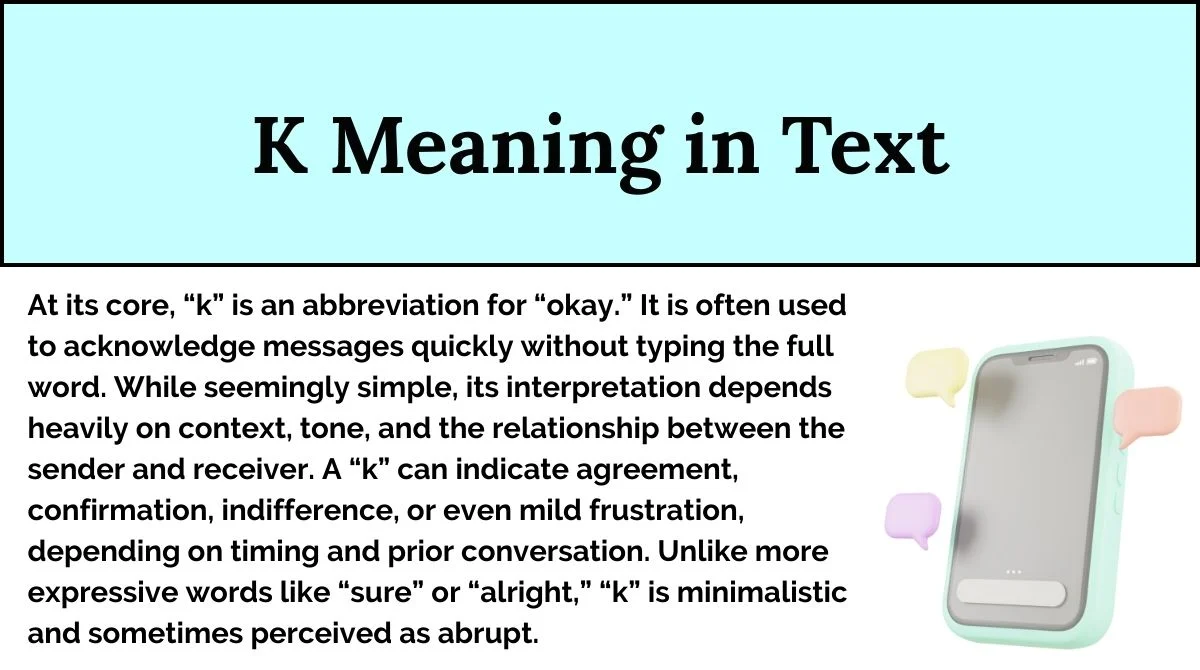
At its core, “k” is an abbreviation for “okay.” It is often used to acknowledge messages quickly without typing the full word. While seemingly simple, its interpretation depends heavily on context, tone, and the relationship between the sender and receiver. A “k” can indicate agreement, confirmation, indifference, or even mild frustration, depending on timing and prior conversation. Unlike more expressive words like “sure” or “alright,” “k” is minimalistic and sometimes perceived as abrupt.
In text messaging, the brevity of “k” reflects modern communication trends where efficiency often outweighs formality. Its popularity stems from mobile typing convenience, where sending a single character is faster than writing a complete response. However, its concise nature also leads to misunderstandings when tone is difficult to convey in text.
When Should You Use “K” in a Message?
“K” works best in quick, informal conversations where the meaning is already clear. It can be useful when acknowledging a simple request, confirming information, or ending a conversation naturally.
However, using only “K” may not always communicate warmth or enthusiasm. In sensitive conversations, dating situations, or professional communication, alternatives such as “Okay,” “Got it,” or “Sounds good” can make your response feel clearer and friendlier.
Choosing the right version depends on your relationship with the recipient and the tone you want to create. When in doubt, adding a few extra words can help prevent your message from sounding unintentionally harsh.
Why Does “K” Sometimes Sound Rude in Texting?
Although “K” simply means “okay,” receiving only one letter can sometimes make a message feel cold or dismissive. This is mainly because text messages do not include vocal tone, facial expressions, or body language.
For example, “K” after a disagreement may seem annoyed, while the same reply between close friends may be completely normal.
The sender’s usual texting habits also matter. Someone who regularly uses short replies may not intend any negativity. Before assuming that “K” means anger or disinterest, consider the conversation, timing, and relationship with the sender.
K Meaning in Text from a Girl
When a girl uses “K” in texting, it also means “Okay,” but the tone can carry different emotions depending on context. Sometimes it’s a simple acknowledgment, showing she understands or agrees. However, similar to guys, “k” can feel a bit cold or distant if used alone, especially in an ongoing conversation.
It might suggest she’s not very interested, slightly annoyed, or just wants to end the chat quickly. On the other hand, some girls use it casually without any negative intent.
The meaning really depends on her texting habits, mood, and the flow of the conversation. Paying attention to context helps you understand whether it’s neutral or carries a deeper tone.
Background of K
The usage of “k” dates back to early internet chat rooms and SMS messaging, where character limits encouraged short forms. Over time, “k” evolved from being a neutral acknowledgment to a term with social nuance. Linguists studying digital communication note that “k” reflects minimalist language trends, emphasizing speed and functionality over politeness.
Interestingly, its rise coincided with the emergence of instant messaging platforms like AIM, MSN Messenger, and early mobile texting in the 2000s. Since then, it has become a staple of online communication, adapting across generations and platforms. Social scientists argue that the way people interpret “k” reveals much about modern social etiquette, online communication styles, and digital relationships.
Usage in Different Contexts
The meaning of “k” varies depending on the platform and relationship between communicators:
- Chat & Messaging: Used to acknowledge a message quickly. Can indicate indifference if overused.
- Social Media: On platforms like Twitter or Facebook, “k” may be used humorously or sarcastically.
- Professional Fields: In emails or work chats, “k” is often avoided because it can seem curt or unprofessional. Here, “okay” or “noted” is preferred.
Its versatility makes “k” a unique term—efficient in casual messaging but potentially misinterpreted in formal communication.
Meaning in Chat, WhatsApp, Instagram, TikTok
On popular messaging apps and social platforms:
- WhatsApp: Often used to quickly acknowledge receipt of a message. May signal mild annoyance if used alone after a long text.
- Instagram & TikTok: Can be used in DMs, comments, or replies. In younger demographics, it may be playful or sarcastic, depending on tone.
- Group Chats: The meaning shifts based on context—responding with “k” in a long thread might indicate agreement without contributing further.
Understanding the social norms of each platform helps users avoid misinterpretation.
Meaning in Physics, Medical, and Aircraft Terminology
Outside casual texting, “k” carries specialized meanings:
- Physics: “k” commonly represents the Boltzmann constant in thermodynamics or a spring constant in mechanics.
- Medical: May denote “kilo-” for measurement (e.g., kg for kilograms) or “potassium” in lab reports.
- Aircraft & Engineering: In aviation, “K” might refer to specific codes or classifications, often unrelated to its texting use.
Thus, context is key—while “k” in texts often means “okay,” in scientific settings, it has precise, technical definitions.
Common Misconceptions
Several misconceptions surround “k” in digital communication:
- Rudeness: While sometimes perceived as curt, “k” is not inherently rude; tone and context define its impact.
- Ambiguity: Some assume it always signals irritation—this is not universally true.
- Formality: Many think it is unprofessional, but in quick, informal workplace chats, it is acceptable if the recipient understands it.
Similar Terms & Alternatives
If “k” feels too abrupt, alternatives include:
- Okay / OK – Standard, neutral acknowledgment.
- Sure / Alright – Friendly, conversational tone.
- Noted / Got it – Professional acknowledgment in work contexts.
- Yup / Yep – Casual and agreeable.
These alternatives allow flexibility depending on tone and social context.
How to Respond to It
When receiving a “k,” response strategies depend on interpretation:
- Neutral acknowledgment: No response needed if conversation is complete.
- Clarification: If “k” seems curt, ask for confirmation or elaboration.
- Humorous: Respond playfully to reduce tension in casual chats.
- Professional: Mirror the tone in brief work messages or use more formal language.
Choosing the right approach prevents miscommunication.
Differences from Similar Words
Unlike “okay” or “alright,” “k” is:
- Shorter: Single-character convenience.
- Ambiguous: Tone is harder to detect.
- Context-dependent: Can indicate agreement, indifference, or annoyance.
Understanding subtle differences helps interpret digital conversations more accurately.
Relevance in Online Conversations & Dating Apps
“K” plays a critical role in online communication dynamics:
- Dating Apps: A “k” reply may indicate disinterest or minimal engagement, but context matters.
- Group Messaging: Serves as a quick acknowledgment without prolonging conversation.
- Social Dynamics: Reflects brevity culture—digital communication often values speed over expression.
Being aware of its social implications ensures clearer interactions in casual and romantic contexts.
K Meaning in Text from a Guy
When a guy uses “K” in text, it usually stands for “Okay,” but the tone can vary a lot depending on the situation. In many cases, it’s just a quick acknowledgment, meaning he has understood what you said.
However, because it’s so short, it can sometimes come across as dry, uninterested, or even slightly annoyed—especially if the conversation was more detailed before. For example, replying with just “k” instead of “okay” or “sounds good” might feel less engaged.
Still, not every “k” is negative; some guys simply prefer short replies. The key is to look at the overall conversation and his usual texting style to understand what he really means.
FAQs
What Does “K” Mean in Text?
“K” is a shortened form of “okay.” It is commonly used to acknowledge a message, confirm something, or show agreement. However, its tone can vary depending on the conversation.
What Does “K” Mean From a Girl?
When a girl sends “K,” she may simply mean “okay.” Depending on the situation, it can also sound brief, uninterested, or slightly annoyed, but it is not always negative.
What Does “K” Mean From a Guy?
A guy may use “K” as a quick way to say “okay” or acknowledge what you said. Its meaning depends on his usual texting style and the context of the conversation.
What Does “K” Mean on WhatsApp?
On WhatsApp, “K” usually means “okay.” It can be a simple acknowledgment, although a one-letter reply may sometimes seem curt or distant.
What Does “K” Mean on Instagram?
On Instagram, “K” is commonly used in DMs or comments as a brief way to acknowledge something. Depending on the conversation, it may sound neutral, sarcastic, or dismissive.
What Does “K” Mean on TikTok?
On TikTok, “K” can be used in comments, replies, or DMs to mean “okay.” The intended tone depends on the surrounding conversation.
Is “K” Rude in Texting?
“K” is not automatically rude, but it can sometimes sound curt or dismissive because it provides very little emotional context. The sender’s habits and the situation are important.
Does “K” Mean Someone Is Angry?
Not necessarily. A “K” can simply mean “okay,” but after an argument or serious conversation, it may be interpreted as frustration, annoyance, or a desire to end the discussion.
What Is the Difference Between “K” and “Okay”?
Both generally mean the same thing, but “K” is much shorter and can sound more abrupt. “Okay” usually feels more neutral and expressive.
What Is the Difference Between “K” and “KK”?
Both can mean “okay.” “KK” is often perceived as more casual or friendly, while a single “K” may sometimes feel more abrupt depending on the context.
Is “K” a Romantic or Flirty Term?
“K” is not inherently romantic or flirty. In a dating conversation, its meaning depends on the surrounding messages and the relationship between the two people.
What Does “K” Mean in a Professional Message?
In a professional setting, “K” may simply acknowledge information, but it can appear overly brief. Phrases such as “Okay,” “Got it,” or “Noted” are often clearer and more professional.
What Does “K” Mean in Physics?
In physics, “k” has several technical meanings. For example, it can represent the Boltzmann constant or a spring constant, depending on the topic.
How Should I Respond to “K” in a Text?
If the conversation is finished, you may not need to respond. If the “K” seems unusually cold or unclear, you can continue normally or ask whether everything is okay rather than assuming the sender is upset.
Conclusion
“K meaning in text” is simple on the surface but multifaceted in practice.
While primarily shorthand for “okay,” its interpretation depends heavily on context, platform, and tone.
From casual chats on WhatsApp and TikTok to technical uses in physics, medicine, and aviation, “k” demonstrates the flexibility and complexity of language in the digital age.
Recognizing its nuances can prevent misunderstandings, help convey appropriate tone, and allow users to respond effectively in personal, social, and professional interactions.
By understanding “k,” we gain insight not only into a letter but also into the evolving nature of human communication in the 21st century.

Joseph Roy crafts witty puns and punchlines that brighten your day. His playful twist on language keeps readers laughing and thinking.