If you have received a message containing “DWBI”, you may have wondered what the abbreviation means.
Internet conversations are full of short forms, acronyms, and slang that can be difficult to understand, especially when someone uses them without explaining the context.
One abbreviation that can cause confusion is DWBI meaning in text.
In casual online communication, DWBI is commonly understood as “Don’t Worry ’Bout It,” where “’bout” is an informal shortened form of “about.”
People generally use it to reassure someone that a situation is not serious, important, or worth worrying about.
You may see DWBI in text messages, group chats, social media comments, direct messages, and other informal conversations.
Its tone can be friendly, relaxed, or dismissive depending on the situation and the relationship between the people communicating.
Understanding the surrounding conversation is important because abbreviations can have different meanings in specialized fields. This guide explains what DWBI means, how people use it, how to respond, and how it differs from similar expressions.
DWBI Meaning & Definition
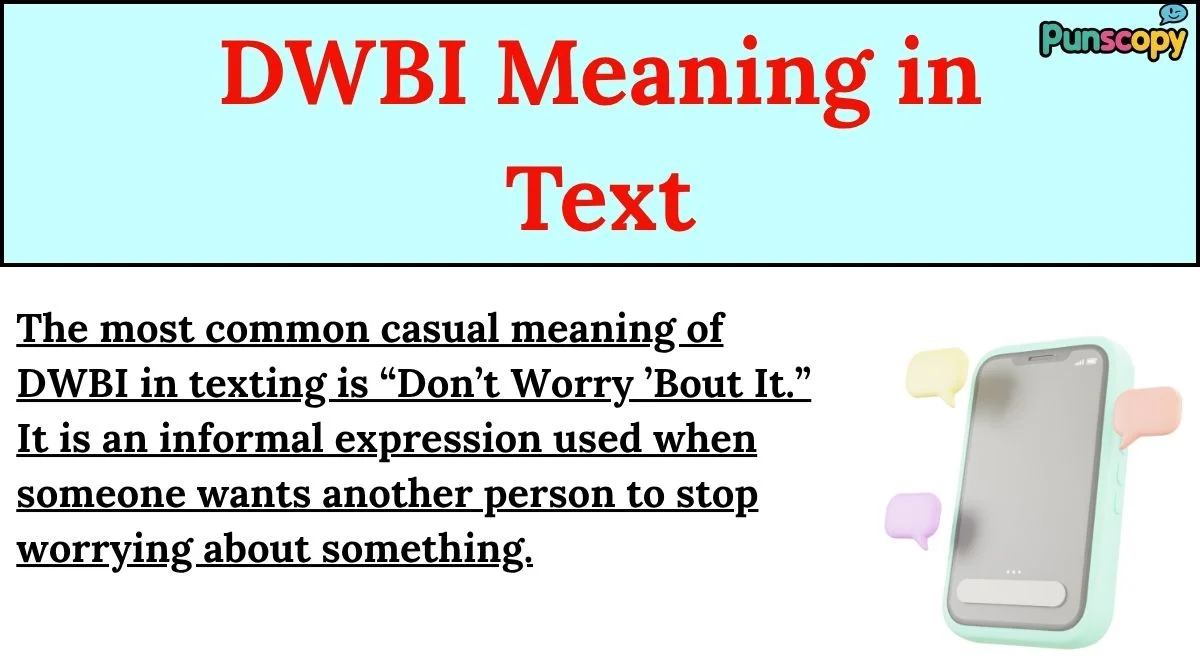
The most common casual meaning of DWBI in texting is “Don’t Worry ’Bout It.” It is an informal expression used when someone wants another person to stop worrying about something.
The phrase is essentially a shortened version of:
“Don’t worry about it.”
The word “bout” is a casual shortening of “about,” and the abbreviation takes the first letters of the main words:
- D = Don’t
- W = Worry
- B = ’Bout
- I = It
For example, imagine that you accidentally forget to reply to your friend for several hours. You might apologize by saying:
“Sorry, I got busy and forgot to answer.”
Your friend could respond:
“DWBI, it’s all good.”
In this situation, DWBI tells you that the other person is not upset and does not want you to continue worrying about the missed reply.
The expression can also be used when someone apologizes for a minor mistake. For example:
“Sorry I spilled some water on the table.”
A casual response could be:
“DWBI. I’ll clean it up.”
The tone is usually informal. Because of this, DWBI is more appropriate for friends, family members, casual online conversations, and social media interactions than for formal business communication.
However, context matters. A person may use DWBI sincerely to reassure you, while someone else may use it to quickly end a conversation. If the surrounding messages sound warm and friendly, it will usually feel reassuring. If the conversation is tense or the person gives very short replies, it could sound dismissive.
Therefore, the basic DWBI meaning in text is simple: don’t worry about it; it is not a big deal.
Background of DWBI
The growth of internet slang has made communication much shorter and faster. People often use abbreviations because typing a complete sentence can feel unnecessary in casual conversations. DWBI fits naturally into this culture of shortened language.
Text messaging, online forums, instant messaging, and social media have all encouraged people to develop quick ways of expressing common phrases. Instead of writing “Don’t worry about it,” a person can type DWBI and communicate the same general idea with only four letters.
The phrase behind DWBI is older than the abbreviation itself. “Don’t worry about it” has long been used in everyday English as a way of reassuring someone, accepting an apology, or indicating that a problem is insignificant. The abbreviated version simply adapts that familiar phrase to digital communication.
The use of informal spellings also plays a role. In spoken English, people frequently pronounce “about” in a relaxed way that sounds closer to “’bout.” Internet slang sometimes represents this casual pronunciation in written form.
DWBI should therefore be understood as part of the broader development of digital language rather than as a formal English term. Like many texting abbreviations, its meaning depends heavily on context.
A person might write:
“You don’t have to pay me back. DWBI.”
Here, the abbreviation communicates reassurance and generosity.
Another person might write:
“DWBI, just forget what happened.”
In that situation, the writer is probably asking the recipient not to continue thinking about an incident.
The abbreviation may appear in uppercase or lowercase. DWBI, dwbi, and occasionally Dwbi can all represent the same expression. Capitalization usually does not change its meaning.
Because online slang evolves continuously, individual communities may occasionally assign different meanings to the same letters. That is why it is safer to interpret DWBI according to the complete conversation rather than assuming every use has exactly the same emotional tone.
DWBI Usage in Different Contexts
The way DWBI is understood can change slightly depending on where it appears. In most casual environments, however, it communicates reassurance or tells someone not to worry.
In Chat
Private conversations are one of the most common places to encounter DWBI. A friend may use it after you apologize, ask a question, or express concern.
For example:
“Sorry I couldn’t make it yesterday.”
“DWBI! We can hang out another day.”
Here, DWBI makes the response sound relaxed and forgiving.
On Social Media
People may also use DWBI in comments, replies, captions, or direct messages. Someone might respond to a minor issue with:
“DWBI, everything worked out.”
The abbreviation saves space while maintaining a casual tone.
In Group Conversations
In group chats, DWBI can reassure someone who thinks they have caused a problem.
For example:
“Guys, I accidentally sent the wrong file.”
Someone could reply:
“DWBI. We noticed it and fixed it.”
In Personal Conversations
DWBI can communicate emotional reassurance between friends or family members. A person may use it to tell someone that their mistake has not damaged the relationship.
In Professional Fields
This is where caution is necessary. DWBI is not generally considered a standard formal business abbreviation. A coworker might use it in an informal workplace chat, but it would usually be better to write the complete phrase in formal emails, reports, contracts, or official documents.
For example, instead of writing:
“DWBI about the delay.”
A professional message could say:
“Please don’t worry about the delay; we have adjusted the schedule.”
The second version is clearer and more appropriate for formal communication.
Overall, DWBI is primarily a casual digital expression. Its natural home is texting and informal online communication rather than technical or professional documentation.
DWBI Meaning in Chat, WhatsApp, Instagram, and TikTok
The meaning of DWBI generally stays the same across popular messaging and social platforms. What changes is the style and context in which people use it.
DWBI in Chat
In ordinary chat, DWBI usually means “Don’t Worry ’Bout It.” It can be used after an apology, a mistake, or a question.
Example:
“Sorry for bothering you.”
“DWBI.”
The response suggests that the person does not consider the interruption a problem.
DWBI on WhatsApp
WhatsApp conversations often contain informal abbreviations because people communicate quickly. Someone might send:
“I forgot to bring your charger. DWBI, I’ll bring it tomorrow.”
Here, the sender is reassuring the recipient that the forgotten item is not a serious issue.
DWBI on Instagram
Instagram users may use DWBI in DMs or comment replies. A person could respond to a minor misunderstanding with:
“DWBI 😂”
The emoji can make the message feel even more relaxed.
However, emojis and punctuation can change the perceived tone. “DWBI 😊” may sound warm, while a bare “DWBI.” might feel more abrupt depending on the conversation.
DWBI on TikTok
TikTok comments and direct messages often rely on shortened language and slang. DWBI may appear when someone wants to dismiss a small concern or reassure another user.
For example:
“I thought I missed your live!”
“DWBI, you can watch the replay.”
The abbreviation keeps the conversation quick and informal.
Does the Platform Change the Meaning?
Usually, no. WhatsApp, Instagram, TikTok, Snapchat, and ordinary text messages do not automatically give DWBI different meanings.
The context changes the tone more than the platform does.
If someone writes DWBI after you apologize, it probably means they accept your apology. If they use it during an argument, it could instead mean they do not want to discuss the matter further.
Therefore, always consider the complete message, the conversation history, and the relationship between the people involved.
DWBI Meaning in Physics, Medical, and Aircraft Terminology
Because abbreviations are widely used in technical fields, people sometimes wonder whether DWBI has a specialized meaning in physics, medicine, aviation, or aircraft terminology.
The important distinction is that the common texting expansion of DWBI does not automatically become a technical definition in these fields.
DWBI in Physics
DWBI is not generally recognized as a universal standard physics abbreviation with one fixed meaning comparable to widely established scientific symbols and terms. If the abbreviation appears in a physics paper, textbook, laboratory document, or technical discussion, its meaning should be determined from that particular source.
Technical documents often define abbreviations before using them. Therefore, it would be inaccurate to assume that every occurrence of DWBI refers to “Don’t Worry ’Bout It.”
DWBI in Medical Terminology
Medical writing contains thousands of abbreviations, and some can be highly specialized. However, the casual texting interpretation of DWBI should not automatically be treated as a recognized medical term.
If you see DWBI in a medical record, research document, prescription-related material, or clinical communication, check the surrounding information and the document’s abbreviation list. Guessing the meaning of an unfamiliar medical abbreviation can lead to misunderstandings.
DWBI in Aircraft or Aviation Terminology
Aviation also uses extensive abbreviations for aircraft systems, procedures, airports, organizations, and operational terminology. DWBI should therefore be interpreted from the specific aviation document or communication in which it appears rather than assuming that the texting definition applies.
Aviation terminology is often highly standardized, so an abbreviation used in a technical manual may have a completely different meaning from an acronym used in a social-media conversation.
Why Context Matters
The same group of letters can sometimes appear in unrelated fields. The safest approach is to identify where you encountered DWBI.
If it appeared in a message from a friend, “Don’t Worry ’Bout It” is a reasonable interpretation. If it appeared in a scientific or professional document, look for the definition provided by that document.
In short, do not confuse a popular texting abbreviation with a universal technical term.
Common Misconceptions About DWBI
Several misunderstandings can arise when people encounter DWBI for the first time.
Misconception 1: DWBI Always Means the Same Thing
Although “Don’t Worry ’Bout It” is the common informal interpretation, abbreviations can be context-dependent. A technical document may use the same letters differently.
Misconception 2: DWBI Is Always Friendly
Not necessarily. The phrase can be reassuring, but its tone depends on how it is written and what happened before it.
Compare:
“DWBI 😊”
with:
“DWBI.”
The first may feel warm and comforting. The second could sound short or dismissive.
Misconception 3: DWBI Is Suitable for Formal Writing
DWBI is primarily casual slang. Using it in a formal report, official letter, academic paper, or professional application may make the writing appear too informal.
Misconception 4: Every Abbreviation Has a Hidden Meaning
Sometimes people search for complicated interpretations when the simplest explanation is correct. In ordinary texting, DWBI generally has a straightforward reassuring meaning.
Misconception 5: DWBI Is an Insult
DWBI is not inherently insulting. It normally communicates that someone should stop worrying about a situation. However, if used during an argument or with an unfriendly tone, the recipient may perceive it as dismissive.
Misconception 6: Capitalization Changes the Meaning
DWBI, dwbi, and Dwbi generally communicate the same phrase. Capitalization is usually a stylistic choice rather than a change in definition.
The key lesson is that abbreviations should be interpreted within their conversational environment. The words surrounding DWBI often reveal more about the intended meaning than the four letters themselves.
Similar Terms and Alternatives to DWBI
There are several expressions that communicate an idea similar to DWBI. They may not have exactly the same tone, but they can serve similar purposes.
“Don’t worry about it”
This is the complete version of the phrase. It is clearer than DWBI and works in both casual and moderately formal conversations.
“No worries”
This is one of the closest alternatives. It is commonly used to reassure someone or accept an apology.
Example:
“Sorry I was late.”
“No worries!”
“It’s okay”
This phrase is simple and direct. It can reassure someone that their mistake has not caused a major problem.
“It’s all good”
This is another casual alternative. It generally communicates that there is no serious issue.
“No problem”
This can be used when someone apologizes, asks for a favor, or expresses concern.
“Forget about it”
This expression can have a similar meaning, but its tone can be stronger. Depending on context, it may sound either reassuring or dismissive.
“You’re good”
In informal conversation, this can mean that the other person has nothing to worry about.
For example:
“Sorry, did I upset you?”
“You’re good.”
The right alternative depends on the relationship and situation. DWBI feels particularly informal because it compresses a spoken-style phrase into an acronym.
How to Respond to DWBI
Your response to DWBI depends on why the other person used it. In many cases, no lengthy response is necessary.
If someone says:
“DWBI, it wasn’t a big deal.”
You could simply say:
“Thanks!”
Or:
“Okay, I appreciate it.”
If the person is reassuring you after an apology, you can acknowledge their kindness:
“Thanks for understanding.”
If the conversation is casual, you could respond with:
“Alright 😊”
or:
“Got it!”
If you are still concerned about the situation, it is also reasonable to clarify rather than assuming everything is fine.
For example:
“Thanks. I just wanted to make sure we’re okay.”
This can be especially useful when the other person’s message is very short.
If DWBI Sounds Dismissive
Sometimes a person may use DWBI because they genuinely do not want to discuss the subject. If you are unsure, look at their previous messages and overall tone.
You might respond:
“Okay, I just wanted to check.”
This gives the other person space without creating unnecessary tension.
If DWBI Is Used After an Apology
A simple:
“Thanks, I appreciate it.”
is usually enough.
If DWBI Is Used Flirtatiously
If you are talking to someone you like, the response can remain relaxed:
“Okay, if you say so 😄”
The important point is not to overthink the acronym itself. Focus on the meaning of the entire conversation.
Differences Between DWBI and Similar Words
DWBI is close to several expressions, but small differences can affect the tone.
| Expression | General Meaning | Typical Tone |
|---|---|---|
| DWBI | Don’t Worry ’Bout It | Very casual |
| Don’t worry about it | No need to worry | Neutral/casual |
| No worries | It is not a problem | Friendly |
| No problem | The situation is acceptable | Casual/neutral |
| It’s okay | Everything is fine | Reassuring |
| It’s all good | There is no serious issue | Casual |
| Forget about it | Stop thinking about the issue | Can be casual or dismissive |
| You’re good | You have nothing to worry about | Informal |
The main difference is often tone rather than basic meaning.
For example, “No worries” can sound warm and conversational, while “DWBI” has a more distinctly texting-oriented style.
“Forget about it” can sometimes sound harsher than DWBI because it may suggest that the speaker wants to close the subject completely.
Similarly, “It’s okay” is more universally understandable and can be used in situations where an acronym would feel inappropriate.
Understanding these differences can help you choose language that matches the situation.
DWBI in Online Conversations and Dating Apps
Online dating has created another environment where short expressions can carry emotional meaning. If someone sends DWBI during a dating-app conversation, the basic phrase usually remains “Don’t Worry ’Bout It.”
However, the meaning behind the message may depend on what happened immediately before it.
Suppose you write:
“Sorry, I disappeared yesterday. Work became really busy.”
The other person might reply:
“DWBI, I understand.”
This is likely reassuring and suggests that they are not upset about the delayed response.
Another example could be:
“Sorry, I asked too many questions.”
“DWBI 😂”
Here, the response may indicate that the questions were not a problem.
However, DWBI does not automatically indicate romantic interest. It should not be treated as a secret dating signal simply because it appears in a conversation with someone you like.
Dating-app conversations are especially dependent on tone, timing, and surrounding messages. An abbreviation by itself rarely provides enough information to determine someone’s feelings.
If someone sends:
“DWBI, we’re good.”
the clearest interpretation is that they are telling you not to worry about the particular issue being discussed.
If you are uncertain, you can continue the conversation naturally rather than trying to decode every abbreviation.
For example:
“Haha, okay. I just wanted to make sure.”
This keeps the conversation open without putting unnecessary pressure on the other person.
In online dating, it is better to interpret DWBI as a conversational reassurance unless the surrounding context clearly suggests another meaning.
FAQs
What does DWBI mean in text?
DWBI commonly means “Don’t Worry ’Bout It.” It is an informal texting abbreviation used to reassure someone that a situation is not a serious problem.
What does DWBI mean on WhatsApp?
On WhatsApp, DWBI generally means “Don’t Worry ’Bout It.” Someone may use it after an apology, mistake, question, or concern to say that everything is fine.
What does DWBI mean from a girl?
If a girl sends DWBI, it generally means “Don’t Worry ’Bout It.” The exact tone depends on the conversation. It can be friendly, reassuring, or occasionally dismissive.
What does DWBI mean from a guy?
If a guy sends DWBI, the usual interpretation is also “Don’t Worry ’Bout It.” It does not automatically have a romantic meaning.
Is DWBI rude?
DWBI is not inherently rude. It is normally a casual way to reassure someone. However, a very short or cold message such as “DWBI.” could feel dismissive depending on the conversation.
Is DWBI a slang word?
DWBI is best described as an informal texting abbreviation based on the phrase “Don’t Worry ’Bout It.” It belongs to the broader style of internet and chat shorthand.
Can I use DWBI in professional emails?
It is generally better to avoid DWBI in formal emails. Write “Don’t worry about it” or another clear professional phrase instead.
Does DWBI mean “don’t worry, be happy”?
No. In common texting usage, DWBI is generally understood as “Don’t Worry ’Bout It.” It should not automatically be expanded to “Don’t Worry, Be Happy.”
Conclusion
Understanding DWBI meaning in text is fairly simple once you recognize the phrase behind the abbreviation. In casual digital communication, DWBI commonly stands for “Don’t Worry ’Bout It.”
People use it to reassure someone, accept a minor mistake, or communicate that a situation is not worth worrying about.
You may encounter DWBI in text messages, WhatsApp conversations, Instagram DMs, TikTok comments, group chats, and other informal online spaces.
Its tone can vary depending on the relationship and surrounding conversation. It may sound friendly and comforting in one situation and slightly dismissive in another.
DWBI is primarily an informal expression, so it is not normally appropriate for formal documents or professional writing.
Likewise, if you encounter the abbreviation in a technical field such as medicine, physics, or aviation, you should check the specific context rather than automatically assuming the texting meaning.
When someone sends DWBI, the safest everyday interpretation is simple: they are telling you not to worry about the matter being discussed.

Joseph Roy crafts witty puns and punchlines that brighten your day. His playful twist on language keeps readers laughing and thinking.