If you have received a message containing “GTG”, you may have wondered what those three letters mean.
The GTG meaning in text is most commonly “Got to go” or “Gotta go.” People use it when they need to leave a conversation, stop chatting, or move on to another task.
This abbreviation is especially common in texting, online chats, social media, gaming, and casual conversations. It is short, quick, and easy to understand, which makes it useful when someone does not have time to type a complete sentence.
For example, a friend might write, “GTG, talk later!” This simply means they have to leave but may want to continue the conversation later.
Understanding GTG is useful because abbreviations can sometimes have different meanings depending on context.
Although its everyday texting meaning is straightforward, the same letters may have other interpretations in technical or professional settings.
Meaning & Definition
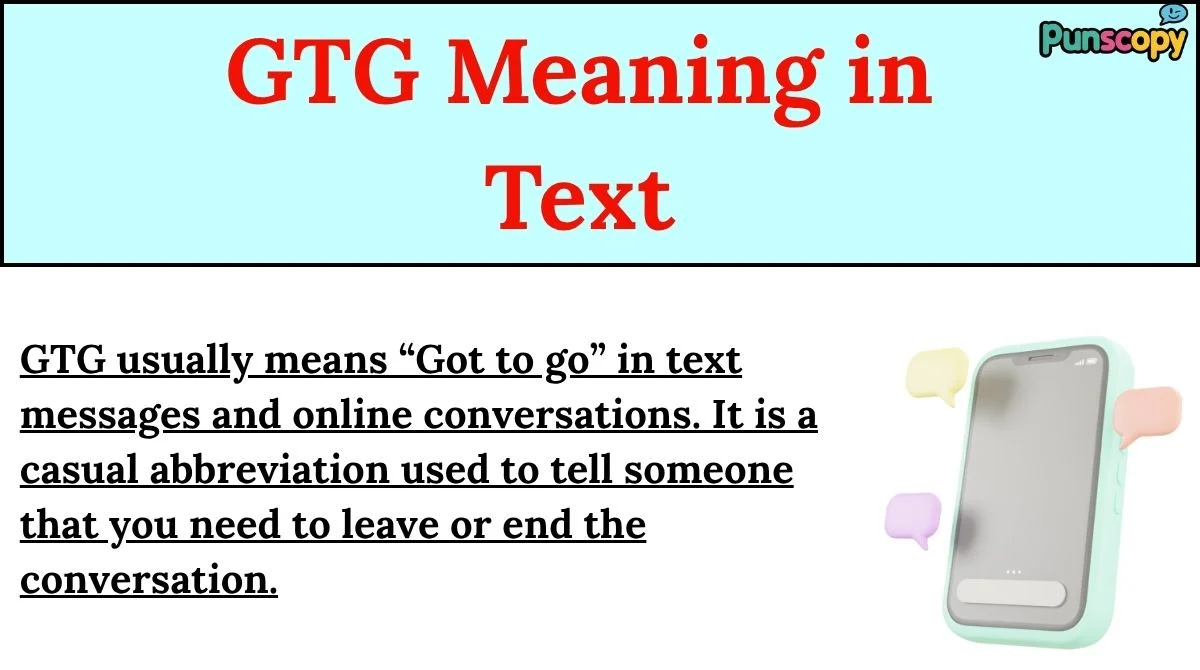
GTG usually means “Got to go” in text messages and online conversations. It is a casual abbreviation used to tell someone that you need to leave or end the conversation.
It can also be understood as “Gotta go,” which has essentially the same meaning. Both expressions communicate that the person is no longer available to continue chatting.
For example:
- “GTG, my class is starting.”
- “I’m tired. GTG.”
- “GTG now, catch you later!”
- “Sorry, GTG. I’ll message you tomorrow.”
The tone is usually neutral, friendly, and informal. It does not necessarily mean that the person wants to end the relationship or avoid the conversation. In most cases, they simply have another responsibility or need to leave.
The exact feeling can depend on the surrounding message. “GTG, bye!” may sound like a simple goodbye, while “GTG, talk later ❤️” can sound warm and affectionate.
GTG is especially useful when speed matters. Instead of typing “I have to go now,” someone can type three letters and communicate the same basic idea.
It is generally more appropriate for casual communication than formal writing. A student might use it with friends, but it would usually be better to write a complete sentence when communicating with a professor, employer, customer, or other professional contact.
Background
The popularity of GTG comes from the long history of internet shorthand and mobile texting. As online messaging became more common, people developed shorter ways to communicate everyday expressions.
Early chat rooms, instant messaging services, gaming communities, and SMS conversations encouraged users to type quickly. Abbreviations such as LOL, BRB, TTYL, OMG, and GTG became recognizable parts of informal digital communication.
GTG fits naturally into this style because “got to go” is a phrase people frequently use when ending a conversation. Turning it into an abbreviation saves time while preserving the essential meaning.
The abbreviation became especially useful when people were chatting from computers or mobile phones and wanted to respond quickly. It could signal that someone was leaving without requiring a long explanation.
For example, instead of writing:
“I need to go because I have an appointment now.”
A person could simply say:
“GTG, I have an appointment.”
The abbreviation can also appear at the end of longer messages. Someone may explain what they need to do and then finish with GTG as a clear signal that the conversation is ending.
Today, GTG remains familiar across many digital platforms. Younger users may use it alongside newer slang, while older internet users may recognize it from earlier forms of online communication.
Although communication styles have changed significantly, the usefulness of short expressions has not disappeared. GTG continues to work because its meaning is simple and easy to understand.
Usage in Different Contexts
The meaning of GTG is usually connected to leaving, but its tone can change according to the situation.
In Casual Chat
Friends often use GTG when they need to stop texting.
Example:
“GTG, dinner is ready.”
Here, the sender is simply saying they have to leave the conversation.
In Social Media
GTG may appear in comments, direct messages, captions, or replies. Someone might use it when they are about to leave a live conversation or stop responding.
Example:
“GTG everyone, thanks for chatting!”
In Gaming
Gamers frequently use short abbreviations because conversations can happen quickly during gameplay.
Example:
“GTG after this match.”
This means the player needs to leave once the current game ends.
In Professional Communication
GTG is generally considered too informal for most workplace messages. Writing “I need to leave the meeting now” or “I have to step away” is usually clearer and more professional.
However, coworkers who have an informal relationship may occasionally use it in casual internal chats.
In Family Conversations
Parents, siblings, and relatives may use GTG in everyday texting.
Example:
“GTG, I’ll call you tonight.”
The phrase usually communicates a temporary departure rather than a permanent ending.
Overall, context determines whether GTG feels rushed, casual, friendly, or simply practical. Looking at the words before and after it can help you understand the sender’s intention.
Meaning in Chat, WhatsApp, Instagram, and TikTok
On popular social platforms, GTG generally retains its common meaning: “Got to go” or “Gotta go.”
GTG in Chat
In ordinary messaging, GTG tells another person that the sender needs to leave.
“GTG, my mom is calling.”
The person may return later or continue the conversation another time.
GTG on WhatsApp
On WhatsApp, GTG can be used in individual chats and group conversations.
“GTG for now. I’ll text you later.”
It is particularly useful when someone wants to end a conversation politely without writing a long goodbye.
GTG on Instagram
On Instagram, you may see GTG in DMs or comments. Its meaning remains similar.
“GTG, I have work early tomorrow.”
In this setting, the abbreviation can also appear in conversations between friends or followers.
GTG on TikTok
TikTok users may use GTG in comments, messages, or live-chat conversations.
For example:
“GTG, this live was fun!”
The user is simply indicating that they are leaving.
The platform does not normally change the basic meaning. Instead, the surrounding conversation determines the tone. A message such as “GTG 😂” can feel playful, while “GTG, sorry!” may sound more apologetic.
Because social media language changes quickly, people sometimes wonder whether GTG has developed a completely different slang meaning. In ordinary texting, however, “got to go” remains the most common interpretation.
Meaning in Physics, Medical, and Aircraft Terminology
GTG can have meanings beyond everyday texting. This is why context matters when you encounter the abbreviation in technical material.
Physics
In physics or scientific writing, abbreviations can represent specialized concepts, variables, organizations, or experimental terminology. GTG does not have one universal physics definition that replaces its everyday texting meaning. Its interpretation depends on the specific textbook, research paper, course, or technical field.
Therefore, if GTG appears in a physics document, you should examine the surrounding definitions rather than automatically interpreting it as “got to go.”
Medical Context
Healthcare uses thousands of abbreviations, and some can vary between hospitals, specialties, and countries. GTG is not a single universally accepted medical abbreviation with one meaning across all clinical situations.
If you encounter GTG in a medical record, report, prescription-related document, or clinical message, the surrounding information is essential. Medical abbreviations should not be interpreted based solely on common texting slang.
Aircraft and Aviation
Aviation also uses specialized abbreviations and codes. A sequence of letters that looks like internet slang may represent something entirely different in an aviation document or communication system.
Because aviation communication prioritizes clarity and safety, official terminology should be interpreted according to the relevant aviation context rather than casual texting conventions.
The key point is simple: GTG means “got to go” in ordinary texting, but technical environments can use the same letters differently. When accuracy matters, always rely on the terminology defined within the specific field or document.
Common Misconceptions
One common misunderstanding is that GTG always means the sender is annoyed. That is not necessarily true.
When someone writes “GTG,” they are usually just saying they need to leave. The abbreviation does not automatically indicate anger, boredom, rejection, or dislike.
Another misconception is that GTG always means “goodbye forever.” In reality, it often describes a temporary interruption.
For example:
“GTG, I’ll be back in an hour.”
The person clearly intends to return.
Some people also assume that GTG is only used by teenagers. That is incorrect. People of different ages who participate in digital communication may recognize or use the abbreviation.
Another misunderstanding comes from assuming that every abbreviation has one fixed meaning. Context can change the interpretation of many acronyms. GTG is a good example because it can have different meanings in specialized environments.
Tone also matters. Compare:
- “GTG.”
- “GTG 😂 talk later!”
- “GTG, sorry!”
- “GTG ❤️”
The basic message is similar, but the emotional tone changes.
Finally, GTG should not automatically be interpreted as a sign that someone wants to avoid you. If someone says they have to leave, the safest interpretation is usually the literal one unless other parts of the conversation suggest otherwise.
Similar Terms & Alternatives
Several abbreviations communicate a similar idea to GTG, although their exact meanings differ.
BRB — Be Right Back
BRB means the person expects to return soon.
“BRB, grabbing some water.”
TTYL — Talk to You Later
TTYL indicates that the conversation will continue at another time.
“GTG, TTYL!”
BBL — Be Back Later
BBL suggests the person plans to return later, though the timing may be less immediate.
G2G — Got to Go
G2G is another common variation of GTG. The number 2 replaces the word “to.”
Bye
A simple “bye” directly communicates that the conversation is ending.
AFK — Away From Keyboard
AFK is particularly common in gaming and online communities. It usually means someone is temporarily away from their device or keyboard.
These alternatives are not perfectly interchangeable. GTG focuses on needing to leave, while BRB emphasizes returning shortly and TTYL emphasizes speaking again later.
How to Respond to GTG
Responding to GTG is usually easy. A short, friendly message is often enough.
You can say:
- “Okay, talk later!”
- “Sure, bye!”
- “No worries!”
- “Catch you later!”
- “Take care!”
- “See you soon!”
If the person says they have something important to do, you can acknowledge it.
For example:
Them: “GTG, I have a meeting.”
You: “Sure, good luck with the meeting!”
If you are talking to someone you care about, you might respond warmly:
“Okay ❤️ Talk to you later!”
In a professional setting, a simple response may be better:
“Sure, speak later.”
You do not need to overthink the message. GTG is normally a straightforward signal that the person needs to leave.
If the conversation has been emotional or romantic, however, consider the context. A sudden “GTG” after a difficult discussion could mean the person genuinely needs time away, but it could also signal discomfort. Rather than assuming, look at their overall communication pattern.
Differences From Similar Words
Although GTG, BRB, TTYL, and AFK can all appear when someone stops chatting, they communicate slightly different ideas.
| Term | Common Meaning | Main Idea |
|---|---|---|
| GTG | Got to go | I need to leave |
| G2G | Got to go | I need to leave |
| BRB | Be right back | I will return soon |
| BBL | Be back later | I will return later |
| TTYL | Talk to you later | We will talk again later |
| AFK | Away from keyboard | I am temporarily away |
For example, if someone says “BRB,” they are usually not ending their availability completely. They are temporarily stepping away.
If someone says “GTG,” they are emphasizing that they need to go.
If someone says “TTYL,” they are focusing on the next conversation rather than the reason for leaving.
These distinctions are small, but they can help you understand the intended message more accurately.
Relevance in Online Conversations & Dating Apps
GTG can also appear in conversations on dating apps and other social platforms. Its basic meaning does not change: the person needs to leave or stop chatting.
For example:
“I’m enjoying this conversation, but GTG. I have an early morning.”
This sounds like a normal temporary ending and does not necessarily indicate a lack of interest.
On the other hand:
“GTG.”
with no additional context may feel more abrupt. Even then, it is not enough evidence to conclude that someone has lost interest.
In dating conversations, people often pay close attention to short messages because tone can be difficult to read through text. A useful approach is to consider the whole conversation rather than interpreting one abbreviation in isolation.
A message such as “GTG 😊 talk tomorrow” gives a much clearer indication that the person wants to continue talking.
Similarly, “GTG, goodnight ❤️” can be warm and affectionate.
If someone repeatedly uses GTG whenever the conversation becomes personal or serious, that pattern may provide more information than the abbreviation itself. However, one instance of GTG should generally be taken at face value.
The safest interpretation is simple: they need to go. If they are interested in continuing the relationship or conversation, their future messages will usually make that clearer.
FAQs
What does GTG mean in texting?
GTG most commonly means “Got to go” or “Gotta go.” It tells someone that the sender needs to leave the conversation.
What does GTG mean on WhatsApp?
On WhatsApp, GTG usually means “Got to go.” A person may use it when they need to stop chatting or become unavailable.
Is GTG rude?
Not usually. GTG is generally casual and neutral. However, writing only “GTG” without any friendly wording can sometimes feel abrupt depending on the conversation.
What does GTG mean from a girl?
If a girl sends GTG, it normally means “Got to go.” The abbreviation itself does not indicate romantic interest, rejection, or anger. Context matters.
What does GTG mean from a guy?
If a guy sends GTG, it generally means “Got to go” or “Gotta go.” It usually indicates that he needs to leave or stop chatting.
Is GTG the same as G2G?
Yes. Both GTG and G2G are commonly used to mean “Got to go.” The difference is simply the way the phrase is abbreviated.
What should I reply when someone says GTG?
You can reply with “Okay, talk later!”, “Sure, take care!”, or “Catch you later!” A short response is perfectly appropriate.
Does GTG mean they don’t like me?
No. GTG by itself does not mean someone dislikes you. It normally means that they need to leave. Look at the broader conversation and their future communication before drawing conclusions.
Conclusion
Understanding the GTG meaning in text is simple once you know its most common definition. In everyday texting, GTG usually means “Got to go” or “Gotta go.”
It is a convenient abbreviation for telling someone that you need to leave, stop chatting, or become unavailable.
You may see it in text messages, WhatsApp conversations, Instagram DMs, TikTok discussions, gaming chats, and other informal digital spaces. Its tone can be friendly, neutral, rushed, or playful depending on the surrounding words and emojis.
GTG is also different from terms such as BRB, TTYL, BBL, and AFK, even though they can appear in similar situations. In specialized fields such as medicine, physics, or aviation, the same letters may have different meanings, so context is essential.

Joseph Roy crafts witty puns and punchlines that brighten your day. His playful twist on language keeps readers laughing and thinking.