The abbreviation SU can have different meanings depending on where and how it is used. In text messages, online chats, and social media, short forms like this are popular because they make communication faster and more casual.
When someone searches for the SU meaning, they may be trying to understand a message, comment, caption, or conversation where the abbreviation appears without any explanation.
In casual texting, SU can commonly be understood as “shut up,” especially when someone wants another person to stop talking.
However, the meaning can change with tone and context. In some conversations, it may be used jokingly between friends rather than as a serious insult.
The abbreviation can also have different meanings in professional, technical, medical, scientific, or organizational settings. Therefore, looking at the surrounding words is important before deciding what someone means.
Understanding the context can help prevent confusion and avoid misinterpreting a short message.
Meaning & Definition
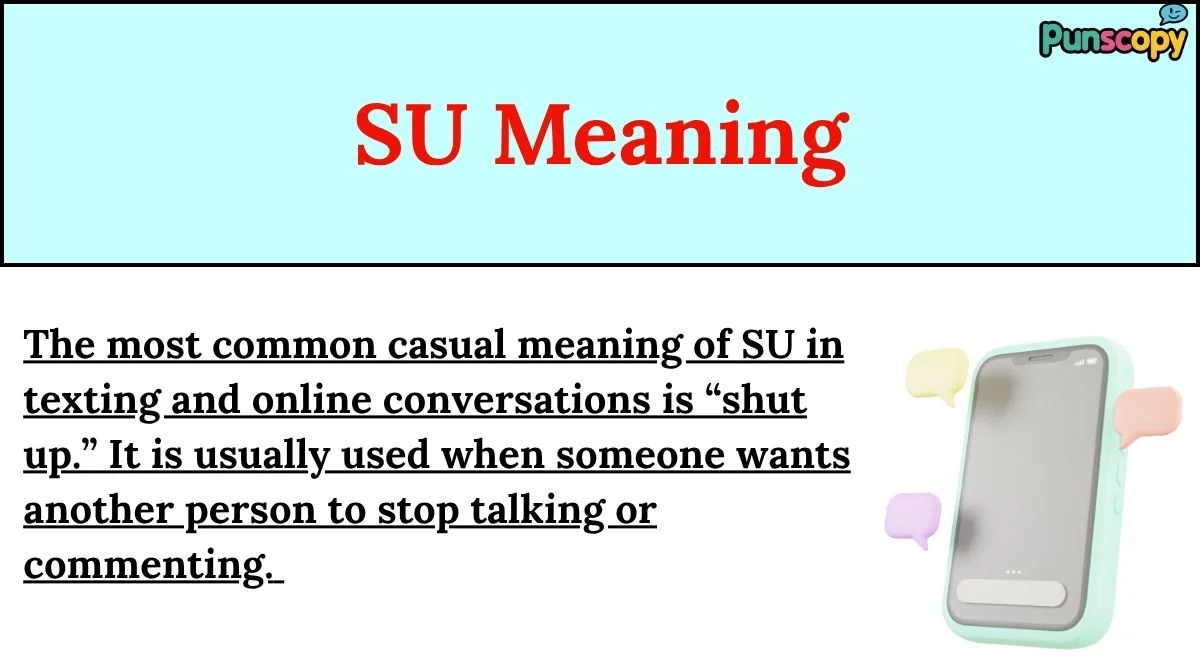
The most common casual meaning of SU in texting and online conversations is “shut up.” It is usually used when someone wants another person to stop talking or commenting. However, the expression does not always carry an angry or hostile meaning.
Among close friends, SU can sometimes be used playfully. For example, if someone shares surprising news, a friend might reply with “SU!” to show disbelief or excitement. In this situation, the person may not literally be telling the other person to remain silent.
Tone plays an important role. A short message containing only “SU” can sound harsh, while the same abbreviation accompanied by laughing emojis or friendly language may be humorous.
The meaning can also depend on the platform and conversation. Someone using it in a casual text may have a completely different intention from someone using the same letters in a technical document.
Because abbreviations are often created and adapted by online communities, there is not always one universal definition. The safest approach is to examine the complete sentence, the relationship between the people communicating, and the surrounding conversation.
Background
Shortened expressions became increasingly common as texting, instant messaging, and social media developed. People began using abbreviations to communicate quickly, particularly on platforms where messages are short and informal.
SU fits naturally into this style of communication. Rather than writing a complete phrase, users can type two letters that regular online communities may already understand.
The phrase “shut up” itself has existed for a long time, but its shortened form became easier to use as digital communication became more popular. Texting culture encouraged people to remove unnecessary words and replace familiar expressions with initials or abbreviations.
Online language also changes rapidly. A meaning that is common in one group may be unfamiliar to another. Friends, gaming communities, fandoms, and social media users can develop their own meanings for the same abbreviation.
This is why it is risky to assume that every occurrence of SU has the same definition. Context remains more important than the letters alone.
The background of an abbreviation is therefore connected to the evolution of digital communication. As people continue to communicate through messages, comments, and short-form content, new interpretations can appear and existing ones can change.
Usage in Different Contexts
The meaning of SU can change significantly depending on the communication setting.
Chat
In casual chat, SU commonly refers to “shut up.” It may be serious, playful, surprised, or sarcastic depending on the conversation.
Social Media
On social platforms, users may write SU in comments or direct messages. A person could use it to react to surprising information or jokingly tell a friend to stop.
Professional Fields
Professional environments require more caution. SU can represent different technical terms, organizational names, units, or abbreviations depending on the industry.
For example, a workplace document may use an abbreviation that has nothing to do with slang. Someone reading the term outside that professional context could easily misunderstand it.
Gaming and Online Communities
Gaming communities often develop their own shorthand. In these spaces, the meaning may depend on the game’s terminology or the particular community.
The key lesson is that SU should not automatically be interpreted as slang. Identify the setting first, then consider the surrounding words.
Meaning in Chat, WhatsApp, Instagram, and TikTok
On messaging and social platforms, SU is usually interpreted according to casual internet language.
In WhatsApp conversations, someone may use SU as a shortened form of “shut up.” Between friends, it may express disbelief or playful teasing rather than genuine anger.
On Instagram, SU might appear in comments, direct messages, or replies. Its meaning depends on the post and the conversation surrounding it.
TikTok
TikTok users frequently use short expressions and abbreviations in comments. Here, SU can be part of a humorous reaction or a casual response.
General Chat
In ordinary texting, the surrounding message is the best clue. If someone says something surprising and receives “SU 😂,” the abbreviation may be playful. If it appears during an argument, the same letters could sound much more aggressive.
Therefore, emojis, punctuation, previous messages, and the relationship between the speakers can all help determine the intended meaning.
Meaning in Physics, Medical, and Aircraft Terminology
The letters SU can have meanings beyond internet slang.
In physics, abbreviations are often highly dependent on the subject being discussed. A notation involving “SU” may refer to mathematical or physical concepts rather than everyday language.
In medical contexts, abbreviations can represent medical terms, institutions, procedures, measurements, or other specialized terminology. The exact definition depends on the document and medical field.
In aircraft and aviation terminology, abbreviations are also commonly used for aircraft models, organizations, systems, locations, or operational terms. An aviation-related use of SU should therefore be interpreted using the relevant aviation reference or surrounding documentation.
These technical meanings demonstrate why context is essential. Seeing SU in a medical report, physics discussion, or aviation document does not automatically mean “shut up.”
The same two letters can represent completely different concepts across different industries. When accuracy matters, especially in technical or professional settings, the full context should always be checked before interpreting the abbreviation.
Common Misconceptions
One common misconception is that SU always means “shut up.” While this is a common interpretation in casual texting, it is not the only possible meaning.
Another misconception is that using SU automatically means someone is angry. In friendly conversations, people may use it jokingly to react to surprising or unbelievable information.
People may also assume that an abbreviation has exactly the same meaning on every platform. Internet slang does not work that way. Different communities can develop different meanings and usage styles.
Another mistake is ignoring tone. A message containing “SU” may look rude when read without context, but emojis, punctuation, and previous messages can completely change the intended feeling.
Finally, some people assume that slang meanings apply to professional documents. This can lead to serious misunderstandings. Technical abbreviations should be interpreted according to their specific field.
Similar Terms & Alternatives
Several expressions can have a similar conversational purpose to SU, although their tone may be different.
- Be quiet — a direct request for silence.
- Stop talking — more literal and straightforward.
- Enough — suggests that someone should stop.
- Seriously? — can express disbelief rather than silence.
- No way — often shows surprise.
- OMG — commonly expresses shock or excitement.
- LOL — signals amusement and may accompany playful reactions.
The appropriate alternative depends on what the speaker wants to communicate. Someone who genuinely wants silence may use a direct phrase, while someone reacting to surprising news may use an expression such as “no way.”
Because SU can sound blunt, choosing a clearer phrase may sometimes prevent misunderstandings.
How to Respond to It
Your response should depend on the tone and context.
If someone uses SU jokingly, you can respond with humor or continue the conversation naturally. For example, a surprised friend may be reacting playfully rather than asking you to stop talking.
If the message seems serious or rude, you can remain calm and ask what they mean. A simple response such as “Are you serious?” can clarify the situation.
If someone clearly wants the conversation to stop, respecting that request may be the most appropriate response.
The relationship between the speakers also matters. A close friend may use the abbreviation casually, while the same wording from a stranger could feel disrespectful.
When the meaning is unclear, asking for clarification is usually better than assuming the worst. Context can reveal whether the abbreviation was intended as a joke, reaction, disagreement, or genuine request for silence.
Differences From Similar Words
SU can be confused with several other short expressions, but their purposes may differ.
SU vs. STFU: Both can relate to telling someone to stop talking, but STFU is generally much more explicit and can sound significantly harsher.
SU vs. Be Quiet: “Be quiet” directly communicates a request for silence, while SU is a shortened internet expression that may also be used playfully.
SU vs. Seriously?: “Seriously?” usually expresses disbelief or frustration. It does not necessarily ask someone to stop speaking.
SU vs. LOL: LOL normally communicates amusement, while SU may communicate surprise, teasing, or a request for silence.
Understanding these differences helps readers interpret online messages more accurately.
Relevance in Online Conversations & Dating Apps
Abbreviations are especially common in online conversations because users often prefer short, quick messages. Dating apps are no exception.
If SU appears in a dating conversation, the meaning should be interpreted according to the surrounding messages. Someone might use it jokingly after hearing an unexpected story, while another person might use it during an argument.
Tone is particularly important in dating conversations because text does not provide facial expressions or vocal cues. A short abbreviation can therefore be interpreted differently by different people.
If you receive SU and are unsure whether it was playful or rude, consider the conversation immediately before it. Emojis, punctuation, and the person’s previous communication style can provide useful clues.
When uncertainty remains, asking politely can prevent unnecessary confusion. Online communication works best when both people understand the intended tone rather than relying only on the literal appearance of an abbreviation.
FAQs
What does SU mean in text?
In casual texting, SU commonly means “shut up.” However, it can have other meanings depending on the context.
Is SU rude?
It can be rude when used seriously, but friends may also use it playfully to express surprise, disbelief, or amusement.
What does SU mean on WhatsApp?
On WhatsApp, SU can commonly mean “shut up” in casual conversations. The intended tone depends on the surrounding messages.
What does SU mean on Instagram?
On Instagram, SU may be used as a casual abbreviation or reaction. Its exact meaning depends on the conversation or comment.
What does SU mean on TikTok?
On TikTok, SU can be used in comments or messages as casual slang. The context determines whether it is serious or playful.
Can SU have a professional meaning?
Yes. In technical, medical, scientific, aviation, and organizational contexts, SU can represent specialized terminology unrelated to internet slang.
How should I respond when someone says SU?
Consider the tone first. If it appears playful, you can respond casually. If it seems serious or disrespectful, you can ask for clarification or calmly end the conversation.
Conclusion
The abbreviation SU is a good example of how a short online expression can have different meanings depending on context.
In casual texting, it commonly means “shut up,” but the expression can be serious, playful, sarcastic, or simply a reaction to something surprising.
Its meaning can also change across social media platforms, professional environments, technical fields, and specialized communities. This makes context especially important when interpreting the abbreviation.
If you see SU in a message, look at the words around it, the relationship between the people communicating, and any emojis or punctuation. These clues can help you understand the intended tone.
Rather than assuming one fixed definition, consider how the abbreviation is being used in that particular conversation. This simple approach can help you avoid misunderstandings and communicate more effectively online.

Joseph Roy crafts witty puns and punchlines that brighten your day. His playful twist on language keeps readers laughing and thinking.