If you have ever received a message containing the term SMS, you may have wondered exactly what it means. The abbreviation is extremely common, but its meaning can seem unclear when people use it in different conversations.
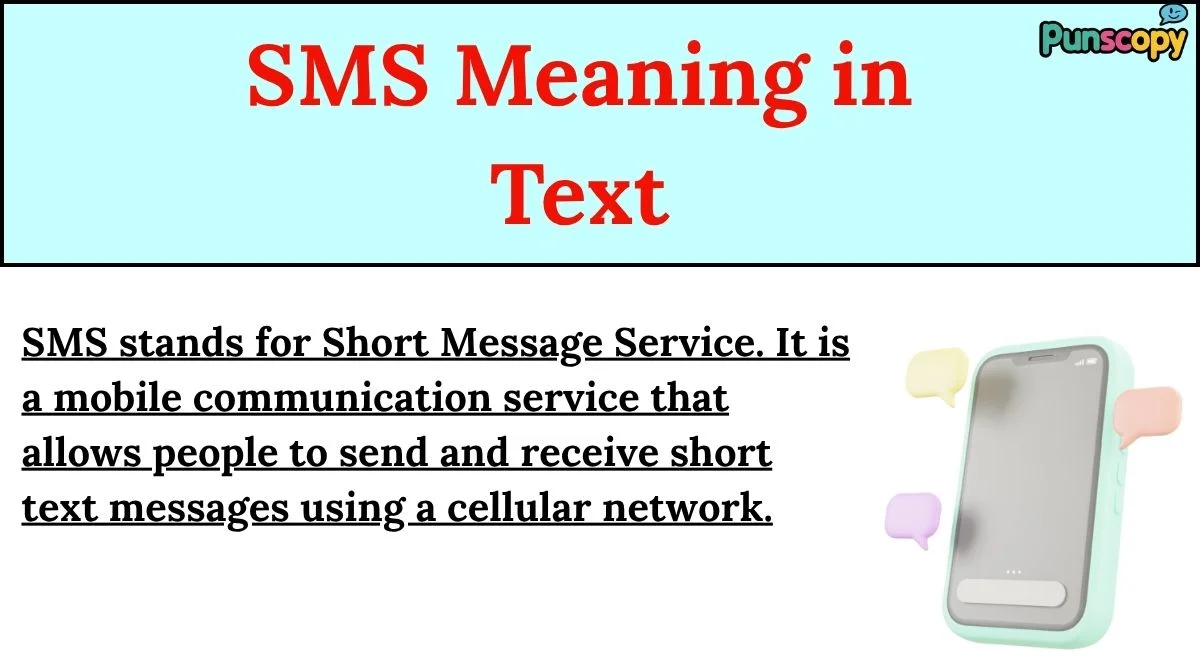
The SMS meaning in text is generally “Short Message Service,” the technology used to send short text messages between mobile phones.
SMS became one of the earliest and most popular ways to communicate through mobile devices. Even with modern messaging apps such as WhatsApp, Instagram, and TikTok, people still use the term when talking about ordinary text messages.
People search for this meaning because SMS can appear in phone settings, mobile plans, notifications, business messages, and everyday conversations.
Understanding it makes it easier to know whether someone is referring to a traditional text message, a messaging service, or simply written communication. This guide explains the term in simple language and explores how it is used in different situations.
Meaning & Definition
SMS stands for Short Message Service. It is a mobile communication service that allows people to send and receive short text messages using a cellular network.
In everyday language, people usually use “SMS” to mean a regular text message sent from one mobile phone to another. Unlike many internet-based messaging services, traditional SMS does not normally require a Wi-Fi connection or a separate messaging platform. Instead, it works through the mobile carrier’s network.
For example, if someone says, “I sent you an SMS,” they usually mean, “I sent you a text message.”
SMS is commonly used for:
- Personal text messages
- Appointment reminders
- Verification codes
- Delivery notifications
- Banking alerts
- Promotional messages
- Emergency notifications
- Business communication
The word can refer both to the technology and to the message itself. This is why you may hear phrases such as “SMS service,” “SMS alert,” or “send me an SMS.”
The term is especially useful when distinguishing traditional carrier-based texting from internet messaging. A WhatsApp message, for example, is generally an internet-based chat message rather than a traditional SMS.
In simple terms, SMS means a short text message sent through a mobile phone network. Although smartphones now offer many advanced communication options, SMS remains an important part of mobile communication.
Background
SMS developed as part of the early evolution of mobile telecommunications. The idea was to create a simple way for mobile users to exchange short written messages without making a voice call.
The first SMS systems were designed around the limitations of early mobile networks. Phones were primarily built for voice communication, so text messaging offered a lightweight way to communicate when a call was unnecessary or inconvenient.
Over time, texting became extremely popular. People discovered that sending a short message could be faster and less disruptive than calling someone. This helped SMS become a normal part of everyday communication.
The technology also became important outside personal conversations. Companies began using text messages to send notifications, confirmations, security codes, reminders, and marketing messages.
Modern smartphones have introduced many alternatives, including internet-based messaging platforms. These services can support photos, videos, voice notes, stickers, reactions, group conversations, and other features that traditional SMS was not designed to provide.
However, SMS has remained useful because it is widely supported across mobile devices and networks. It can also be useful when a person does not have access to a particular messaging application.
Today, the word SMS may therefore appear in both technical and everyday settings. Someone might discuss an SMS notification at work, receive an SMS verification code, or simply tell a friend that they sent a text.
The history of SMS shows how a relatively simple communication method became a major part of mobile culture.
Usage in Different Contexts: Chat, Social Media, and Professional Fields
The abbreviation SMS can appear in several different environments, and its meaning is usually connected to mobile text messaging.
In casual chat
In everyday conversation, SMS usually means a normal text message. Someone might say:
“Can you send me an SMS when you arrive?”
Here, the person simply wants a regular text message.
On social media
People may use the term when comparing traditional texting with social-media messaging. For example, someone could say that they prefer receiving an SMS rather than a direct message because they check their texts more often.
However, a message sent through Instagram, TikTok, or another social platform is generally not called SMS simply because it contains written text.
In professional communication
Businesses use SMS extensively. Companies can send appointment reminders, order updates, authentication codes, customer alerts, and other short notifications.
For example:
- “Your appointment reminder was sent by SMS.”
- “You will receive an SMS confirmation.”
- “Enter the code from the SMS to continue.”
In marketing
Businesses sometimes use SMS marketing to send offers, announcements, and updates directly to customers’ phones. These messages are usually short and designed to communicate information quickly.
In customer service
Some companies allow customers to communicate with support teams through text messaging. In such situations, SMS provides a convenient alternative to phone calls or email.
Therefore, the meaning remains basically the same across these contexts: SMS refers to communication through traditional mobile text messaging. What changes is the purpose of the message.
Meaning in Chat, WhatsApp, Instagram, and TikTok
The SMS meaning in text becomes particularly interesting when people compare traditional texting with modern communication platforms.
SMS in chat
In ordinary chat, SMS usually means a standard text message. If someone says, “Check your SMS,” they are probably asking you to check your phone’s regular messaging inbox.
SMS on WhatsApp
WhatsApp uses an internet connection rather than traditional SMS for its normal messages. Therefore, a WhatsApp chat message is generally not an SMS.
Someone might still mention SMS while using WhatsApp if they are discussing phone verification, mobile communication, or the difference between texting services.
SMS on Instagram
Instagram Direct Messages are internet-based messages. They are not traditional SMS messages. A person may mention SMS when asking someone to contact them through their phone instead of Instagram.
SMS on TikTok
TikTok messaging works through the platform rather than traditional cellular SMS. Users may mention SMS when moving a conversation from TikTok to ordinary phone texting.
This distinction matters because people sometimes use “text” and “message” as broad terms. Technically, however, not every written message is an SMS.
For example:
“I’ll text you.”
This often means the person will send a normal mobile text.
“I’ll message you on WhatsApp.”
This generally means an internet-based message.
“Check your SMS.”
This specifically points toward a traditional mobile text message.
So, while all of these involve written communication, the underlying technology can be different.
Meaning in Physics, Medical, and Aircraft Terminology
SMS does not always refer to Short Message Service. The abbreviation can have different meanings in specialized fields. Context is therefore important.
SMS in physics
There is no single universal physics meaning of SMS that replaces the everyday meaning. In technical documents, abbreviations can be created for specific concepts, systems, experiments, or mathematical terms.
If you encounter SMS in a physics textbook or research paper, you should examine the surrounding terminology rather than automatically assuming it means Short Message Service.
SMS in medical terminology
Medical organizations may use SMS to refer to different systems, services, or concepts depending on the document. For example, healthcare providers can use SMS as a communication method for appointment reminders, alerts, and patient notifications.
In this situation, SMS usually retains its standard meaning of Short Message Service.
SMS in aircraft and aviation
Aviation uses many specialized abbreviations, and SMS can have an important technical meaning: Safety Management System.
In aviation, a Safety Management System is a structured approach to identifying hazards, managing safety risks, and improving safety performance.
This is completely different from mobile texting.
For example:
- “I received an SMS.” → likely Short Message Service.
- “The airline operates an effective SMS.” → could mean Safety Management System.
This demonstrates why context matters when interpreting abbreviations. The same three letters can represent completely different concepts in different industries.
Common Misconceptions
One common misunderstanding is that SMS means any message sent through a phone or social-media app. Technically, that is not correct.
SMS specifically refers to the Short Message Service used by mobile networks. Messages sent through WhatsApp, Instagram, Facebook Messenger, or similar internet-based platforms are generally not SMS.
Another misconception is that SMS always means something informal. In reality, SMS is widely used for serious and professional purposes. Banks, hospitals, airlines, retailers, schools, and government organizations can all use text messaging for important notifications.
Some people also believe that SMS and MMS are exactly the same. They are related mobile messaging technologies, but they are not identical. MMS was designed to support multimedia content such as pictures and certain other media, while traditional SMS focuses primarily on text.
Another mistake is assuming that every use of “SMS” means Short Message Service. Specialized industries may use the same abbreviation for completely different concepts.
The safest approach is to look at the context.
If SMS appears in a phone notification, it probably relates to texting. If it appears in an aviation safety document, it may refer to a Safety Management System.
Understanding the surrounding conversation prevents most confusion.
Similar Terms & Alternatives
Several words and abbreviations are closely related to SMS, but they are not always interchangeable.
Text message
This is the most common everyday alternative to SMS. When someone says “send me a text,” they usually mean an SMS, although the word “text” can sometimes be used more broadly.
Texting
Texting describes the act of sending written messages through a phone.
MMS
MMS stands for Multimedia Messaging Service. It was developed to handle multimedia content in mobile messages.
Instant messaging
Instant messaging usually refers to internet-based services that allow users to exchange messages in real time.
DM
DM means Direct Message. It is commonly associated with social-media platforms such as Instagram, TikTok, and X.
Chat
“Chat” is a broad term for online or mobile conversation. A chat may happen through SMS, an app, or another communication service.
iMessage
iMessage is Apple’s messaging service and is different from traditional SMS, although compatible devices can also fall back to SMS in certain circumstances.
The important point is that these terms describe related forms of communication, but their technology and features may differ.
How to Respond to It
If someone says, “I’ll send you an SMS,” the appropriate response depends on the conversation.
You can simply reply:
- “Sure.”
- “Okay, I’ll check it.”
- “Sounds good.”
- “Thanks!”
- “I’ll wait for your message.”
If someone asks, “Did you get my SMS?”, you could say:
- “Yes, I got it.”
- “Not yet. Can you send it again?”
- “Yes, I just saw it.”
- “I received it, thanks.”
If someone uses SMS in a professional setting, a clear response is usually best. For example:
“Yes, I received the SMS confirmation.”
You generally do not need to explain what SMS means unless the other person seems confused.
When the abbreviation has a specialized meaning, however, you should consider the context before replying. If an aviation professional says “SMS,” for example, they may be talking about a Safety Management System rather than a text message.
Differences From Similar Words
The main difference between SMS and similar communication terms is the technology involved.
| Term | General meaning |
|---|---|
| SMS | Traditional mobile text messaging |
| MMS | Mobile multimedia messaging |
| DM | Direct message on an online platform |
| Chat | General online or mobile conversation |
| Text | Common everyday term for a text message |
| Electronic mail sent through an email service | |
| Instant message | Internet-based real-time message |
SMS is often confused with “text,” because people commonly use these words interchangeably. In everyday conversation, this usually causes no problem.
However, the technical distinction becomes useful when discussing communication services.
For instance, a person might say, “Message me on Instagram,” meaning a DM. Another might say, “Text me,” meaning SMS. A business might say, “We will send confirmation by SMS,” specifically referring to a mobile-network text.
These differences may seem small, but they help explain why an abbreviation appears in certain conversations.
Relevance in Online Conversations & Dating Apps
SMS can still matter in online conversations and dating, even though many people begin communicating through apps.
A person may start talking to someone on a dating platform and later exchange phone numbers. Once they move outside the platform, they may communicate through regular text messages.
For example:
“Message me here first, and I’ll send you an SMS later.”
In this situation, SMS simply means a traditional phone text.
Dating apps also sometimes use phone numbers for account verification. A service may send a verification code by SMS to confirm that the number belongs to the user.
SMS can also be useful when someone wants a communication method that does not depend on a particular social platform. Unlike an app-based conversation, a traditional text message can be sent directly through a person’s mobile service.
However, people should still use good judgment when sharing phone numbers with strangers. Moving from an app to personal texting can make communication more direct, but it also means sharing contact information outside the original platform.
In online conversations, context remains the key. If someone says, “Check your SMS,” they are most likely referring to the regular messaging app on your phone—not a message inside a dating app or social-media platform.
FAQs
What does SMS mean in text?
SMS stands for Short Message Service. In everyday communication, it usually means a traditional text message sent through a mobile network.
Is SMS the same as a text message?
Usually, yes. People commonly use “SMS” and “text message” to describe the same type of mobile communication.
Is WhatsApp an SMS?
No. Normal WhatsApp messages are sent through the internet rather than traditional SMS technology.
What does SMS mean on Instagram?
SMS still generally means Short Message Service. Instagram’s own direct messages are not traditional SMS messages.
What does SMS mean on TikTok?
If someone mentions SMS on TikTok, they are generally referring to regular mobile texting rather than TikTok’s internal messaging system.
What does SMS mean in aviation?
In aviation, SMS can mean Safety Management System, which is a structured approach to managing and improving safety.
What is the difference between SMS and MMS?
SMS is primarily designed for text messages, while MMS was developed to support multimedia content such as images and other media.
Why do companies send SMS messages?
Companies use SMS for alerts, verification codes, reminders, confirmations, customer updates, and other short notifications.
Conclusion
Understanding the SMS meaning in text is simple once you know the context. In everyday mobile communication, SMS stands for Short Message Service and usually refers to a traditional text message sent through a cellular network.
It remains useful for personal conversations, business alerts, verification codes, reminders, and customer notifications.
SMS is different from messages sent through platforms such as WhatsApp, Instagram, and TikTok, even though people may casually call all of them “texts” or “messages.”
The abbreviation can also have specialized meanings. In aviation, for example, SMS can refer to a Safety Management System.
When you see these three letters, look at the surrounding conversation first. That small step will usually reveal exactly what the sender means.

Joseph Roy crafts witty puns and punchlines that brighten your day. His playful twist on language keeps readers laughing and thinking.